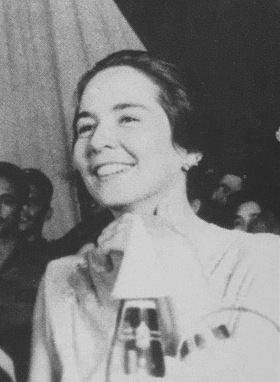
Santiago, Privilege, and the Choice to Fight
The decision of Vilma Espín to join the July 26 Movement was not the decision that the trajectory of her social class and educational background would have predicted. She was the daughter of a man who worked for the Bacardí company — one of the most powerful foreign-linked commercial enterprises in pre-revolutionary Cuba — and she had studied at MIT in Cambridge, Massachusetts, acquiring the technical credential that would have made her a professional asset in the corporate and governmental structures of the Batista-era republic. She returned to Cuba and joined a revolutionary underground instead. The specific path from MIT to weapons-running in Santiago is not fully documented in the available biographical material, but the political formation that produced it was the specific combination of technical intelligence, moral clarity, and access to the information about what the Cuban system actually required from people outside its privileged circle that a woman of her background, moving through both the privileged world and the world of the university student movement, would have had in the early 1950s.
She was radicalized at the University of Oriente in Santiago — the city's secondary university, less politically prominent than the University of Havana but similarly shaped by the anti-Batista politics that defined Cuban student life after the 1952 coup. She made contact with the networks that Frank País was building, and her specific combination of gifts — the organisational intelligence, the capacity for operational calm under pressure, the social connections that allowed her to move through Santiago's middle-class world without arousing the suspicion that would have attached to a person of more obviously working-class or politically radical background — made her exactly the kind of person that urban underground operations required.
Running weapons through police checkpoints in Batista's Santiago was work that required the specific capacity to present a surface of normality while managing acute risk — the ability to be, to the police officer examining her papers, a well-dressed professional woman going about her business, while actually carrying the weapons that would be used against that police officer's employers. She did this work, by the accounts of the people who knew her in the underground, with a steadiness that suggested the risk was something she had assessed and accepted rather than something she was overriding through the force of ideological conviction alone. She was not reckless. She was deliberate.
Frank País, the 30 November Uprising, and the Urban War
Her collaboration with Frank País in the Santiago underground placed her at the operational centre of the most important urban revolutionary organisation in Cuba outside Havana. País trusted her with the coordination responsibilities that required both organisational ability and absolute personal reliability — the two qualities that underground work demands above all others — and she proved to possess both in the measure required. She was part of the group that planned and executed the 30 November 1956 Santiago uprising, the coordinated attacks on police stations and government buildings that were designed to divert security forces from the Granma landing and that constituted the most significant armed action in Santiago since the independence wars.
The months following the 30 November uprising — the months when the landing had gone wrong, the Granma column had been nearly destroyed, and the security forces across Oriente were hunting both the Sierra survivors and the urban networks that had supported the operation — were the most dangerous of the urban campaign. Espín continued her work through these months, maintaining the networks, managing the communications, staying ahead of the police surveillance that was increasingly focussed on the Santiago underground following the November action. She was hunted. She was not caught.
When Frank País was murdered in July 1957 — shot in the back of the head in a Santiago back street by Batista's police — Espín lost the person who had been her most important revolutionary collaborator and, by accounts from people who knew both of them, a figure of genuine personal importance to her. She continued the work after his death, eventually making the transition from urban underground to the Sierra Maestra, joining Raúl Castro's Second Front in the mountains as a combatant. The decision to join the mountains — to leave the urban underground for the guerrilla camp — was not forced on her by the collapse of the Santiago network. It was a choice, made by a woman who had the option of other paths and chose the hardest one.
The Sierra Maestra and the Meeting With Raúl
Vilma Espín's time on Raúl Castro's Second Front in the northern Sierra Maestra and the Guantánamo area was the period in which she met the man she would marry a week after the revolution's victory. The relationship that developed between them in the mountains — in the specific conditions of a guerrilla camp where daily proximity, shared danger, and the particular intensity of lives lived at constant risk produce the kind of rapid emotional understanding that ordinary social contexts take years to achieve — was, by all accounts from people who observed it, a genuine mutual commitment rather than a political alliance disguised as a personal one.
She served on the Second Front as an organiser and combatant, contributing the same operational capacities she had demonstrated in Santiago — the ability to manage complex logistics under pressure, the organisational intelligence that could hold together the supply and communication networks that kept a guerrilla force in the field — alongside the armed participation that made her one of the small group of women who fought as combatants in the Sierra rather than as urban supporters. She was not the most prominent woman of the Sierra Maestra campaign — Celia Sánchez's role was more central and more celebrated — but she was one of the women whose presence in the mountains was a matter of operational fact rather than symbolic gesture.
Founding the Federation of Cuban Women
The Federación de Mujeres Cubanas was founded in August 1960, eighteen months after the revolution entered Havana, as the official mass organisation representing Cuban women in the political and social structures of the revolutionary state. Vilma Espín was its founder and its president from the first day until her death forty-seven years later — a tenure of leadership that made her, in the specific domain of Cuban women's organisations, one of the longest-serving institutional leaders in the history of any country's women's movement.
The FMC's relationship to the revolutionary government was formally subordinate — it was a mass organisation of the Cuban Communist Party, operating within the political framework established by the party, advocating for women's interests within a political system that had already defined what those interests were — but the practical scope of what Espín and the FMC accomplished within that framework was substantial. The maternity leave legislation that the FMC advocated for and achieved in the early 1960s was one of the most progressive in the hemisphere. The childcare infrastructure — the círculos infantiles, the state-run day care centres that the FMC organised and that enabled Cuban women to participate in the workforce at rates that were among the highest in Latin America — was a practical achievement of considerable importance. The integration of women into the Cuban workforce across the 1960s and 1970s — from approximately 12% of the workforce in 1958 to approximately 38% by 1985 — was one of the most significant transformations in the social structure of Cuban life, and the FMC was the organisation that coordinated the training programmes, the childcare support, and the advocacy work that made it possible.
The 1975 Family Code — the reform of Cuban family law that established equal legal rights and responsibilities for men and women in marriage, in parenting, and in the distribution of domestic work — was the FMC's most significant legislative achievement. The code was formally progressive by any international standard: it established in law the principle that domestic work was shared responsibility, that neither partner in a marriage could be compelled to stay home while the other worked, and that children were the equal responsibility of both parents. Whether the legal change translated into actual equality in the distribution of domestic labour in Cuban households is a question that sociological research consistently answered in the negative — Cuban women continued to bear a disproportionate share of domestic work even as they participated in the formal economy at rates approaching parity — but the legislative framework the FMC achieved was real and provided the basis for continued advocacy.
The Complications of Her Position
Vilma Espín's position in the Cuban revolutionary hierarchy was complicated by the specific intersection of her genuine revolutionary credentials, her institutional leadership of the FMC, and her status as Raúl Castro's wife. The question of how much her access to power and her ability to achieve things within the revolutionary system depended on the first two factors and how much on the third is one that the historical record does not fully resolve, and it is a question she herself was apparently unwilling to discuss directly in the interviews she gave over her long career.
What is recoverable from the record is that the achievements she made — the legislative changes, the institutional infrastructure, the transformation of Cuban women's participation in public life — were real and were not the inevitable outcomes of a government commitment to women's equality that would have produced them without her specific leadership. Other revolutionary governments with formal commitments to women's equality did not produce comparable institutional outcomes. The FMC under Espín's leadership produced specific changes in specific domains of Cuban women's lives, and those changes were the product of sustained institutional advocacy that required both the political access that her position as Raúl's wife provided and the organisational ability and personal commitment that she had demonstrated since the Santiago underground.
The limitations of her position were equally real. The FMC operated within a political framework that defined women's liberation in terms that were largely compatible with the revolutionary government's other priorities — women's integration into the workforce as a contribution to economic development, women's participation in the defence of the revolution, women's role in the family as the primary educators of the revolutionary generation — and was less able to advocate for aspects of women's liberation that complicated the government's social priorities. The treatment of lesbian and gay Cubans under the revolution's systematic homophobia — which affected women as well as men, which contradicted the FMC's formal commitment to gender equality, and which the FMC was largely unable or unwilling to challenge in the most repressive years — is the clearest example of the limits of what was achievable within the framework the revolutionary government had established.
Forty-Seven Years and the Question of What She Built
Vilma Espín died on 18 June 2007, fourteen months before Raúl Castro became president of Cuba. She had been ill with leukaemia for several years and had continued working through her illness, maintaining the leadership of the FMC until it was no longer physically possible. She was seventy-seven years old. The organisation she had founded and led for forty-seven years survived her — it continues to exist, though its political role in contemporary Cuba is considerably reduced from the height of the revolutionary period — and the specific changes she had achieved in Cuban women's legal and social position were not reversed by her death.
The question of what she built — what the FMC's half-century of work actually changed about Cuban women's lives, and how much of that change would have happened anyway under any revolutionary government committed to modernisation, and how much was specifically the product of her leadership — is not fully answerable. What is answerable is that the Cuba of 2007 was different from the Cuba of 1960 in the specific domain of women's participation in public and economic life, and that the FMC and Vilma Espín's leadership of it were central to that difference. That is not a small thing. It is, in the specific terms of material improvement in the conditions of millions of Cuban women's lives, one of the more substantial achievements of anyone in this gallery of Cuban revolutionaries — achieved not through a single dramatic act of military heroism or political defiance but through forty-seven years of institutional work in a political system that was rarely easy to navigate and that required, daily, the combination of conviction and patience and political intelligence that she had first demonstrated running weapons through Santiago's police checkpoints in 1956.