Havana, the United States, and the Road to Mexico
Camilo Cienfuegos grew up in the Lawton neighbourhood of Havana — a working-class district that was as far as it was possible to be, economically and socially, from the Vedado mansions and the Havana Country Club where the Cuban elite and the American businessmen who owned large parts of the country's economy spent their leisure time. His father, Ramón Cienfuegos, was a Spanish immigrant tailor who had come to Cuba early in the century and built a modest life making and repairing clothes. Camilo worked in his father's shop, learned the trade, and developed alongside it a political consciousness shaped by the daily evidence of who the Cuban republic of the 1940s and 1950s worked for and who it worked against.
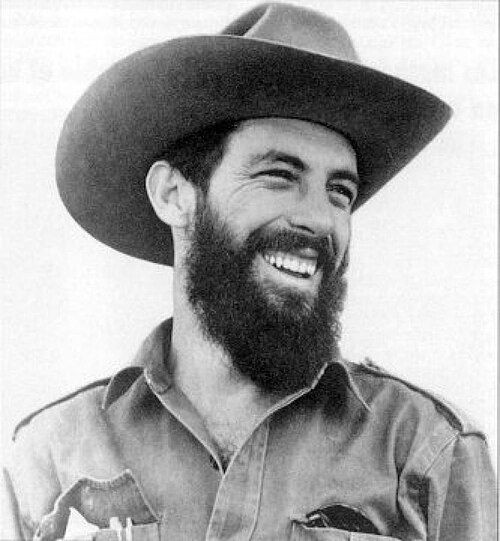
He was not a systematic political thinker in the way that Guevara was, and he did not have the legal training and political formation that gave Castro his particular analytical framework. What he had instead was an intuitive sense of injustice and a personal magnetism that made him effective at building loyalty and enthusiasm among people who might have been sceptical of more cerebral political arguments. He was funny, warm, physically courageous to the point of recklessness, and possessed of an informality — the wide hat, the permanent grin, the habit of wrapping his arm around whoever he was talking to — that was genuine rather than performed and that communicated itself immediately to everyone he met.
He tried to go to the United States in the mid-1950s, working his way north through Mexico, reaching San Francisco, and being arrested at a political demonstration — accounts differ on the specifics — before being deported. He eventually made his way back to Mexico City, heard about the training camp where Castro was preparing the Granma expedition, and presented himself as a volunteer. He was initially told the roster was full. He returned. He was accepted. The particular persistence that got him onto the Granma was characteristic of everything that followed.
The Granma Landing and the Sierra Maestra
The Granma expedition was the most dangerous undertaking Cienfuegos had ever been part of, and it went wrong from almost the first moment. The yacht was overloaded, the crossing took longer than planned, and the landing was in the wrong location — a mangrove swamp on the southern Oriente coast rather than the prepared beach that the underground network had been told to expect. The expeditionaries waded ashore through water and mud, dispersed and disoriented, and were found by Batista's air force within two days. At the ambush at Alegría de Pío, the column was attacked while resting and scattered into small groups that had to make their way independently to the Sierra Maestra. Most of the eighty-two men on the Granma were killed or captured in the days that followed.
Cienfuegos survived, reaching the mountains with one of the small groups that eventually reconstituted around Castro and Guevara. He was, in those first weeks in the Sierra, one of the least militarily experienced members of the column — he had no prior guerrilla training and no battlefield experience — but he proved immediately and continuously that physical courage and the ability to inspire confidence in the men around him were as militarily useful as technical training. He was promoted rapidly through the rebel ranks, receiving the rank of Comandante — the revolution's highest military grade — in February 1958, alongside Guevara and Raúl Castro.
His time in the Sierra Maestra built the personal qualities that made him the most popular of the revolution's commanders with ordinary Cubans. He lived exactly as the soldiers under his command lived, shared what he had without calculation, and treated the peasants of the Sierra with the respect that Celia Sánchez's networks and Guevara's political programme had established as the standard for the entire rebel army. He was also genuinely reckless under fire — his willingness to expose himself in combat situations that a more cautious commander would have avoided was noted admiringly by his soldiers and with controlled alarm by his superiors, who needed him alive.
The Westward March: From the Sierra to Santa Clara
The decision to send rebel columns westward from Oriente — to break through the Trocha fortification line and carry the war into the central and western provinces — was the strategic turning point of the 1958 campaign, a conscious echo of Antonio Maceo's Western Invasion of 1895–96. Guevara commanded one column; Cienfuegos commanded the other. They marched in parallel, fighting their way west through terrain that offered limited cover and against Spanish forces that were numerically superior and better equipped.
The march lasted approximately three months, from August to November 1958. The conditions were extraordinarily harsh. The columns moved mainly at night to avoid air reconnaissance, were chronically short of food, ammunition, and medicine, and were required to fight multiple engagements against Spanish forces while continuing to advance westward rather than consolidating any position they captured. Cienfuegos's column fought at El Jobito, at Las Villas, and in a series of smaller engagements that reduced his force through casualties and attrition while failing to stop the westward advance. His ability to maintain the cohesion and morale of his column under these conditions was, by the account of the soldiers who made the march with him, primarily a function of his personal presence — the fact that he was visibly and continuously there, sharing the difficulty, making the march seem like something it was possible to survive and complete.
At Santa Clara, Cienfuegos's column was assigned the siege of the Yaguajay garrison — a Spanish force that held out in a fortified position while Guevara's column attacked the armoured train and the rest of the city. Cienfuegos's siege of Yaguajay lasted eleven days, from 18 to 30 December 1958, with a force of approximately three hundred men using improvised equipment against a garrison that included a tank. He maintained the siege with the kind of methodical persistence that his personal style might have made seem unlikely and that was, in context, exactly the right approach. The Yaguajay garrison surrendered on 30 December. Santa Clara fell on 31 December. That night, Batista left Cuba.
Entering Havana and the Nine Months of Revolution
The photographs of 8 January 1959 — the day Fidel Castro entered Havana — show Cienfuegos constantly: at Castro's right hand on the tank that moved through the city, surrounded by the enormous crowd that had come out to see the revolution arrive, grinning with the effortless warmth that made him the most immediately accessible of the revolution's leaders. He was twenty-six years old, the son of a tailor from Lawton, and he had just helped end a government that the United States had supported and that had made Cuban life miserable for most of the people who actually lived it. The crowd that day was as large as anything Havana had seen. The moment was, for everyone who was there, the experience that the previous two years of extraordinary difficulty had been building toward.
Cienfuegos was appointed Commander of the Revolutionary Armed Forces — the Jefe del Estado Mayor — in the new government, responsible for the organisation and command of the armed forces that the revolution was building from the remnants of Batista's army and the rebel columns that had won the war. It was an enormous administrative responsibility for a man whose gifts were operational rather than institutional, and the historical record suggests that the work was less congenial to him than the mountain campaign had been — that the meetings and the paperwork and the political navigation of the early revolutionary government suited him less well than the directness and clarity of military operations.
He remained, throughout those nine months, the most popular figure of the revolution among ordinary Cubans — more popular, polls and testimonies from the period consistently suggest, than Castro himself, whose authority was recognised but whose personal style was more distant. Cienfuegos was approachable in a way that Castro, for all his political brilliance, was not. He was the revolutionary you could imagine having a conversation with rather than the revolutionary who was giving you a speech. This quality — real rather than performed, rooted in the working-class Havana background that he had never left behind despite his military advancement — was precisely what made the circumstances of his death, and the lack of a clear explanation, so devastating to the Cuban public.
The Huber Matos Crisis and the Flight to Havana
The last days of Camilo Cienfuegos's life were spent managing one of the first serious political crises of the revolutionary government. Huber Matos, the comandante who had commanded the rebel forces in Camagüey province during the war, had resigned his military command in October 1959 in protest at what he characterised as the growing communist influence in the revolutionary government. His resignation letter was sent to Fidel Castro and simultaneously leaked to the press — a public challenge to Castro's authority that could not be ignored. Castro sent Cienfuegos to Camagüey to arrest Matos and handle the situation.
The Matos affair was politically delicate in ways that went beyond the immediate crisis. Matos had been a widely respected revolutionary commander, and his concerns about communist influence were shared by a significant section of the Cuban population and by the United States, which was already deeply alarmed by the direction of the revolution. Castro's decision to arrest rather than merely accept Matos's resignation — Matos was subsequently tried and sentenced to twenty years imprisonment — was a signal that the revolution would not tolerate public dissent from senior figures, regardless of their military records. Cienfuegos carried out the arrest. He flew to Camagüey, handled the situation, and departed for Havana on the evening of 28 October 1959 in a Cessna 310.
The aircraft never arrived. The flight from Camagüey to Havana was approximately three hundred miles, a straightforward route over familiar terrain that should have taken less than two hours. The Cessna disappeared somewhere over or near the Straits of Florida. Search operations were conducted for several days without finding wreckage or survivors. No definitive explanation for the disappearance has ever been established. The Cuban government attributed it to adverse weather conditions — there was a front moving through the area — and this remains the most probable explanation. But the timing of the disappearance, on the same day as the politically sensitive Matos arrest, immediately generated speculation about other possibilities that the absence of physical evidence has made impossible to either confirm or refute. Conspiracy theories of various kinds have circulated continuously since 1959, none of them with sufficient evidence to be compelling, none of them entirely dismissable given the political context.
The Disappearance and the Memory
The loss of Cienfuegos at twenty-seven, nine months into the revolution, hit the Cuban public with an impact that none of the other deaths of the revolutionary period — not the Granma losses, not Frank País, not the war's other casualties — had produced in quite the same way. Those deaths had occurred in the context of a war that everyone understood required sacrifice. Cienfuegos's disappearance happened in peacetime, in the country he had fought to liberate, in the ordinary course of a domestic flight, and it happened to the person who was, by popular consensus, the most loved man in Cuba. The sense of loss was immediate and total.
Castro announced his disappearance in a speech that was notably emotional even by the standards of Castro's oratory — a public display of genuine grief that reinforced the understanding that Cienfuegos had been a personal friend as well as a political comrade. Guevara, who had marched to Santa Clara alongside him and who was among the people closest to him in the revolution's inner circle, wrote about his loss with the particular restraint of someone describing something too painful for the usual rhetorical registers. The grief was real on both sides of the revolution's deepening political divide — among those who supported the direction the revolution was taking and among those who were already developing reservations.
Every year since 1959, on 28 October, Cubans throw flowers into the sea for Camilo. The ritual — unofficial, spontaneous in origin, maintained across six decades of political change — is one of the more revealing expressions of popular Cuban sentiment about the revolution and its losses: a private grief practised publicly, a acknowledgement that something was taken in 1959 that was never replaced. He was twenty-seven years old. He had survived the Granma landing, the Sierra Maestra, the westward march, the battle of Yaguajay, and the entry into Havana. He disappeared on a clear-weather domestic flight nine months after the victory he had helped make possible, and his body was never found, and the full truth of what happened has never been established, and Cuba still throws flowers into the sea for him.