At a Glance
Soweto, the Bantu Education System, and the Afrikaans Medium Instruction Crisis
Tsietsi Mashinini grew up in Soweto in the 1960s and early 1970s — in the years when the apartheid system was not only fully consolidated but was being refined and extended through the Bantu Education Act and the broader programme of separate development that Hendrik Verwoerd had designed and his successors were implementing. Bantu Education was one of the apartheid system's most deliberately malicious instruments: it had been designed explicitly to produce African workers rather than African citizens, to limit African educational aspiration to the vocational and the subordinate, and to prevent the formation of the educated African professional and intellectual class that might have provided the liberation movement with the critical mass of leadership it needed. Verwoerd had been explicit about this: Africans should not be educated above the level that the white economy had a place for them to occupy.
The imposition of Afrikaans as a medium of instruction in certain subjects at Soweto's secondary schools in 1975–1976 was, against this background, not merely a bureaucratic decision about language but a political provocation of the first order. Afrikaans was the language of the oppressor — the language of the Nationalist government, of the police who enforced the pass laws, of the officials who administered the apartheid system's daily humiliations. To require Black students to receive instruction in that language was to add insult to a system already saturated with injury, and the students of Soweto — shaped by the Black Consciousness movement's insistence on dignity and self-assertion, connected through the South African Students' Movement's networks, and angry with the accumulated anger of a generation that had been told since birth that its aspirations were out of order — were not prepared to accept it.
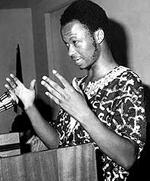
Mashinini's role in organising the student response was the work of months of preparation through the SSRC and SASM networks. He was a student leader of unusual charisma and organisational effectiveness, capable of building consensus among the diverse student bodies of Soweto's secondary schools while maintaining the momentum toward collective action that the moment demanded. The march of 16 June 1976 was not a spontaneous eruption but a carefully planned act of collective protest — which makes it, if anything, more rather than less impressive as an achievement of student political organisation.
16 June 1976: The Day That Changed South Africa
The morning of 16 June 1976 began with thousands of Soweto students gathering at their schools and marching toward Orlando West, where the Orlando West Junior Secondary School had been one of the first institutions required to implement the Afrikaans instruction policy. They carried placards and sang freedom songs; they were students, mostly between thirteen and eighteen years old, marching in the way that Steve Biko's Black Consciousness had taught them — with dignity, with pride, with the insistence that they were human beings whose education mattered and whose protests deserved to be heard. The police met them with teargas, and then, when the students responded with rocks, with live ammunition.
Hector Pieterson was among the first to fall — shot at thirteen years old, his body captured in the photograph by Sam Nzima that became one of the most reproduced and most devastating images of the apartheid era: a young man carrying the dying child, a screaming girl running alongside, the face of the murdered student a face that could not be unseen. The photograph circled the globe within days and forced on the world's attention a reality that the apartheid government had been successfully obscuring for decades: that its system was maintained by the routine murder of children, that its "separate development" was a euphemism for a programme of dispossession enforced by lethal violence.
Mashinini was at the centre of the march's organisation and was present when the shooting began. He was seen at the front of the march, attempting to maintain order and direction in the chaos that the police assault created. In the days that followed, as the uprising spread across Soweto and then across the country — as more students and community members were killed, as the police responded to resistance with escalating force, as the cycle of protest, repression, and further radicalisation produced the most sustained internal resistance the apartheid state had faced since the 1950s — he became the face of the student movement for the international media and for the thousands of young South Africans who were looking to the SSRC for leadership and direction.
The uprising's consequences were profound and far-reaching. It shattered the apartheid state's international reputation in ways that years of ANC diplomatic work had not fully achieved; it produced a wave of young South Africans who went into exile and joined MK, flooding the liberation movement's external military structures with the most politically conscious generation it had yet encountered; it forced the apartheid government to abandon the Afrikaans instruction policy; and it demonstrated, definitively, that Black South Africans were prepared to resist at great personal cost and that the cost of maintaining apartheid — in lives, in international isolation, in the ongoing delegitimisation of the state — was higher than had previously been apparent. Steve Biko's murder the following year, in September 1977, confirmed that the apartheid state's response to Black Consciousness resistance was lethal violence, and it confirmed equally that lethal violence would not silence the resistance it was intended to crush.
Exile: The Long Diminishment
Tsietsi Mashinini left South Africa before the end of 1976 — the security forces were looking for him, he had been identified as one of the uprising's organisers, and arrest and likely torture and indefinite detention awaited him if he stayed. He crossed into exile as a nineteen-year-old who was already one of the most famous South Africans in the world, whose name and face were associated with a moment that had captured the attention of the international community, and who had every right to expect that the liberation movement would find a significant place for him in its structures and provide the political home and the direction that his moment of historical prominence seemed to promise.
What he found instead was the complicated, fractured, politically intense, and often personally devastating world of the South African exile community — a world of competing organisations, factional disputes, ideological arguments, security anxieties, and the peculiar psychological pressures of displacement that took different people in different directions. Some exiles — Oliver Tambo's generation — had built full adult lives in exile over the course of decades and had developed the organisational discipline and the political experience to navigate its demands. The young exiles of the Soweto generation arrived with extraordinary energy and political commitment but without the experience, the institutional roots, or the personal networks that gave the older generation its stability.
Mashinini's relationship with the ANC was complicated from the beginning. His Black Consciousness formation put him at some distance from the ANC's political culture, which was shaped by non-racialism and the SACP's Marxist analytical framework; his independent public profile made him a figure of status but also of potential competition within exile structures that had their own hierarchies and their own ways of assigning authority; and his personal disposition — the charisma and the spontaneity that had made him an effective student organiser — was not always well suited to the patience and the institutional discipline that exile political work required.
He moved through several countries — Nigeria, Britain, the United States — attempting to maintain a political presence and a role in the liberation movement's international solidarity networks. He married Nkele Ntlonti and had children. He received support from various sources — governments sympathetic to the liberation struggle, solidarity organisations, the ANC's external structures. But he never found the stable political home that the post-uprising years should have provided. His mental health deteriorated under the pressures of exile; his political effectiveness diminished; the distance between his moment of historical centrality and the daily reality of exile life became a gap that widened rather than narrowed as the years passed.
Death and the Questions That Remain
Tsietsi Mashinini died in Conakry, Guinea, in 1990 — the year of Nelson Mandela's release from Robben Island and the unbanning of the ANC, the year that the liberation struggle's decisive decade was beginning, the year that the South Africa he had helped to create was finally beginning to become visible. He was thirty-three years old. He did not live to see the 1994 elections, the democratic transition, the South Africa that his generation's sacrifice had made possible.
The official cause of his death was given as a blood disorder, but the circumstances of his final years — his political marginalisation, the deterioration of his mental and physical health, the isolation of his Conakry years — have led some family members and commentators to suggest that his death was not from natural causes. His wife Nkele has been among those who have expressed doubts about the official account. The Truth and Reconciliation Commission did not produce a definitive public account of his death. Like Tennyson Makiwane's assassination in 1980, Mashinini's death in 1990 remains one of the liberation struggle's unresolved questions.
His remains were repatriated to South Africa after the democratic transition, and 16 June is now celebrated as Youth Day — a national public holiday commemorating the Soweto Uprising and the generation of young people who gave the liberation struggle its most dramatic internal moment. The holiday is, implicitly, a commemoration of Mashinini's leadership on that day, even when his name is not always as prominent in the commemorations as the significance of his role would warrant.
Legacy: The Symbol, the Person, and What They Both Deserve
Tsietsi Mashinini's legacy is inseparable from 16 June 1976, and 16 June 1976 is inseparable from the history of the South African liberation struggle. The uprising he helped organise and lead was the event that, more than any other single moment in the decade between the Rivonia Trial and the unbanning of the ANC, shifted the balance of forces in the South African conflict — that demonstrated the ANC's exile politics needed to be supplemented by internal mass resistance, that filled MK's camps with the most politicised generation of cadres the organisation had received, that broke the apartheid state's international credibility in ways from which it never fully recovered, and that killed enough young people to make it impossible for anyone anywhere in the world to maintain the fiction that separate development was a benign and moderate policy of cultural preservation.
But Mashinini's legacy is also the story of what happened after — and that story deserves to be told alongside the heroism of 16 June rather than suppressed in favour of it. He was a young man who achieved something extraordinary at nineteen and who was then placed, by the logic of exile politics and the structural difficulties of his own situation, in circumstances that were too difficult for the resources — organisational, psychological, financial, relational — that he had available to him. His tragedy is not a reason to diminish his achievement; it is a reason to understand more fully what the liberation struggle cost the people who were at its centre, and what the exile experience did to the generation of young South Africans who fled the country after 1976 with their lives and their commitment but without the institutional support and the personal resources that might have given them a more sustainable existence in the world the struggle was trying to build.
South Africa commemorates 16 June every year, and it should. It should also remember more fully what happened to the young man who organised that day's march — not as a diminishment of the commemoration but as its deepening, as the insistence that the people who made liberation history were people, with full and complicated lives and needs and vulnerabilities, not just symbols to be deployed on public holidays. Tsietsi Mashinini was a person as well as a symbol. He deserves to be remembered as both.