At a Glance
Soweto, 1976, and the Making of a Generation
Murphy Morobe was born in Soweto in 1956 — the same year as the Women's March on the Union Buildings, the same year as the beginning of the Treason Trial, the year in which the anti-apartheid movement was at the height of the organisational achievement that the apartheid state would spend the following decade systematically dismantling. He grew up in the Soweto of the 1960s and early 1970s, in a township that was simultaneously one of the most politically conscious communities in South Africa and one of the most thoroughly surveilled and controlled — a place where the ANC's underground maintained whatever presence it could and where the political traditions of the liberation movement circulated through families and communities even as the organisations that carried them were officially banned.
He was nineteen years old on 16 June 1976 — the day that Soweto's schoolchildren began the uprising that would transform the political landscape of South Africa. The immediate trigger was the South African government's decision to enforce the use of Afrikaans as a medium of instruction in Black schools — a decision that the students experienced as both a practical educational burden and a symbolic humiliation, the imposition of the language of the oppressor on the education of the oppressed. The student protest, organised through the Soweto Students Representative Council, brought thousands of children into the streets and was met with police gunfire. Hector Pieterson was shot and killed; the photograph of his body being carried through the streets became the defining image of the uprising; and the protest spread across Soweto and eventually across the country.
The 1976 uprising shaped Murphy Morobe and his entire cohort of Soweto activists in ways that no subsequent political experience could replicate. It gave them the experience of collective action against the apartheid state, of state violence and its costs, of the possibility of mass resistance even in conditions of apparent total domination. It gave them — personally, viscerally, through the experience of having been in those streets — a political formation that no amount of organisational training or ideological education could substitute for. The generation of 1976 entered the liberation movement's structures knowing, from their own bodies and their own fear, what the stakes of the struggle were.
The UDF and the Internal Resistance Architecture
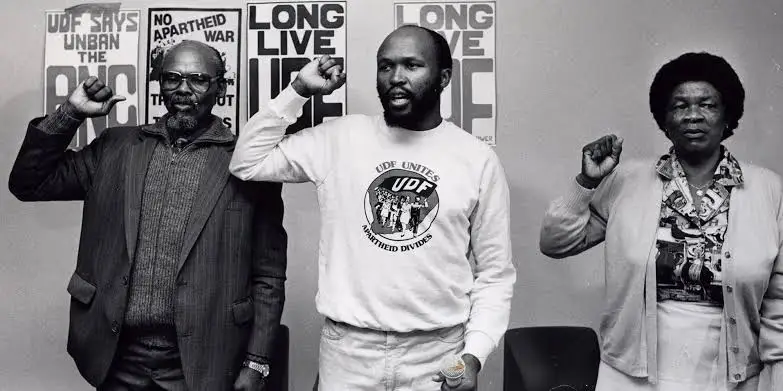
The United Democratic Front, founded in August 1983 in Mitchell's Plain, Cape Town, was the most ambitious attempt to organise internal resistance to apartheid since the Congress Alliance's campaigns of the 1950s. It brought together more than four hundred organisations — civic associations, student bodies, women's groups, youth movements, trade unions, professional associations, church groups, and the revived Indian congresses — in a coalition explicitly aligned with the Freedom Charter and committed to the defeat of the tricameral parliament and the broader apartheid system.
Murphy Morobe's election as UDF publicity secretary placed him at the centre of one of the most important communication challenges the liberation movement faced in the internal context. The UDF was a legal organisation — it had been formed within the framework of South African law and had not been banned — but it operated in conditions of intense surveillance, regular harassment, and increasing restriction as the apartheid government recognised the threat it posed. Communicating the UDF's positions, maintaining its public presence, managing its relationship with the domestic and international media, and articulating its demands in conditions where the government was progressively restricting the ability of opposition organisations to be heard: these were the tasks of the publicity secretary, and Morobe performed them with a combination of political intelligence and personal courage that made him one of the UDF's most effective public figures.
The townships of the Witwatersrand and the Eastern Cape where the UDF built its strongest structures in 1984 and 1985 were communities in upheaval — communities where the combination of rent increases, political mobilisation, and the traumatic memory of 1976 had produced a generation of young activists ready for sustained confrontation with the apartheid state. Morobe's connection to this generation — as a person of their age, from their townships, shaped by the same formative experiences — gave his public role as UDF spokesperson an authority that went beyond organisational position.
The State of Emergency: Communication Under Repression
The partial state of emergency declared in July 1985, covering thirty-six magisterial districts, and the nationwide state of emergency declared in June 1986 were the apartheid government's most comprehensive attempt since Sharpeville to suppress the internal resistance through legal and coercive means. The emergency gave the security forces the power to detain people indefinitely without charge, to prohibit the activities of organisations, to impose restrictions on individuals, and to censor the media's coverage of unrest. Tens of thousands of people were detained during the emergency period, including many of the UDF's most prominent leaders.
For Murphy Morobe as UDF publicity secretary, the emergency created an operational environment of extraordinary difficulty. The organisation he represented was under sustained assault from the security apparatus — its leaders detained, its activities restricted, its ability to communicate publicly curtailed by emergency regulations that prohibited media coverage of many of the activities the UDF was engaged in. The challenge was to maintain the UDF's public presence, to continue communicating its positions to domestic and international audiences, and to demonstrate that the movement had not been suppressed, in conditions where the government was doing everything in its legal power to ensure exactly that suppression.
He was detained multiple times during the emergency period. Each detention was both a personal cost and a demonstration of the government's failure — the movement's continued existence and continued capacity for political action was itself evidence that the emergency was not achieving its objectives. Each time he was released, the work continued.
The American Consulate: Political Theatre at the Height of Repression
In May 1988, Murphy Morobe and Valli Moosa — two of the UDF's most prominent internal leaders — led a group of UDF activists who presented themselves at the American Consulate in Johannesburg and requested asylum, citing the conditions of repression under which the internal resistance was operating. The action was simultaneously a genuine expression of the danger the activists faced and a calculated act of political theatre designed to force international attention onto the conditions of emergency-era South Africa.
The choice of the American Consulate was deliberate. The United States' relationship with the apartheid government was one of the most important dimensions of the international political context — American policy toward South Africa, shaped by the Cold War's logic of anti-communism, had for decades provided the apartheid state with a degree of diplomatic protection and economic engagement that limited the effectiveness of international pressure. The Comprehensive Anti-Apartheid Act of 1986, which had imposed economic sanctions against South Africa over President Reagan's veto, had marked a shift in American policy, but the US government remained an ambiguous force in relation to the liberation movement. Presenting themselves at the American Consulate forced the American government into a public engagement with the situation of political activists under the emergency that its existing policy preferred to avoid.
The UDF leaders remained in the Consulate for several weeks — long enough to generate sustained international media coverage, long enough to become an international political issue, long enough to demonstrate that the apartheid government's emergency restrictions had produced a situation that even its closest international allies found embarrassing. They eventually negotiated their departure from the Consulate with assurances about their safety. The incident had achieved its purpose: it had brought international attention to the conditions of the emergency in a way that no press statement could have matched.
The Mass Democratic Movement and the Defiance of 1989
By 1988 the formal UDF had been effectively suppressed through a combination of detentions, restrictions on its activities, and the banning of many of its leaders and structures. The movement responded by reorganising under the informal banner of the Mass Democratic Movement — a coalition that maintained much of the UDF's organisational substance while avoiding the formal structures that the government's restrictions were designed to disable.
The MDM's defiance campaign of August and September 1989 was one of the final and most dramatic acts of the internal resistance movement — a campaign in which activists deliberately violated emergency restrictions in organised acts of civil disobedience across multiple sites simultaneously. Hospital workers marched in defiance of restrictions on gatherings. Church services became political meetings. Sporting events were disrupted. The systematic and coordinated nature of the defiance campaign demonstrated that the movement retained organisational capacity despite years of emergency restrictions, and it created the political pressure that contributed to the climate in which FW de Klerk, newly installed as State President, announced the unbanning of the ANC, the SACP, the PAC, and other organisations on 2 February 1990.
Murphy Morobe's role in the MDM was continuous with his UDF work — the same political intelligence applied to the changed conditions of the late emergency period, the same commitment to maintaining the public presence of the internal resistance movement as a demonstration of its continued vitality. The transition that followed was in part the product of the sustained pressure that he and his colleagues had maintained through the most difficult years of the emergency.
Legacy: The Generation That Held the Line Inside
Murphy Morobe's legacy is inseparable from the legacy of the UDF and the MDM — the internal resistance movement of the 1980s that maintained the pressure on the apartheid state during the period when the ANC's external mission was the more visible face of the liberation struggle but when the internal organisation was doing the work that eventually made the transition unavoidable. He was the public voice of that internal movement — the person who appeared before cameras and microphones to articulate its positions, who managed its relationship with a domestic and international media that the apartheid government was simultaneously trying to control and to manipulate, who continued to speak when the security apparatus was doing everything it could to silence him.
He was also a representative of the 1976 generation — the Soweto schoolchildren who had been shaped by the uprising into a political cohort whose commitment to the liberation struggle was not inherited or intellectual but experiential and bodily. This generation carried the internal resistance through the 1980s with a combination of political sophistication and personal fearlessness that was specific to people who had been in those streets, who had seen their classmates shot, and who had decided that the cost of resistance was worth bearing. Murphy Morobe was one of the most visible representatives of that generation, and his career traced its arc from the schoolyards of Soweto to the corridors of the post-apartheid public life that their collective sacrifice had helped to make possible.