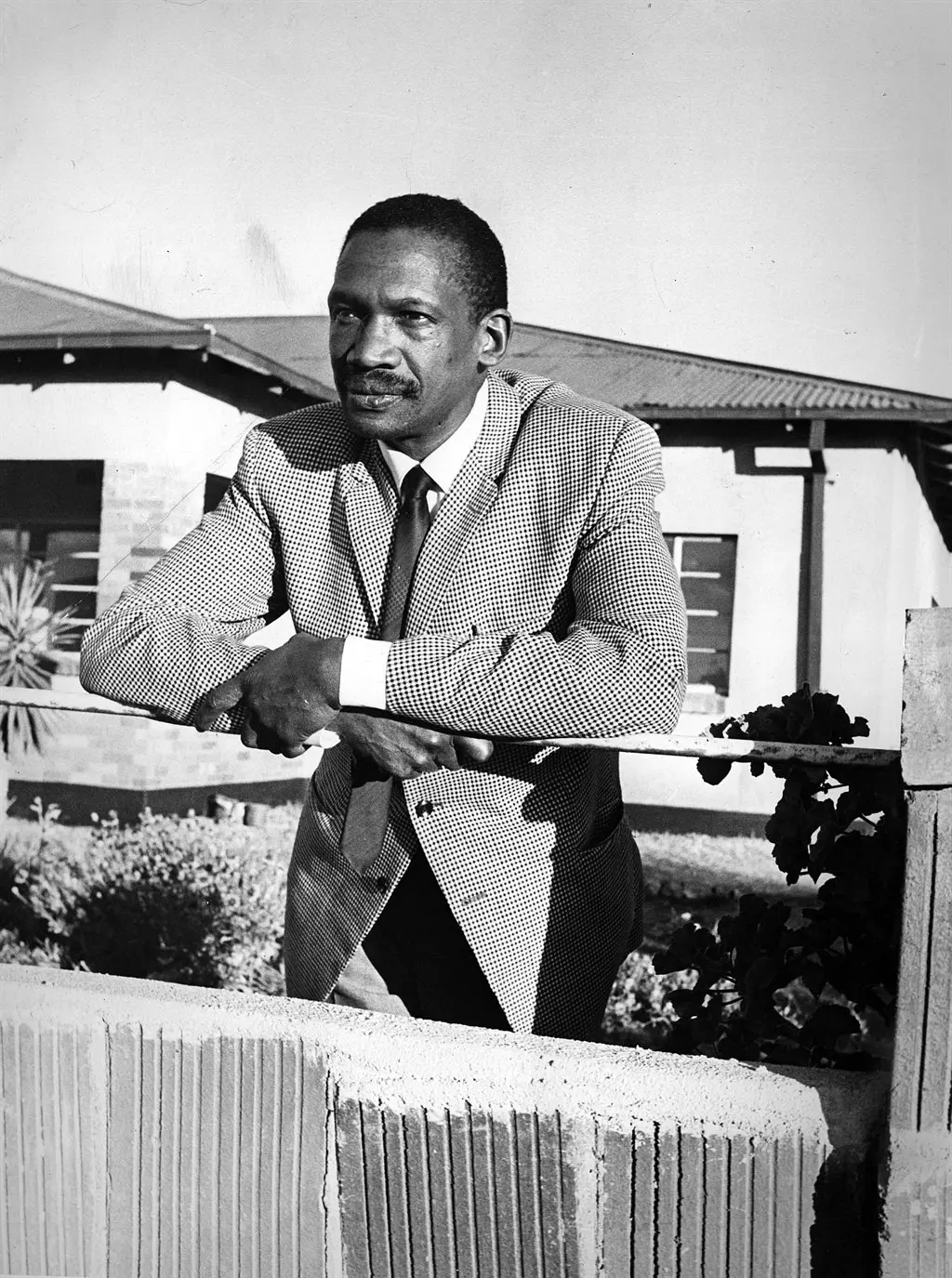
At a Glance
Graaff-Reinet, Fort Hare, and the Formation of a Political Mind
Robert Mangaliso Sobukwe was born on 5 December 1924 in Graaff-Reinet — the ancient Karoo town that sits at the foot of the Sneeuberg mountains in the Eastern Cape interior, a place with a history that stretches back to the eighteenth century and that had been the site of some of the earliest confrontations between colonial settlement and African resistance. The Eastern Cape's long tradition of African political organisation was part of the air of the place, and Sobukwe grew up in an environment where the question of African liberation was not abstract but immediately present in the conditions of life around him.
He was educated at Healdtown, the Methodist mission school in the Eastern Cape that had educated many figures of the liberation movement, and then at Fort Hare University College, where he became president of the Student Representative Council and where his political thinking developed in the rich political environment that Fort Hare provided in the late 1940s. His intellectual gifts were evident from his student years — he was not merely a political activist but a systematic thinker who brought to the questions of African liberation the same rigour and clarity that he brought to his academic work. His graduation speech at Fort Hare, in which he articulated the principles of African nationalism with a precision and an eloquence that made it one of the most admired political addresses of its time among those who heard it, demonstrated the quality of mind that the apartheid government would eventually conclude needed to be permanently confined.
After Fort Hare he worked as a school teacher, then moved to Johannesburg where he became a lecturer in Bantu languages at the University of the Witwatersrand — the English-speaking university that admitted students of all racial groups. At Wits he continued his political work alongside his academic career, engaging with the ANC Youth League and with the developing Africanist current within African nationalism that would eventually produce the PAC. The combination of academic life and political engagement gave his political thinking a particular character — more systematically developed, more carefully argued, more intellectually self-aware than the thinking of many political activists whose formation was primarily organisational rather than intellectual.
The Break with the ANC: Africanism Versus Non-Racialism
The founding of the Pan Africanist Congress in April 1959 was the most consequential organisational split in the history of the South African liberation movement. The Africanists who broke from the ANC — led by Sobukwe, with the support of figures like Potlako Leballo and others — were making a genuinely ideological argument rather than simply a factional one. Their case was that the ANC's Congress Alliance, with its formal partnership with the Indian congresses, the Congress of Democrats, and the Coloured People's Congress, compromised the African character of the liberation movement and gave disproportionate influence to communities whose relationship to African liberation was necessarily different from that of the African majority.
Sobukwe's own formulation of Africanism was more sophisticated than this summary suggests. He explicitly rejected racial hatred — the PAC's slogan was "Africa for the Africans" but Sobukwe's definition of "African" was not biological but political, encompassing all who committed themselves to Africa and to the African people regardless of their racial origin. He envisaged the eventual non-racial society with as much commitment as the ANC did; he simply argued that the path to it required the prior establishment of African majority government rather than the simultaneous construction of a non-racial coalition.
The argument was serious and the people who made it were serious. The PAC attracted some of the most intellectually impressive activists in the liberation movement — people who had thought carefully about the national question and who had concluded, against the ANC and the SACP's position, that the Africanist approach was the more honest and the more effective response to the specific conditions of South African colonialism. Whether the argument was ultimately correct — whether the PAC's approach would have produced better outcomes than the ANC's — is a counterfactual that history did not allow to be tested, because the Sharpeville massacre and the subsequent banning of both organisations ended the PAC's brief organisational life before it could demonstrate what its strategy could achieve.
21 March 1960: The Day That Changed Everything
The PAC's anti-pass campaign of March 1960 was designed as a mass act of civil disobedience — Africans presenting themselves at police stations without their pass books, inviting arrest in the tradition of Gandhian nonviolent resistance. The campaign's explicit model was the Sharpeville massacre itself — not as a planned outcome, but as an anticipated risk. Sobukwe and the PAC leadership knew that the anti-pass campaign would provoke a police response, and they had accepted this as the price of the demonstration they were making.
What they did not fully anticipate was the specific form that the response at Sharpeville would take. On the morning of 21 March 1960, a crowd of between five thousand and seven thousand people assembled at the Sharpeville police station in the southern Transvaal — many of them responding to the PAC's call, some simply drawn by the gathering. The police opened fire into the crowd without warning. Sixty-nine people were killed. One hundred and eighty were wounded. The majority of the dead had been shot in the back, indicating they were fleeing when they were shot.
The Sharpeville massacre was immediately a global event. The images of the dead and wounded, the count of the casualties, the fact that the majority had been shot in the back: these details were disseminated around the world by the international media present in South Africa for other reasons, and the international response — of shock, of outrage, of the demand that something fundamental change in the relationship between the international community and the apartheid state — was instantaneous and transformative. The United Nations Security Council condemned South Africa for the first time. International investors withdrew capital. The rand fell sharply. The apartheid state's international position, already difficult, became acute.
Domestically, Sharpeville triggered the crisis that the apartheid government had been trying to prevent: a state of emergency, mass detentions, and — crucially — the banning of both the ANC and the PAC on 8 April 1960. The banning transformed both organisations: it removed them from legal political activity, forced them underground, and set them on the path to the armed struggle that the formation of uMkhonto we Sizwe in December 1961 represented. Sharpeville was the hinge moment of the liberation struggle — the point after which everything was different from what it had been before.
The Sobukwe Clause: A Law Created for One Man
Robert Sobukwe was convicted of incitement and sentenced to three years in prison. He served this sentence on Robben Island. As his release date approached, the apartheid parliament did something without precedent in South African legal history: it passed a law specifically designed to prevent one person from being released. The General Law Amendment Act of 1963 contained a provision — immediately dubbed the Sobukwe Clause by the legal community and the press — that allowed the Minister of Justice to detain specified individuals for one year at a time, indefinitely, after their sentence had been served, without charge, without trial, and without any of the procedural constraints that even the apartheid legal system's political prosecutions required.
The Sobukwe Clause was a measure of how afraid the apartheid government was of Robert Sobukwe. The parliament created it because the government concluded that his release — a man whose only actual crime had been leading a nonviolent anti-pass campaign — was more dangerous than the political and legal costs of passing a law that made his continued imprisonment possible beyond the term of his sentence. The law was passed. It was applied. Sobukwe remained on Robben Island for six years after his sentence expired, until 1969.
The conditions of his confinement on the island were distinct from those of the other political prisoners. He was held in isolated confinement — separated from the general population, confined to a cottage, prevented from contact with the other prisoners. The isolation was as deliberate as the Sobukwe Clause itself: the government feared not only his presence in the world outside the prison but the effect of his intellectual engagement with the other prisoners. Even in confinement, even in prison, the government judged him dangerous enough to require isolation from his fellow prisoners. This judgment — that Sobukwe's mind was so powerful that even his conversations with the other prisoners needed to be prevented — was the most direct possible acknowledgment of the quality of the mind the state was trying to contain.
Kimberley: The Confined Mind and Its Choices
Sobukwe was released from Robben Island in 1969 and confined to Kimberley under banning orders that prevented him from engaging in any form of public political activity. He was forty-four years old. He had been imprisoned for nine years — three on his original sentence, six under the Sobukwe Clause. The banning orders in Kimberley were a continuation of the imprisonment by other means: he could live in a house rather than a cell, but the political activity that had been the substance of his life was prohibited.
He chose to qualify as a lawyer — studying through correspondence while under the banning orders, eventually passing the bar and practising law in Kimberley. The choice was characteristic: a man who could not speak in the political arena he had chosen chose the legal arena, another form of speaking for people who needed someone to speak for them. His legal practice in Kimberley brought him into contact with the ordinary suffering of Black South Africans navigating the apartheid legal system, the same suffering that had motivated his political career, experienced now at the level of the individual client rather than the mass campaign.
He refused throughout the Kimberley years — as he had refused throughout the Robben Island years — every approach the apartheid government made to him in exchange for some form of compromise of his political position. The government's offers varied in their details but were consistent in their logic: some form of renunciation, some form of acknowledgment of the government's authority, some form of acceptance of the conditions the government was willing to impose in exchange for greater freedom. He refused them all. The refusals were not dramatic; they were simply complete. He would not compromise. He maintained this position until his death.
Death, Unbroken
Robert Sobukwe died of lung cancer on 27 February 1978, in Kimberley. He was fifty-three years old. He had been under restriction, in one form or another, for eighteen years. He died still under banning orders. He died having refused every compromise the apartheid government had offered him. He died nine years before the Sharpeville massacre would be commemorated as Human Rights Day in South Africa, sixteen years before the democratic elections that finally dismantled the system he had fought against.
His funeral in Graaff-Reinet was the occasion of one of the largest political gatherings the apartheid era had seen in that part of the country — a demonstration that the political authority he had possessed in life had not been diminished by the years of imprisonment and restriction, that the people who had followed him and the people who had come to know of him had not forgotten what he represented. Nelson Mandela, still imprisoned on Robben Island, sent a message of tribute.
Legacy: The Road Not Taken and the Mind That Was Never Broken
Robert Sobukwe's legacy is complex, as the legacy of any figure whose political organisation failed to achieve its immediate objectives necessarily is. The PAC — which he founded and which produced the Sharpeville campaign — was never as organisationally effective as the ANC, never built the international solidarity network that Oliver Tambo built, never maintained the coherent underground that the ANC maintained, and never achieved the political dominance that brought the ANC to the presidency in 1994. The Africanist tradition that Sobukwe represented lost the strategic argument to the non-racialist tradition, and the South Africa that emerged from the transition was built on Freedom Charter principles rather than Africanist ones.
And yet Sobukwe himself was, by virtually every account from across the political spectrum, one of the most formidable figures the South African liberation movement produced — a man of extraordinary intellectual gifts, of absolute personal integrity, and of a political courage so complete that the apartheid government created a law named after him to keep him imprisoned. The Sobukwe Clause is his most perverse monument: a law designed specifically to contain one man, because that man's mind was judged sufficiently dangerous to require extraordinary legal measures even after he had served his sentence.
What would South African history have looked like if Sobukwe had not been confined? If the PAC had been allowed to develop under his leadership through the 1960s and 1970s? These are counterfactuals that cannot be answered, but they are not trivial. The Sharpeville massacre — the event that transformed South African politics — was Sobukwe's campaign. The banning that followed, the state of emergency, the formation of MK, the armed struggle, the decades of pressure that eventually forced the democratic transition: all of this flows from the events of 21 March 1960, the day Sobukwe led his campaign and the police opened fire at Sharpeville.
He was the man who, more than any other single individual, triggered the chain of events that eventually produced the democratic South Africa. He did not live to see it. He was confined and restricted and prevented from doing the political work he had committed his life to for eighteen years. He refused every compromise. He maintained his position to the end. In the history of the South African liberation struggle, there is no figure who paid a higher personal price for a more complete refusal to yield.