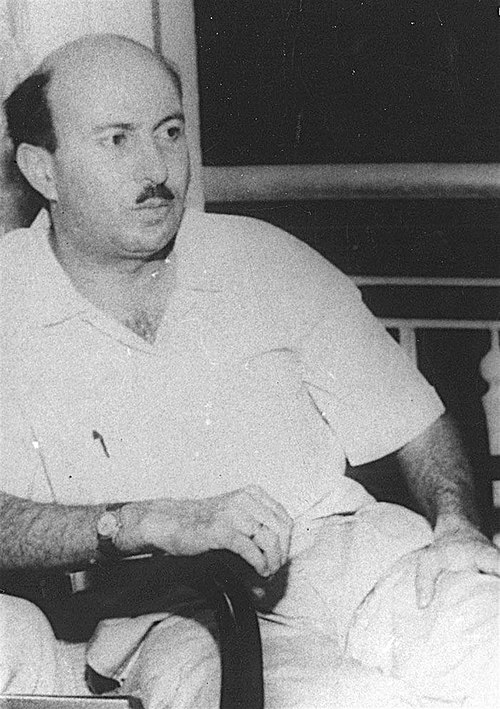
At a Glance
TWA 840 hijacking involving Leila Khaled (August 1969)
Dawson's Field operation — simultaneous hijacking of three aircraft (TWA, Swissair, BOAC) to Dawson's Field, Jordan (September 1970) — the most operationally complex multiple hijacking in aviation history
Lod Airport massacre (May 1972) — conducted by Japanese Red Army operatives under PFLP direction
After formal split from PFLP: Air France hijacking to Entebbe, Uganda (June–July 1976) — ended in Israeli commando rescue operation that killed all hijackers and killed or wounded over 100 Ugandan soldiers
Safed Origins and the AUB Partnership
Wadi Haddad was born in 1927 in Safed — the ancient walled city perched on a hilltop in the Upper Galilee, one of the four cities sacred to Judaism and simultaneously a major Arab cultural and commercial centre with a mixed Jewish and Arab population. His family were Greek Orthodox Christians, part of the Palestinian Christian minority that would provide a disproportionate share of the secular Palestinian left's leadership in the subsequent decades. In 1948, Safed's Arab population fled during the fighting — another Nakba expulsion in a long list of them — and the Haddad family became refugees.
At the American University of Beirut, where he studied medicine in the late 1940s and early 1950s, Haddad met George Habash — a fellow Palestinian Christian medical student from Lydda whose family had also been expelled in 1948. The two men formed a partnership that would last nearly thirty years and that would produce the most significant Palestinian Marxist organisation of the twentieth century. Where Habash was the ideologist — the man of political vision, theoretical analysis, and public rhetoric — Haddad was the organiser and operational planner: the man who figured out how to turn political decisions into operational reality. The combination made each more effective than either would have been alone.
Together they co-founded the Arab Nationalist Movement in 1952 and built it into one of the most significant pan-Arab political organisations of the 1950s and 1960s. After the catastrophic Arab defeat of June 1967, which destroyed the pan-Arab nationalist framework they had been building within, they co-founded the PFLP — and Haddad took on the operations portfolio that his specific abilities made him the natural choice to fill.
The Logic of Hijacking: A Weapon Conceived and Deployed
Wadi Haddad did not invent the airline hijacking — aircraft had been hijacked for various purposes before the PFLP's operations — but he transformed it from an improvised individual act into a systematic political weapon with a coherent strategic logic. His argument was precise: the Palestinian cause was being ignored by the international community, diplomatic approaches had produced nothing, and armed operations within the Middle East were insufficient to force the attention of the Western powers whose political support Israel depended on. Something was needed that would make it impossible for the Western world to continue treating the Palestinian question as a peripheral regional problem.
The airline hijacking addressed this need with specific operational elegance. Western airlines flew into the heart of Western political and commercial life; a hijacked Western aircraft was front-page news in every country that mattered diplomatically. The hostages created the kind of immediate political pressure — on Western governments to act, on Israel to negotiate — that no amount of guerrilla activity in the Palestinian refugee camps or the occupied territories could generate. And the operation required relatively small numbers of operatives, could be planned and executed with the security discipline that clandestine operations required, and could be directed from outside the immediate conflict zone in ways that limited exposure to Israeli military retaliation.
The first major PFLP hijacking — El Al Flight 426, seized between Rome and Tel Aviv in July 1968 and flown to Algeria — established the operational model. Subsequent operations refined it. The TWA 840 operation involving Leila Khaled in August 1969 demonstrated that the programme could use female operatives who attracted less security scrutiny. The series of operations built the PFLP's reputation as the most operationally capable Palestinian faction and forced governments across the world to take the Palestinian question seriously in ways they had not before.
Dawson's Field: The Masterwork
The operation of 6 September 1970 — the simultaneous hijacking of three Western airliners to Dawson's Field, a remote desert airstrip in Jordan — was the most operationally ambitious and politically significant single operation of Haddad's career. Three aircraft — a TWA Boeing 747, a Swissair DC-8, and a BOAC VC-10 — were seized simultaneously by PFLP operatives on flights originating from different European cities and flown to Dawson's Field, where the PFLP held over 400 passengers and crew as hostages while negotiating with multiple governments for the release of Palestinian prisoners held in Israel, Britain, West Germany, and Switzerland.
The simultaneous seizure of three aircraft required the coordination of multiple operational teams in different countries, precise timing, and the kind of logistical planning that represented the highest level of sophistication in contemporary non-state armed operations. The operation demonstrated that the PFLP was not merely a political organisation conducting occasional armed actions but a genuinely capable intelligence and operations structure that could execute complex multi-country operations with professional discipline.
The political outcomes were mixed. The hostages were eventually released after negotiations that produced the exchange of Palestinian prisoners from several countries. The aircraft themselves were blown up — filmed events that generated enormous international coverage. But the operation's aftermath — the Jordanian army's decision to move against the Palestinian guerrilla presence that the hijackings had highlighted — produced the Black September of 1970, in which the Jordanian army destroyed the PLO's military infrastructure in Jordan and expelled the Palestinian organisations from the country. The hijackings had forced a crisis that ended badly for the Palestinian movement overall, raising the question of whether Haddad's operational genius was matched by adequate strategic judgment about consequences.
The Break with Habash and the Entebbe Overreach
By the mid-1970s, Haddad and Habash had diverged sufficiently in their assessments of the operations strategy that the PFLP formally dissociated itself from Haddad's external operations programme in 1974. Habash concluded that the international hijacking operations were producing diminishing political returns while generating increasing international isolation — the PFLP was being condemned by governments whose support Palestinian diplomacy needed, and the operations were not producing the political advances that justified their costs. Haddad disagreed: he believed the operations were the Palestinian movement's most effective means of maintaining international pressure and that the diplomatic path that Habash was increasingly favouring could not deliver Palestinian rights without the coercive leverage that armed operations provided.
Haddad continued directing external operations independently after the split — working with the international network he had built over the previous decade, drawing on relationships with the Japanese Red Army, the German Red Army Faction, and other organisations that maintained operational connections with the PFLP's external programme. The Entebbe operation of June 1976 — in which an Air France aircraft was hijacked by a joint team of PFLP operatives and German Revolutionary Cells members and flown to Entebbe Airport in Uganda, where Idi Amin's government provided logistical support — was the most ambitious operation of this independent period.
Entebbe ended in the Israeli commando rescue operation of 4 July 1976 — one of the most celebrated special operations in military history — that killed all the hijackers, killed several Ugandan soldiers, and freed most of the hostages. The operation's failure was a strategic and personal catastrophe for Haddad: it demonstrated that the Israeli military could reach him and his operations wherever they were based, it destroyed the Ugandan connection, and it confirmed the declining effectiveness of the hijacking strategy that had once been his most powerful tool.
Death in East Berlin: The Poisoned Chocolate
Wadi Haddad died in an East German hospital in East Berlin on 28 March 1978, officially of leukaemia. The circumstances of his death were disputed from the beginning: his sudden deterioration from apparent health to fatal illness over several months in the late 1970s struck those who knew him as inconsistent with natural disease progression, and suspicion of Israeli intelligence involvement was immediate.
Decades later, those suspicions were confirmed by Israeli intelligence disclosures. According to accounts that emerged in the 2000s and 2010s, the Mossad had developed a biological toxin that could be introduced into food and would produce symptoms indistinguishable from leukaemia over a period of months. An asset with access to Haddad contaminated Belgian chocolate that he was known to consume regularly. The toxin worked as designed: Haddad deteriorated over several months, sought medical treatment in East Germany — which had provided him hospitality and operational support — and died there without his doctors understanding what had caused his illness.
The operation, if the Israeli accounts are accurate, was one of the most technically sophisticated covert assassinations of the Cold War period — a targeted killing that left no conventional evidence of foul play and that required both the technical capacity to develop the toxin and the intelligence penetration to deliver it. It was also the Mossad's acknowledgment, delivered in the most unambiguous possible language, that Haddad had been sufficiently dangerous and sufficiently effective to justify the resources and risks of a complex assassination rather than the more straightforward methods used against other Palestinian targets.
Legacy: The Operational Genius and Its Limits
Wadi Haddad's legacy is defined by the tension between his extraordinary operational capability and the strategic limitations of the programme he built. He was undoubtedly the most technically capable Palestinian operational planner of his generation — the man who developed the airline hijacking as a systematic weapon, who built the international networks that gave Palestinian armed resistance a global reach, and who executed operations of a complexity and ambition that non-state organisations rarely achieved in the twentieth century.
But the strategic question — whether the operations programme advanced the Palestinian cause in ways that justified its costs, including the international isolation, the harm to Palestinian civilians in the Black September aftermath, and the moral damage of operations that killed or terrorised civilians — remains contested. Habash himself concluded that the programme's costs outweighed its benefits. The subsequent history of Palestinian politics, in which the Oslo process achieved formal Palestinian political gains without armed operations and in which the continued use of operations similar to Haddad's has produced continued international isolation without political progress, has not provided a clear answer.
What is not contested is the quality of his commitment: Wadi Haddad gave his entire adult life to the Palestinian cause, developed capabilities in its service that required extraordinary intelligence and organisational skill, and was killed for what he had built by an adversary that acknowledged his effectiveness through the care it took to eliminate him. He died at fifty in an East German hospital, far from the Safed that was no longer his, leaving behind an operational legacy that the Palestinian movement has never fully resolved its relationship to.