At a Glance
Haifa, Expulsion, and the Refugee Childhood
Leila Khaled was born in Haifa on 9 April 1944 — four years before the city her family called home would be taken from them. Haifa in 1944 was Palestine's most industrialised city, its primary port, a place of Arab-Jewish coexistence more genuine than almost anywhere else in Mandate Palestine, and one that Palestinian Arabs regarded as one of their country's great modern urban achievements. The Khaled family were part of the Arab Muslim community of modest means that constituted a large share of Haifa's population.
In April 1948, Haifa fell to the Haganah's Operation Scissors — a rapid military operation combining military pressure, psychological warfare including loudspeakers broadcasting threatening messages, and the shock of the Deir Yassin massacre news to produce the mass flight of approximately 70,000 Arab residents. The Khaled family fled by sea from the port in chaotic conditions, joining the wave of Palestinian refugees that would become the defining demographic fact of the conflict's aftermath. They eventually settled in Tyre in southern Lebanon, where Leila grew up in the Palestinian refugee community.
The refugee camp childhood produced her political consciousness in the most direct way available: not through ideology but through biography. She grew up knowing that her family had a home in Haifa that had been taken from them, that the international community that claimed to uphold human rights had not restored it, and that the Palestinian situation required something more than patient waiting. When the PFLP's analysis — that liberation required armed struggle against the colonial project that had expelled her family — reached her as a teenager, it was not an abstraction. It was the most rational available explanation for her own life.
The PFLP and Wadi Haddad's Operations Programme
Khaled joined the Arab Nationalist Movement in the late 1950s, became a PFLP member when George Habash founded the organisation in 1967, and was recruited into the operations programme that Wadi Haddad was building as the PFLP's military infrastructure. Haddad was the operational genius of the PFLP — the man who developed the strategic logic of airline hijacking as a weapon of political pressure and who possessed the planning skills to execute it at the level of sophistication that the Dawson's Field operation would eventually demonstrate. Khaled was among the fighters he selected and trained for the hijacking programme.
The selection of a woman for a hijacking operation was itself a deliberate strategic choice. Airport security in the late 1960s was primarily oriented toward detecting weapons rather than profiling operatives, and female operatives attracted less suspicion than male ones. Khaled's selection also reflected the PFLP's explicit commitment to women's equal participation in resistance — an ideological position that distinguished the Marxist PFLP from more socially conservative Palestinian factions and that Khaled herself embodied and articulated with conviction throughout her career. For her, the question of women's participation in armed resistance was not a tactical matter but a matter of political principle: if the resistance was genuinely a national liberation movement, it required the full participation of the nation.
TWA Flight 840: History in the Skies Over Rome
On 29 August 1969, Leila Khaled and her partner Salim Issawi boarded TWA Flight 840 in Rome bound for Tel Aviv. As the aircraft approached the Lebanese coast, Khaled and Issawi entered the cockpit and ordered the pilot to divert to Damascus. The aircraft landed at Damascus International Airport; after passengers and crew were evacuated, the cockpit section was destroyed with explosives. No passengers were killed.
The operation achieved its primary objectives with precision: it demonstrated that the PFLP could strike at Israeli aviation interests despite security measures, it generated the kind of international media coverage that put the Palestinian cause on front pages globally, and Khaled's identity as the operation's female operative gave it a political resonance that multiplied its impact far beyond what a conventionally organised hijacking would have achieved. Her photograph — taken after the Damascus operation and circulated internationally — began the process by which she became one of the most recognisable faces of Palestinian resistance in the world.
Plastic Surgery and the Return to Operations
The TWA 840 hijacking made Khaled internationally identified — her face was known to security services on every continent. For most operatives in her position, this would have ended an active career. For Khaled, it meant six separate surgical procedures to alter her nose, chin, and facial features sufficiently to allow her to travel through airport security without immediate recognition. The willingness to physically transform her own body — through painful and risky surgery, purely in service of her political commitment — is one of the most striking facts in her biography, and one of the most concrete possible demonstrations of what the Palestinian cause meant to her personally.
El Al Flight 219: Capture at Heathrow
On 6 September 1970 — the day the PFLP conducted the simultaneous Dawson's Field hijackings of three Western airliners — Khaled and the Nicaraguan-American Patrick Arguello attempted to hijack El Al Flight 219 from Amsterdam to New York. El Al had implemented the most rigorous security of any airline: armed sky marshals, reinforced cockpit doors, and explicit orders to resist. When Khaled and Arguello moved, the sky marshals fought back. Arguello was shot and killed. Khaled was overpowered by passengers and crew, subdued, and held as the aircraft diverted to Heathrow, where British police took her into custody.
She was held for a month while the Dawson's Field crisis unfolded — the PFLP holding hundreds of hostages at the Jordanian desert airfield, negotiating with multiple governments simultaneously. On 30 September 1970, the British government released Khaled as part of the exchange that ended the crisis. The decision was controversial domestically but politically unavoidable: the British government calculated that keeping Khaled while hostages remained in danger was unsustainable. She was freed and returned to Lebanon.
The Photograph and What It Meant
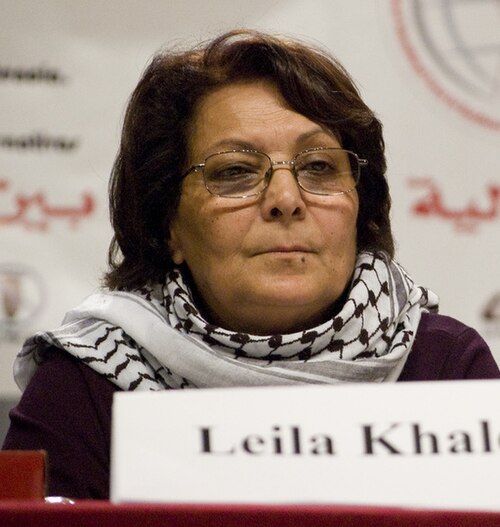
The photograph of Leila Khaled — taken by photographer Eddie Adams and reproduced across the global left — became one of the most politically charged images of the twentieth century. Its power derived from the specific combination it presented: a young Arab woman, in traditional Palestinian headscarf, holding the weapon of armed resistance, with an expression of calm determination rather than aggression. It refused the available stereotypes — neither passive victim nor male militant — and demanded a different political reading.
For the global left, it was a symbol of Third World revolutionary resistance and women's participation in liberation struggles. For Palestinian women specifically, it was evidence that the Palestinian struggle was not only a male project but a national cause in which women participated as agents and actors. Its durability — still reproduced, exhibited, and debated fifty years after it was taken — reflects the enduring power of the political moment it captured: Palestinian resistance at the height of its international visibility, before Oslo and its failures narrowed the terms of the Palestinian question in Western political discourse.
Legacy: The Woman Who Would Not Go Quietly
Leila Khaled is singular in Palestinian resistance history — the only major figure of the PFLP's operational era who is both still alive and still publicly active, providing a living connection between the revolutionary politics of the 1960s and 1970s and the ongoing Palestinian struggle of the twenty-first century. She has given hundreds of interviews across five decades, spoken on four continents, and maintained the political positions she has held since her teenage years with a consistency that reflects genuine conviction.
The moral complexity of her legacy — operations that forced passengers to endure terror and that resulted in the death of her partner Arguello — is real. Her consistent position has been that the hijackings were acts of political warfare by a people denied every other means of asserting their existence on the international stage, not acts of random violence, and that the political context is inseparable from any honest assessment. Whether one accepts that argument, the life it describes is one of extraordinary commitment — a woman expelled from her home at four who gave her young adulthood and risked her life to the cause of reversing that expulsion, and who has spent the decades since maintaining that cause in every arena available. Palestine has produced few figures whose commitment has been as total, as sustained, and as publicly lived.