At a Glance
Jerusalem Origins: The Husayni Dynasty and the Palestinian National Movement
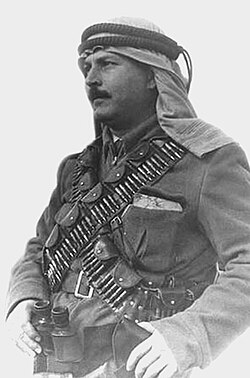
Abd al-Qadir al-Husayni was born in 1907 into one of the most prominent and politically consequential families in Palestinian Arab society — the al-Husayni clan, whose influence in Jerusalem stretched back through the Ottoman period and whose members occupied many of the most important positions in the city's religious, administrative, and civic life. His father, Musa Kazim al-Husayni, served as Mayor of Jerusalem under both Ottoman and British Mandatory authority and was a central figure of the early Palestinian national movement — one of the leaders of the Palestinian Arab Congress and a participant in the early delegations to London that sought to present the Palestinian Arab case against the Zionist project to the British government.
Growing up in this family meant growing up at the centre of Palestinian political life — in a household where the questions of British Mandate policy, Zionist immigration, and Palestinian Arab political strategy were the daily substance of adult conversation. Abd al-Qadir absorbed not only the political framework of Palestinian nationalism but also the specific character of the Husayni family's relationship to it: a combination of notable-class leadership, Islamic religious authority through the family's connections to the Jerusalem religious establishment, and a tradition of political engagement that extended across the family's multiple generations of involvement in Palestinian public life.
He studied chemistry at the American University of Cairo — a choice that combined modernity with practical application — but the direction of his life was determined less by his scientific education than by the escalating political crisis of Palestine in the 1930s. The Arab Revolt of 1936–1939 — the sustained Palestinian uprising against British rule and Zionist immigration that was the most significant Palestinian armed resistance of the Mandate period — pulled him into military organisation and away from any conventional career trajectory. He participated in the revolt's armed operations and developed the military knowledge and experience that would define the rest of his life.
The Arab Revolt and the Making of a Commander
The Arab Revolt of 1936–1939 was the formative military experience of Abd al-Qadir al-Husayni's generation of Palestinian leaders — the uprising that established the parameters of Palestinian armed resistance and that, in its eventual brutal suppression by British military force, also demonstrated the constraints within which any Palestinian military operation would have to function. The revolt had begun as a general strike in April 1936 and escalated into armed insurrection across rural Palestine, with guerrilla bands operating from the hill country attacking British military and police installations and Zionist settlements.
Al-Husayni participated in the revolt's armed operations in the Jerusalem area and developed both tactical military knowledge and the organisational understanding of how Palestinian irregular forces could be raised, sustained, and directed in the specific terrain and social conditions of the Judean Hills. The revolt's eventual suppression — achieved through a combination of massive British military operations, the use of Jewish auxiliary police forces, and the internal fragmentation of the Palestinian leadership — left deep lessons about what Palestinian military organisation needed and what it lacked: central coordination, adequate weapons supply, trained officers, and the material support base that could sustain operations over extended periods against organised opponents.
The years between the revolt's end in 1939 and the 1948 war were years of preparation and exile for al-Husayni — building military knowledge, maintaining connections with Palestinian nationalist networks, and planning for the confrontation that the approaching end of the British Mandate made inevitable. He organised the Holy War Army — Jaysh al-Jihad al-Muqaddas — as the Palestinian irregular military force that would carry the main burden of Palestinian armed resistance in the 1948 period, recognising that the formal Arab state armies that would eventually intervene would be insufficient to prevent the consolidation of Zionist military control over Palestine before any coordinated inter-state response was possible.
The Jerusalem Corridor: The Road That Decided Everything
The strategic geography of the 1948 war in the Jerusalem area was defined by a single physical reality: the road from Tel Aviv on the coast to Jerusalem in the hills climbed through a narrow corridor of terraced valleys and rocky ridges that was dominated by a series of Arab villages and hilltop positions. Whoever controlled these positions could interdict traffic on the road; whoever could keep the road open could supply and reinforce Jerusalem's Jewish population; whoever could close it could besiege and potentially force the surrender of the 100,000 Jewish residents of the city.
Al-Husayni grasped this strategic reality with a clarity that the fragmented Palestinian political leadership did not always share, and he directed the Holy War Army's operations primarily toward controlling and contesting the positions that commanded the Jerusalem road. From late 1947 onward — after the United Nations partition resolution of November 1947 triggered the beginning of the civil war phase of the conflict — his forces conducted operations against Jewish transport convoys moving along the road, ambushing supply columns and attacking the armoured buses and trucks that were attempting to keep Jerusalem supplied against the blockade that Palestinian forces were imposing.
The operations were partially successful: the Jerusalem road was effectively cut for significant periods, and the Jewish population of the city experienced genuine supply shortages that created real military pressure. But they were conducted under severe and increasingly acute constraints. The Holy War Army was chronically short of weapons — the arms embargo that the British Mandatory authorities maintained, and the failure of the surrounding Arab states to provide adequate weapons to Palestinian irregular forces before their own armies were committed, left al-Husayni's men fighting with whatever they could acquire through purchase, capture, or the limited smuggling operations that his networks could sustain. Against Haganah forces that were receiving weapons from Czechoslovakia and that were in the process of transforming from a clandestine militia into a conventional army, the disparity was significant and growing.
The Kastel: Victory and Death
Al-Kastel — the Crusader-era hilltop fortress on the heights above the Jerusalem road at the village of Qastal — was the most strategically significant single position in the Jerusalem corridor. From its summit, the road below was visible for kilometres in both directions; a force holding the Kastel could observe and interdict movement on the road with devastating effectiveness. Both sides understood its importance, and the Kastel changed hands multiple times in the intense fighting of March and April 1948 as the Haganah launched Operation Nachshon — the large-scale offensive designed to break the Palestinian blockade of Jerusalem — and Palestinian forces fought to prevent it.
In early April 1948, Haganah forces captured the Kastel as part of Operation Nachshon's initial thrust. Al-Husayni, recognising the position's critical importance, personally led the counterattack to retake it. On the night of 7–8 April 1948, his forces assaulted the Kastel and drove the Haganah garrison from the hilltop — a genuine military achievement accomplished against an organised defensive position by fighters whose weapons and training were inferior to their opponents'. The Kastel was back in Palestinian hands.
Abd al-Qadir al-Husayni was found dead at the Kastel on the morning of 8 April 1948. The exact circumstances remain disputed: some accounts say he was killed in the final assault, others that he was shot by Haganah soldiers who had not yet retreated from the position, still others that he was hit in the confusion of the night fighting. What is not disputed is that the Palestinian commander who had organised the counterattack died at the position his forces had just won, and that his death was discovered before his fighters had time to consolidate their hold on the hilltop.
The news of his death spread instantly and its effect was catastrophic. Palestinian fighters abandoned the Kastel — the position they had just sacrificed lives to retake — and converged on Jerusalem for his funeral, drawn by grief and the collapse of the organisational coherence that al-Husayni's personal authority had sustained. The Haganah, recognising what had happened, retook the Kastel the following day against minimal resistance. Within weeks, Operation Nachshon had broken the Jerusalem blockade and the corridor was in Israeli hands.
Deir Yassin: The Shadow Over His Death
The day Abd al-Qadir al-Husayni died at the Kastel — 8 April 1948 — was also the day that Irgun and Lehi forces massacred the population of the village of Deir Yassin, approximately five kilometres from the Kastel. The massacre, in which over 100 Palestinian civilians were killed, was not operationally connected to the Battle of the Kastel — it was an independent Irgun-Lehi operation that the Haganah command had not authorised — but its timing meant that the two events are permanently linked in Palestinian historical memory.
The massacre at Deir Yassin and the death of al-Husayni at the Kastel on the same day compressed into twenty-four hours both the worst and the most honoured dimensions of the Palestinian experience of April 1948: the massacre that would drive the panic and flight of Palestinian civilians across the country in the weeks that followed, and the death of the commander whose loss left those civilians without the military leadership that might have organised a more effective defence. The coincidence of timing has given 8 April 1948 a particular weight in Palestinian historical consciousness that neither event alone would have produced.
Legacy: What Was Lost at the Kastel
Abd al-Qadir al-Husayni's death at the Kastel on 8 April 1948 is one of those historical moments whose significance is measured not by what happened but by what did not happen afterward. Palestinian military resistance to the Haganah's operations in the Jerusalem corridor and across Palestine did not collapse immediately after his death — there was continued fighting, and the formal Arab state intervention that began with Israel's declaration of independence in May 1948 introduced new military actors. But the coordination, the strategic clarity, and the personal authority that had sustained Palestinian irregular military operations in the Jerusalem area were not replaced. No subsequent Palestinian commander of comparable ability and standing emerged to fill the space his death created.
His funeral in Jerusalem on 9 April 1948 — the day after his death, the day of the Deir Yassin massacre's aftermath — drew enormous crowds in scenes of communal grief that testified to how deeply his leadership had been felt and how devastating his loss was understood to be. Tens of thousands of Palestinians followed his coffin through the streets of Jerusalem in the knowledge that the war he had been fighting, and that had killed him, was entering its most critical phase without its most capable military leader.
The broader question of what Palestinian military resistance might have achieved with better organisation, better weapons supply, and sustained external Arab support is one that historians continue to debate without resolution. What is not debatable is that al-Husayni represented the best that Palestinian irregular military organisation produced in 1948 — a commander who understood the strategic situation, organised effective operations under severe constraints, and died in the field leading the forces he had built. He was forty-one years old, and Palestine has mourned him for the generations since.