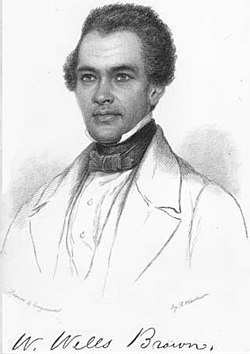
At a Glance
Kentucky, Missouri, and the Mississippi: An Education in Slavery's Commerce
William Wells Brown grew up in the heart of the domestic slave trade's commercial geography — in Missouri, which was in the early nineteenth century one of the primary conduits of the slave trade that moved enslaved people from the Chesapeake and the Upper South southward to the cotton and sugar plantations of the Deep South. His enslavers' move from Kentucky to Missouri when he was a child placed him in a world where slavery's commercial machinery was directly and constantly visible: the slave traders who moved through St. Louis, the steamboats that carried enslaved people down the Mississippi, the markets of New Orleans where they were sold. This world gave him, as an enslaved observer, a knowledge of slavery's economics and its logistics that shaped both the specific content of his subsequent testimony and the analytical intelligence he brought to his literary and historical writing.
His position as an assistant to a slave trader — one of his enslaved occupations on the Mississippi — was particularly formative. He witnessed the buying and selling of human beings at close range, observed the commercial calculations and the casual brutalities of the trade in their daily operation, and developed the specific, detailed knowledge of the institution's commercial dimensions that made his subsequent testimony distinctively valuable. Where most slave narratives focused on the plantation, on the conditions of agricultural labour, and on the specific violence of the master-slave relationship, Brown's testimony addressed the commercial infrastructure of the trade — the riverboats, the markets, the prices, the separation of families at the auction block — in terms that gave his Northern audiences a dimension of slavery's reality they had rarely encountered in such specific and authoritative form.
The escape on New Year's Day 1834 was the product of opportunity and determination: Brown crossed from Kentucky into Ohio when circumstances allowed and made his way northward with the assistance of Wells Brown, the Quaker whose name he took in tribute. The gesture of adopting his benefactor's name was characteristic of the thoughtfulness and the sense of personal history that distinguished Brown throughout his career — the understanding that freedom was not merely a legal status but a full human identity that needed to be built and maintained, and that the people who had contributed to that building deserved to be acknowledged.
Buffalo, the Lake Erie Steamboats, and Underground Railroad in Reverse
Brown settled in Buffalo, New York, after his escape and spent several years working on the Lake Erie steamboats that connected the American side of the lake with Canada — a position that gave him both a livelihood and an unusual opportunity to assist escaped slaves. The conventional Underground Railroad moved people from south to north, from slavery to freedom; Brown operated in a more complex traffic, using his position on the lake boats to assist people who had already reached Canada but who needed to return to the free states for various reasons, including in some cases the attempt to retrieve family members who had been left behind in the United States.
This reversal of the usual Underground Railroad direction reflected the specific situation of escaped slaves in the years before the Fugitive Slave Act of 1850, when the free states of the North offered a degree of safety that was not absolute but was significantly greater than it became after the Act's passage. Many escaped slaves chose to settle in the northern free states rather than continuing to Canada, and their movement between the states and Canada was facilitated by people like Brown whose positions gave them access to the transportation infrastructure of the border region.
He also educated himself intensively during these years — reading everything he could access, developing the analytical intelligence that his subsequent literary career would require, and beginning to think about how the experience of slavery he had accumulated could be turned into effective antislavery argument. He joined the American Anti-Slavery Society's lecture circuit in the early 1840s and quickly became one of its most effective speakers — not the most celebrated (Frederick Douglass, who emerged on the circuit at the same time, quickly became the dominant figure) but one of the most knowledgeable and the most analytically sophisticated, with a specific expertise on the commercial dimensions of slavery that complemented Douglass's focus on the plantation's personal violence.
The Narrative and the Literary Career: Five Genres, Five Firsts
Brown published his Narrative — the autobiographical account of his enslaved years and his escape that was the standard form through which escaped slaves introduced themselves to the antislavery public — in 1847, and it went through multiple editions over the following years. The Narrative was effective and widely read, but it was the beginning rather than the culmination of his literary ambitions. He was, among all the figures of the antislavery movement, the most literarily ambitious and the most literarily versatile — a man who understood that the case against slavery could be made through fiction, through drama, through travel writing, and through history as well as through personal testimony, and who proceeded to make it through all of these forms in rapid succession.
Clotel, published in London in 1853 as the first novel by a Black American, was the most ambitious of these ventures. The novel told the story of the daughters of Thomas Jefferson by an enslaved woman — a story that engaged directly with the most celebrated hypocrisy in American political history, the author of "all men are created equal" as the enslaver and sexual exploiter of the woman who bore his children. The choice of Jefferson as the central figure was deliberate and inflammatory: Brown was not merely making an argument about slavery in the abstract but connecting the institution to the founding mythology of the American republic in a way that made the contradiction between American ideals and American practice impossible to avoid.
The Play — The Escape; or, A Leap for Freedom, published in 1858 — was the first drama published by a Black American, and Brown used it as a performance piece in his lectures, reading it dramatically to audiences who encountered the abolitionist argument through the specifically theatrical form that drama made available. The travel narrative Three Years in Europe, published in 1852, was the first travel narrative by a Black American, and it combined personal observation of European social life with the implicit comparison that a Black American's experience of being treated as a full human being in Europe naturally generated — the comparison between the equality available to him in Britain and the subordination imposed on him in the United States. His historical works — particularly The Black Man: His Antecedents, His Genius, and His Achievements of 1863 — were serious attempts at Black historiography, at constructing the historical record of Black achievement that the slave system's ideology denied and that needed to be asserted as a counter-argument to the racial hierarchy that sustained it.
Britain, the Paris Peace Congress, and Five Years of Productive Exile
Brown crossed the Atlantic to Britain in 1849, driven partly by the same fear of re-enslavement under the increasingly aggressive enforcement of the Fugitive Slave Act that sent many escaped slaves to Canada and to Europe in the late 1840s, and partly by the recognition that the British antislavery audience was substantial, enthusiastic, and prepared to engage seriously with the literary and argumentative work he was developing. He spent five years in Britain, from 1849 to 1854, lecturing across England and Scotland to audiences that received him with the warmth that the British antislavery movement consistently extended to escaped American slaves who came to testify.
The Paris Peace Congress of 1849, which Brown attended as one of the American antislavery movement's representatives, brought him into contact with the European reform world at its most idealistic — the post-1848 moment when the European revolutionary movements had recently been suppressed but when the conviction that a new world of peace and human rights was both possible and imminent was still widely held. Victor Hugo addressed the Congress; Brown addressed it in turn, connecting the American slavery question to the broader European struggle for human freedom in terms that the Congress's participants found both moving and illuminating.
The five British years were among the most intellectually productive of his career. Unable to return to the United States safely, he wrote — the Narrative's new editions, the travel narrative, the novel, the play — with a productivity that reflected both the specific freedoms of exile and the specific energy of a man who understood that his time in Europe was finite and that he needed to accomplish as much as possible before his freedom was formally secured and he could return to America. His British friends eventually purchased his freedom in 1854, and he returned to the United States the same year, carrying with him the published books and the lecture experience that the British years had produced.
Physician, Historian, and the Later Career
Brown trained as a physician in the years after his return to the United States — a choice that reflected both his genuine interest in medicine and his understanding of the specific needs of the Black communities he served. Medical practice gave him a professional identity that was independent of his literary and lecturing career and that provided both a livelihood and a form of service to Black communities that were chronically underserved by the white medical establishment. He practised medicine in the Boston area for years while continuing to write and lecture.
His historical works of the 1860s and 1870s — The Black Man (1863), The Negro in the American Rebellion (1867), and The Rising Son (1874) — represented a sustained and serious attempt to write the history of Black America from a Black perspective, using the historical record to counter the racial ideology that sustained slavery and that continued to operate in the post-emancipation period as justification for the systematic denial of Black civil and political rights. The works were not merely celebratory catalogues of Black achievement — they were analytical arguments about the relationship between Black history and American history, about the specific contributions that Black Americans had made to the country that had enslaved them, and about the obligations that those contributions imposed on the republic.
His persistence as a historian in the post-Civil War decades, when the promise of Reconstruction was being systematically betrayed and the racial hierarchy that slavery had embodied was being reconstructed through new mechanisms of violence and legal discrimination, was characteristic of the intellectual commitment that had shaped his entire career. He understood that the argument for Black humanity and Black equality needed to be made not only in the moment of crisis but across the long arc of history, and that the historical record — properly researched, properly argued, properly published — was one of the most powerful weapons available in that argument.
Legacy: The Writer Who Made Every Form an Argument
William Wells Brown died on 6 November 1884, in Chelsea, Massachusetts, at approximately seventy years of age. He had escaped slavery in 1834 at nineteen or twenty and had spent fifty years building from that escape one of the most extraordinary intellectual and literary careers in the history of Black America — a career that produced the first Black American novel, the first Black American play, the first Black American travel narrative, and a series of historical works that established the foundations of Black historiography. He had been one of the American Anti-Slavery Society's most effective lecturers, had spent five years in productive exile in Britain, had practised medicine, and had continued to write and advocate for Black rights through the Civil War, Reconstruction, and the beginning of its betrayal.
The firsts he achieved — the literary firsts that placed him at the beginning of multiple traditions in Black American letters — were not merely biographical achievements. They were political arguments: demonstrations that Black Americans could produce and were producing the full range of literary and intellectual forms that European and American culture recognised as markers of civilisation and seriousness. Every novel, every play, every history that he published was a refutation of the racial ideology that slavery required — the ideology that Black people were incapable of the intellectual and artistic production that only free, educated, fully human people could achieve. He was, through his literary career, making the same argument that William Still was making through his documentary record and that Thomas Garrett was making through his operational commitment: that the people the slave system had tried to reduce to property were in fact full human beings whose capacities, when given the freedom to develop, were as extensive and as valuable as anyone's.