At a Glance
Charles Town, Pennsylvania, and the Formation of a Political Thinker
Martin Delany's early life was shaped by a combination of intellectual hunger, legal precariousness, and direct exposure to the violence of racial hierarchy that produced, over time, the most systematic political thinker that antebellum Black America had yet seen. His mother's decision to move the family north from Virginia — driven by a Virginia law that made it illegal to teach free Black children to read, a law that Pati Delany had already broken by teaching her son — was itself an act of defiance and an illustration of the kind of Black maternal determination to secure education for children that runs through so much of the Underground Railroad literature. The move to Chambersburg, Pennsylvania placed Delany in a freer environment where the education his mother had begun could be continued, and where he could develop the intellectual capacities that were already apparent in his early years.
He eventually made his way to Pittsburgh, which was in the 1830s and 1840s one of the most important centres of Black community and political life in the northern United States — a city with a substantial free Black population, active Black institutions, and a tradition of Black political organising that gave young men of Delany's ambitions and capacities both a platform and an audience. He studied medicine informally with several Pittsburgh physicians, began publishing a small newspaper called the Mystery, and became deeply involved in the network of Black community organisations, mutual aid societies, and political associations that were building the institutional infrastructure of Black civic life in the antebellum North.
His encounter with Frederick Douglass in the mid-1840s — and the partnership they formed around the North Star newspaper in 1847 — placed him at the centre of the national Black abolitionist network at the moment when that network was achieving its greatest prominence and influence. The partnership was genuine and the two men respected each other, but their fundamental disagreement about the future of Black Americans in the United States was apparent from the beginning and would eventually produce one of the most consequential intellectual splits in the history of Black American thought.
Douglass vs. Delany: The Great Debate of Black Political Thought
The disagreement between Martin Delany and Frederick Douglass was not merely a tactical dispute about the best methods for achieving Black liberation; it was a fundamental disagreement about the nature of the American republic and the prospects for Black freedom within it. Douglass believed — and maintained this belief through decades of evidence to the contrary — that the American republic contained within its founding documents and its stated principles the seeds of a genuinely inclusive democracy, and that the work of the Black freedom movement was to hold America to its own highest ideals, to force the country to become what it claimed to be. Black Americans had fought too hard and built too much in America to abandon it; their claim to the country's promise was as valid as any white citizen's, and the movement should fight to redeem that claim rather than to abandon it.
Delany's position was different in its premises and therefore in its conclusions. He did not believe that the American republic's stated principles represented a genuine commitment that could be redeemed through political pressure and moral persuasion. He believed that the American republic was, at its core, a white republic — that its institutions, its culture, its economy, and its political arrangements were designed to serve white interests and to subordinate Black ones, and that no amount of moral argument or political pressure could fundamentally alter this design. The evidence for this position was abundant: the Constitution's compromises with slavery, the systematic denial of Black political rights even in the nominally free North, the Harvard Medical School episode, the passage of the Fugitive Slave Act. Each of these was a demonstration that the American republic would not honour its obligations to Black people.
If the diagnosis was correct, the prescription followed: Black people needed to build their own sovereign nation, on their own territory, under their own governance, free from the permanent subordination that life in the United States would always entail. This was the argument of The Condition, Elevation, Emigration, and Destiny of the Colored People of the United States — not a despairing argument but a constructive one, an argument about what genuine Black freedom required rather than about the impossibility of freedom itself. Delany was not telling Black people to give up; he was telling them that the terrain on which they were fighting was always going to be hostile, and that the strategic response to that hostility was to find different terrain.
Harvard, Expulsion, and the Racism of the Virtuous North
The episode at Harvard Medical School in 1850 was one of the most revealing demonstrations of Northern racism in the antebellum period, and it was not lost on Delany that the expulsion came from one of the country's most prestigious educational institutions — the institution that was simultaneously a temple of American intellectual achievement and a place whose white students and faculty were unwilling to sit in the same classroom as Black men. The petition that the white students submitted, asking the faculty to remove their Black colleagues, was an act of organised racial exclusion that drew on the same logic as every other form of racial hierarchy in American life: the conviction that Black people's presence in white spaces was inherently degrading to the white people in those spaces, regardless of the Black people's qualifications or their right to be there.
The faculty's compliance was, in some respects, more revealing than the students' petition. The students were reflecting the racial attitudes of their class and their era; the faculty were making a deliberate institutional decision to prioritise white students' preferences over the Black students' right to the education they had been admitted to receive. Harvard's decision demonstrated that Northern educational institutions, for all their stated commitment to learning and to human development, were not prepared to challenge the racial hierarchy that structured American society — that the virtue of the educated North was selective, and that its selectivity was racialized in exactly the ways that Delany's analysis of American institutions predicted.
He completed his medical training through other means — through continued study with Pittsburgh physicians and through the practical experience of treating patients in the Black communities where he worked — and he practised medicine throughout his career alongside his journalistic, political, and military activities. The Harvard expulsion did not end his medical ambitions; it confirmed his political analysis and gave him another specific, documented illustration of the thesis he was developing about the impossibility of Black equality in American institutions.
The Niger Valley Expedition and the Geography of Freedom
The expedition to the Niger Valley in West Africa that Delany led in 1859 and 1860 was the most ambitious practical expression of the emigrationist vision he had been developing since the early 1850s, and it was an extraordinary undertaking by any measure. He and Robert Campbell — a Jamaican scientist and educator who proved to be an indispensable partner in the expedition — travelled to West Africa, navigated the complex political landscape of the Yoruba kingdoms, and negotiated a treaty with the Alake of Abeokuta that granted land for a prospective Black American settlement.
The expedition was a demonstration of the practical seriousness with which Delany approached the emigrationist project. He was not merely theorising about the possibility of Black self-government in Africa; he was doing the groundwork — the travel, the negotiation, the assessment of agricultural potential, the building of the relationships with African leaders that a successful settlement would require. His account of the expedition, published in 1861, is both a practical document about the possibilities of West African settlement and an early contribution to the literature of Pan-African thought — the intellectual tradition that would eventually produce the Garvey movement, the African independence movements of the twentieth century, and the broader conversation about the relationship between Africa and the Black diaspora that has never been fully resolved.
The Civil War intervened before the treaty could be acted on, and the treaty was eventually repudiated by the Yoruba chiefs who had signed it. But the expedition established Delany's credentials as the most serious and most practically engaged advocate of African emigration in the antebellum United States, and it provided the evidence for his subsequent political arguments that the emigrationist vision was not a fantasy but a practical possibility that had been closer to realisation than its opponents were prepared to acknowledge.
Major Delany, the Civil War, and Reconstruction
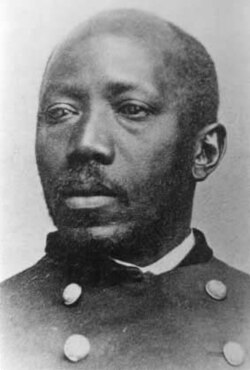
The Civil War transformed the political landscape in ways that temporarily brought Delany's emigrationist vision and Douglass's integrationist vision into the same practical project — the defeat of the Confederacy and the liberation of the enslaved — while leaving their fundamental disagreement about the future of Black Americans in the United States unresolved. Delany threw himself into the Union cause with the same energy and the same practical intelligence that had characterised everything else he had done, recruiting Black soldiers and eventually being commissioned as a Major in February 1865 after his meeting with President Lincoln.
The commission — the first field officer's commission given to a Black man in American military history — was both a personal achievement and a political argument: evidence that Black men were capable of the military leadership that the Army had previously denied them, and a demonstration that the Lincoln administration, under sufficient pressure, was prepared to acknowledge that capability. Delany served briefly in South Carolina before the war's end and remained in the state during the early Reconstruction period, where he became a significant figure in the efforts to establish Black political and economic power in the formerly Confederate South.
The collapse of Reconstruction — the systematic dismantling of Black political rights through terror, fraud, and legal manipulation that began in the early 1870s and was effectively complete by 1877 — confirmed for Delany the diagnosis he had made in the 1850s. The United States had once again demonstrated its unwillingness to honour its obligations to Black people; the constitutional amendments that had seemed to promise genuine freedom were being systematically rendered meaningless; and the prediction he had made twenty years earlier — that Black people would never achieve genuine equality within the American republic — was being vindicated by events in ways that were impossible to ignore.
Legacy: The Prophet Who Was Right
Martin Delany died on 24 January 1885, in Wilberforce, Ohio, at the age of seventy-two. He had been, in the course of his extraordinary career, a physician, a journalist, a political philosopher, a West Africa explorer, a Civil War army officer, and a Reconstruction politician. He had been right about the most important political question of his era — that the United States would not honour its obligations to Black people — and he had spent his life trying to build the alternative that his analysis demanded. The alternative he proposed was not ultimately adopted, and the world he imagined — a Black sovereign nation, in Africa or the Americas, where Black people could govern themselves without the constant subordination that American life imposed — remained unrealised. But the tradition of thought he founded was not extinguished. Marcus Garvey's Universal Negro Improvement Association, the Pan-African movements of the twentieth century, the Black Power movement's insistence on Black self-determination and Black sovereignty — all of these drew, consciously or not, on the intellectual foundation that Delany had laid in his 1852 book and in the decades of political work that surrounded it.
His relationship with Douglass — the great partnership and the great rupture — defined the terms of the most important political debate in Black American life for a century after their collaboration ended. Are Black Americans to fight for inclusion in the American republic, holding the country to its stated ideals? Or are they to build their own institutions, their own economy, their own sovereignty, outside the republic that has repeatedly demonstrated its unwillingness to include them on equal terms? This debate has never been resolved, because the conditions that generated it have never been fully resolved. Delany was the first to frame it with full clarity and full seriousness, and the tradition he founded remains alive precisely because the conditions that produced it remain alive.