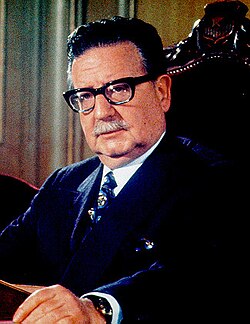
At a Glance
Physician and Politician: A Formation
Salvador Allende trained as a physician at the University of Chile, graduating in 1933 — the same year he helped found the Chilean Socialist Party. The combination was characteristic of his generation and his class: the Latin American professional who studied the sciences and encountered through that study both the consequences of poverty on human bodies and the political economy that produced those consequences. His medical thesis, written in 1933, addressed mental health and the social conditions that produced mental illness — an early indicator of the analytical approach that would define his political career: the insistence on seeing social problems as social problems, with social causes and social solutions, rather than as individual failures of character or fortune.
His political career began immediately after graduation and ran, with barely any interruption, for forty years. He served as health minister in the Popular Front government of 1939–1942, in which capacity he pursued public health initiatives — the expansion of social insurance, nutrition programmes, the development of national health infrastructure — that anticipated the larger programme he would implement as president. He was a senator for years, building the legislative expertise and the network of political relationships that made him the most effective parliamentary politician the Chilean left produced. He ran for president in 1952, 1958, and 1964 before winning in 1970. The persistence required to lose three presidential elections and keep running — with declining personal fortune, with no guarantee that the fourth campaign would succeed any more than the previous three — was itself a statement about what Allende believed was possible and necessary.
The Programme and Its Achievements
The Popular Unity programme was not improvised or utopian — it was the product of years of work by economists, lawyers, trade unionists, and politicians who had studied the Chilean economy carefully and developed a detailed plan for transforming it within constitutional limits. The nationalisation of the copper mines was its centrepiece: Chile's copper, which had been producing enormous profits for Anaconda and Kennecott while a third of Chilean children suffered from malnutrition, would henceforth produce revenue for the Chilean state. The compensation formula that Allende applied — deducting "excess profits" earned by the companies over the previous fifteen years from the assessed value of the nationalised assets — was legally defensible under Chilean law and politically brilliant in its framing: the companies had already taken more than their investments were worth, and Chile owed them nothing. The Chilean Congress agreed: the nationalisation passed unanimously.
The social programmes of the first year were equally concrete in their impact. The provision of half a litre of milk daily to every Chilean child was not a symbolic gesture — it addressed a real nutritional deficit in a population where childhood malnutrition was endemic and measurable. The acceleration of land reform transferred agricultural land from the great estates — the fundos that had controlled Chilean rural life since the colonial period — to the peasant families who worked it. The expansion of the national health service extended access to medical care to communities where it had not previously existed. These were real achievements, felt by real people, and the electoral support that Allende's Popular Unity coalition built during the 1970–73 period — from 36.6 per cent in September 1970 to 44 per cent in the March 1973 congressional elections, despite three years of US-backed economic sabotage — demonstrated that those people recognised what was being done for them.
The Deliberate Destruction
The history of how the Allende government was destroyed cannot be told honestly without the United States. The role of the Nixon administration — coordinated through Henry Kissinger's National Security Council and the CIA, implemented through economic pressure, political subversion, military contacts, and eventually direct support for the coup — is documented in the US government's own declassified records with a specificity that leaves no room for doubt about intent or method. The decision to prevent Allende from governing was made in Washington before he had been inaugurated, and the methods for implementing it were systematic and sustained across three years.
The economic destabilisation was the most effective instrument. By cutting off international credit, pressuring the World Bank and Inter-American Development Bank to deny loans, and coordinating with Chilean business interests to create artificial shortages through hoarding and investment strikes, the Nixon administration helped produce the economic crisis that its propaganda then attributed to socialist mismanagement. The truck owners' strike of October 1972 — which paralysed Chilean commerce and was heavily subsidised by CIA funds — demonstrated how the economic sabotage worked in practice: genuine labour and business grievances were amplified and sustained by external funding beyond what the local participants could have maintained on their own. The Chilean right needed a pretext for military intervention. The Nixon administration helped manufacture it.
The Last Morning
What Allende chose to do on 11 September 1973 — to stay in La Moneda, to broadcast, to die there — was a political decision as much as a personal one, and it needs to be understood as such. He had been offered safe passage and refused it. He could have gone into exile and continued to speak and organise from outside Chile, as many of his colleagues did. He chose not to because he understood that the symbolic value of the president of Chile dying in his office rather than fleeing from it was itself a form of political communication — a statement about what constitutional democracy meant, about the illegitimacy of the coup, about the difference between a government that fought for its mandate and one that abandoned it when the fighting became real.
The broadcast he made in those last hours — knowing, by the time he recorded it, that rescue was not coming and that he was likely speaking his last words — stands as a document of extraordinary political dignity. He did not curse his enemies. He did not despair. He spoke of history with the confidence of someone who had spent forty years thinking seriously about its direction, and who remained convinced, in the ruins of his government, that the direction was toward the liberation he had worked for. He was right in the long arc: Chilean democracy was eventually restored, the people who killed him were eventually prosecuted, the social questions he had tried to answer were eventually partially answered by democratic means. Whether he would have found that vindication satisfying — whether partial answers through other means were what he had hoped for — cannot be known. What can be known is that he chose to die rather than yield, and that the choice was made consciously, deliberately, and with a clarity of purpose that the chaos around him did not disturb.