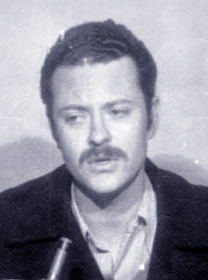
Bautista van Schouwen, MIR central committee member and physician, one of the first senior Chilean revolutionaries captured and disappeared by Pinochet's DINA after the September 1973 coup.
Chile · Latin America

Bautista van Schouwen

Bautista van Schouwen was a physician and a revolutionary, and in the Chile of 1973 those two vocations turned out to be equally dangerous. A member of the MIR's central committee and one of the organisation's most important political leaders, he was captured by Pinochet's forces in December 1973 — just three months after the coup that killed Salvador Allende — tortured, and executed. His death was denied by the military government for years, his body hidden, his fate officially unknown to his family for a generation. He was thirty years old. His case is not exceptional in the history of Pinochet's Chile — it is representative, one data point in a pattern of state violence that killed thousands — but it is precisely that representativeness that makes it important. Bautista van Schouwen's life and death are the story of what the 1973 coup meant for the people who had believed most deeply that a different Chile was possible.

Chile MIR Central Committee Physician Disappeared December 1973 DINA Victim Martyr of the Chilean Left

Born: 1943, Chile  |  Died: December 1973 (disappeared) — MIR central committee member; captured by DINA three months after the coup; executed; his fate denied for decades

At a Glance

Formation and the MIRVan Schouwen came to the MIR through the student and professional milieu of Chilean left politics in the 1960s. Trained as a physician — a profession that in the Latin American revolutionary tradition carried particular moral weight, associating the healer's ethic with the revolutionary's commitment to the health of the social body — he was drawn to the MIR's analysis that constitutional reform alone could not overcome the structural violence of Chilean capitalism and the willingness of the right to use actual violence to defend it. His position on the central committee meant that he was not a peripheral figure in the organisation but one of its actual decision-makers, involved in the strategic and political choices that shaped the MIR's direction in the critical years before and after the coup.
The Coup and Its Immediate ConsequencesSeptember 11, 1973 — the date of Pinochet's coup — was the moment for which the MIR had theoretically prepared and against which its preparation proved inadequate. The speed and comprehensiveness of the military's seizure of power, the simultaneous arrest and killing of thousands in the immediate days after the coup, and the deployment of the military's intelligence apparatus against the left's known leadership meant that the MIR's clandestine structures were under pressure from the first moment. Van Schouwen went underground, attempting to maintain clandestine political activity in the face of a repressive apparatus that was systematically working through known organisational structures using lists of names obtained from prisoners under torture.
Capture, Torture, and ExecutionVan Schouwen was captured in December 1973. The details of what followed his capture are known from the subsequent investigations of the Rettig Commission and the testimony of survivors of the detention centres where he was held. He was tortured — as virtually all political prisoners of the Pinochet period were tortured, with the systematic use of electric shock, waterboarding, beating, and other methods that the DINA had adopted from the training programmes that connected South American military intelligence to the School of the Americas. He was executed — the military government's preferred term for these killings was "shot while attempting to escape," the same euphemism that police states across the world have used for extrajudicial execution. His body was hidden, and its location was not confirmed until years after his death.
The Disappearance as Political StrategyThe decision not merely to kill political opponents but to disappear them — to deny that they had been captured, to refuse to return their bodies, to leave their families in permanent uncertainty about whether they were alive or dead — was not an accident or an oversight of the Pinochet regime. It was a deliberate strategy, adopted across the southern cone dictatorships that were connected through Operation Condor, that served multiple purposes simultaneously. It terrified the left by demonstrating that the state could make people vanish without consequence. It tortured families with permanent uncertainty. It made legal accountability impossible because there was no body, no death certificate, no evidence. Van Schouwen's family lived with that uncertainty for years after December 1973.
The Physician-Revolutionary TraditionVan Schouwen was not the only physician who chose revolutionary politics in Latin America in this period — the tradition runs from Che Guevara (who had trained as a doctor) through Agostinho Neto (who practised medicine in Angola before leading the MPLA) and others. There is something in the medical vocation that the revolutionary tradition has repeatedly found compatible with political commitment: the direct encounter with the consequences of poverty, malnutrition, inadequate housing, and structural violence on individual human bodies makes the political causes of those conditions visible in a way that other professions may not. For van Schouwen, as for others in this tradition, the decision to move from treating the symptoms of injustice to organising against its causes was the logical extension of a commitment to human welfare that had begun in the clinic.
Memory and RecognitionBautista van Schouwen is commemorated in Chile's official memory of the dictatorship's victims — his name appears in the registers maintained by the human rights organisations that documented the repression and in the official reports of the post-dictatorship commissions. Streets and public spaces bear his name in communities where the left's memory is honoured. But the depth of his role in the MIR — the specific content of the political decisions he participated in, the intellectual contribution he made to the movement's analysis — is less accessible, partly because the clandestine conditions under which the MIR operated left fewer documentary traces than a more conventional political career would have produced. He is remembered primarily as a martyr, which is true, but which is incomplete.

The MIR's Analysis: Why Chile's Road Was Not Enough

To understand what Bautista van Schouwen was fighting for — and what he died for — it is necessary to understand the MIR's political analysis, which differed from Salvador Allende's Popular Unity coalition in ways that turned out to be more prescient than comfortable. The MIR argued, from its founding in 1965, that the Latin American right and its American backers would not accept the result of a democratic socialist electoral victory. They had precedent for this view: the CIA-backed overthrow of Árbenz in Guatemala in 1954, the Bay of Pigs invasion in Cuba in 1961, the systematic US support for right-wing military governments across the hemisphere. The MIR's conclusion was not that democratic politics should be abandoned — it was that democratic gains needed to be defended by the organised power of the working class and that the revolutionary left needed to prepare for the armed confrontation that the right would eventually provoke.

Allende disagreed with this analysis — not because he was naive about the right's intentions but because he was genuinely committed to the constitutional road and understood that departing from it would give the military the justification it was looking for. The debate between Allende's constitutionalism and the MIR's revolutionary position was the central political argument of Chilean left politics in the early 1970s, and history has not given a clean verdict on who was right. The coup came regardless of which position the left adopted — the right did not need a justification, it manufactured one. But the question of whether a more armed and organised popular response to the coup would have succeeded in defending the Allende government is one that Chilean historians continue to debate. Van Schouwen and the rest of the MIR central committee believed it would have. They did not get the chance to find out.

Three Months: The Speed of the Killing

One of the most revealing aspects of van Schouwen's case is the timeline: he was captured and killed within three months of the coup. This is not the timeline of a chaotic, disorganised repression that accidentally swept up political opponents. It is the timeline of a systematic programme with lists, infrastructure, and method. The DINA — which was formally established in June 1974 but whose predecessor organisations were operating from the day of the coup — worked from intelligence files that had been compiled over years, supplemented by information extracted under torture from those captured first, to work its way methodically through the known leadership and membership of the Chilean left.

The speed with which van Schouwen was found and killed demonstrates that the MIR's clandestine preparations, however serious, were insufficient to protect its central committee members from an intelligence apparatus that had been preparing for exactly this moment. The names were known. The addresses — even the clandestine ones — could be extracted from those who knew them and were subjected to sufficient pain. The infrastructure of the safe house networks could be progressively penetrated once a single node was compromised. Van Schouwen's capture in December 1973 was almost certainly the product of information extracted from someone else — a chain of interrogation and betrayal under torture that the DINA was expert at exploiting. The moral responsibility for what happened to him lies entirely with those who did it, not with the comrades whose suffering produced the information that led to his location. That distinction — between information extracted by torture and voluntary betrayal — matters to the memory of everyone in this history.

The Long Silence and Its Breaking

For years after his death, Bautista van Schouwen's fate was officially unknown. His family did not know whether he was alive or dead, held in some clandestine prison or executed. The military government's practice of neither confirming nor denying the fate of the disappeared was a calculated form of ongoing psychological violence against families who were left suspended in permanent uncertainty. The work of organisations like the Vicaría de la Solidaridad — the Catholic Church's human rights organisation that began documenting the disappeared from within Chile during the dictatorship — and later the Agrupación de Familiares de Detenidos Desaparecidos slowly built the record that would eventually establish what had happened to people like van Schouwen.

The Rettig Commission — the National Commission on Truth and Reconciliation established after Pinochet's 1988 plebiscite defeat — provided the first official acknowledgment of what had happened to most of the disappeared. Van Schouwen's case was documented: capture, torture, execution, disappeared. The subsequent Commission on Political Imprisonment and Torture (the Valech Commission) filled in more detail about the methods used in the detention centres. What the commissions could not provide — what no commission can provide — is the specific content of his last months: what he thought, what he said to his interrogators, what he held onto. That belongs to the silence of the disappeared, which is the deepest silence of all.

Also Profiled — Brazil, Argentina, Chile & Uruguay

Southern Cone Andrés Pascal Allende MIR leader and Salvador Allende's nephew; survived to lead the post-coup resistance Southern Cone Carlos Marighella Afro-Brazilian communist; MR-8 founder; Minimanual of the Urban Guerrilla; killed 1969 Southern Cone Eva Perón Evita — Argentine first lady who built a welfare state for the descamisados; died at 33 Southern Cone Haydée Tamara Bunke Tania la Guerrillera — killed at Vado del Yeso alongside Guevara's Bolivian column Southern Cone Luciano Cruz MIR co-founder and beloved early leader; died in car accident 1971 aged 28 Southern Cone Luís Carlos Prestes Knight of Hope — led the Prestes Column; Brazilian Communist Party leader Southern Cone María Esther Gatti Uruguayan human rights activist; searched for disappeared grandchildren for decades Southern Cone Miguel Enríquez MIR secretary-general; killed by DINA October 1974 aged 30 Southern Cone Raúl Sendic Tupamaro founder; 13 years in brutal prison; symbol of Uruguayan revolutionary left Southern Cone Salvador Allende Chile's socialist president; died defending La Moneda in the 1973 coup Southern Cone Víctor Jara Folk singer and communist; tortured and shot in Chile Stadium after the coup
Share X Facebook WhatsApp LinkedIn