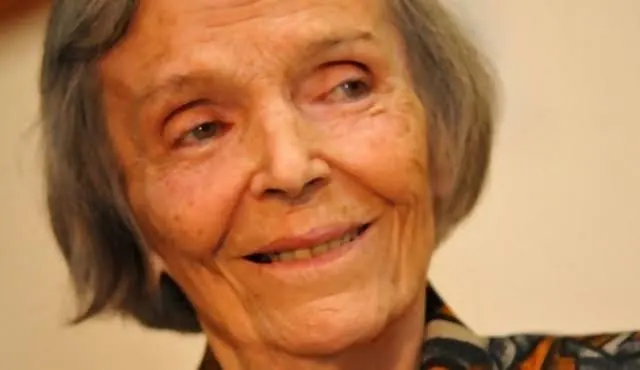
María Esther Gatti, Uruguayan human rights activist and co-founder of Madres y Familiares de Uruguayos Detenidos Desaparecidos, who spent decades searching for grandchildren stolen from disappeared parents by the military dictatorship.
Uruguay · Latin America

María Esther Gatti

María Esther Gatti was born in 1921 and lived to be one hundred years old, and nearly all of those hundred years that mattered politically were spent doing one thing: searching. Searching for her daughter, who was disappeared by the Uruguayan military dictatorship in Buenos Aires in 1976. Searching for her granddaughter, who was born in captivity to a disappeared mother and given a false identity by the Argentine military, and who was not found and reunited with her family until 2014 — when María Esther was ninety-three years old and had been searching for thirty-eight years. Searching, along with the other women who had lost children and grandchildren to the southern cone dictatorships, for all the other children who had been stolen and renamed and given to military families or collaborators as though they were objects that could be appropriated rather than people with families and histories and rights. The organisation she co-founded — Madres y Familiares de Uruguayos Detenidos Desaparecidos — was one of the most important human rights organisations in Latin American history, and her own life embodied its purpose with a consistency and a duration that is almost without parallel in the history of human rights activism anywhere in the world.

Uruguay Madres y Familiares Co-Founder Grandmother of a Disappeared Child 38 Years Searching for Granddaughter Human Rights Activist Lived to 100

Born: 1921, Uruguay  |  Died: 2021, Uruguay — Daughter disappeared 1976; granddaughter born in captivity; co-founded Madres y Familiares de Uruguayos Detenidos Desaparecidos; granddaughter found 2014; continued activism until her death at 100

At a Glance

The Disappearance of Her DaughterThe disappearance of María Esther Gatti's daughter — her name was Elena Paulina Lerena, and she was pregnant at the time of her abduction — was part of the coordinated machinery of Operation Condor, the US-supported network that linked the intelligence services of the southern cone dictatorships and allowed them to pursue political opponents across national borders. Elena was disappeared in Buenos Aires in 1976, as were thousands of Uruguayan political exiles who had fled to Argentina after the 1973 Uruguayan coup, only to find that the Videla dictatorship's security apparatus was hunting them there as well. The Uruguayan and Argentine security services cooperated so closely during this period that the distinction between being arrested in Uruguay and being arrested in Argentina barely mattered to the prisoner. It mattered enormously to the families, who did not know which government had their relatives or where to begin looking.
Children Born in CaptivityOne of the most deliberate cruelties of the Argentine military dictatorship — and through Operation Condor, of the Uruguayan dictatorship as well — was the systematic practice of allowing pregnant women to give birth before killing them, and then appropriating the children and giving them to military families or collaborators to raise under false identities. An estimated 500 children were stolen in this way in Argentina alone. The children grew up not knowing their real names, their real parents, or that their parents had been murdered by the state that was raising them. Elena's daughter — whose real name, once she was found, was determined to be Claudia Victoria Larreta — was one of these children. She had been living for thirty-eight years under the identity given to her by the military, not knowing who she really was or what had happened to her mother.
Madres y Familiares de UruguayosThe organisation that María Esther Gatti co-founded — Madres y Familiares de Uruguayos Detenidos Desaparecidos — was the Uruguayan equivalent of the Argentine Mothers of the Plaza de Mayo: an organisation founded by family members of the disappeared who refused to accept the silence that the dictatorship demanded, and who made the searching itself a public political act. The organisation documented cases, maintained contact with the international human rights community, lobbied for information about specific individuals, and built the institutional infrastructure of memory that would eventually support the legal proceedings against those responsible for the disappearances. It operated under conditions of considerable risk during the dictatorship itself, and continued its work through the democratic transition and into the twenty-first century.
The Found GranddaughterClaudia Victoria Larreta — Elena's daughter, María Esther's granddaughter — was found and her identity confirmed in 2014, through the DNA testing that the Argentine human rights organisation CONADI had been conducting on individuals who suspected they might be among the stolen children. She was thirty-eight years old when she learned who she really was. María Esther Gatti was ninety-three. The reunion of grandmother and granddaughter after thirty-eight years of searching was covered by the Uruguayan and Argentine press as the kind of story that human rights journalism exists to tell — and also as a reminder that the search was not over, that hundreds of other children had still not been found, that the work María Esther had begun in 1976 was still unfinished even as one of its most personal chapters reached its conclusion.
A Century of WitnessMaría Esther Gatti died in 2021, at one hundred years old. She had lived through the entire arc of the twentieth century's most violent decades in the southern cone — the Batllista democracy of her youth, the military coup of 1973 and the dictatorship that followed, the democratic transition of 1985, the slow and incomplete justice processes that followed, and the eventual legal convictions of some of those responsible for the disappearances. She did not live to see full justice — no one has — but she lived to see her granddaughter found, to know that at least one of the children she had searched for had been restored to her real identity and her real family. For a woman who had spent thirty-eight years not knowing, that was not nothing.
The Broader Context: Operation CondorMaría Esther Gatti's story cannot be understood in isolation from Operation Condor — the US-supported intelligence cooperation network that connected the military dictatorships of Uruguay, Argentina, Chile, Bolivia, Paraguay, and Brazil and allowed them to coordinate the tracking, abduction, torture, and murder of political opponents across national borders. Condor was not a secret at the highest levels of the US government: documents declassified decades later show that the US State Department and CIA were informed about its operations and provided logistical and intelligence support. The disappearances that María Esther spent her life trying to reverse were not the spontaneous violence of individual regimes but the coordinated product of a systematic programme, conceived at a regional level and supported at an international level, to eliminate the Latin American left as a political force.

What Disappearance Means

The word "disappearance" — desaparición, desaparecido — acquired its specific political meaning in the Latin American context of the 1970s, and it is worth pausing to understand what that meaning contains. A disappearance is not simply a killing. A disappearance is a killing that the state refuses to acknowledge — that leaves the family in permanent uncertainty about whether the person is alive or dead, in a prison or in a grave, recoverable or gone. It is a form of ongoing psychological violence directed at families as well as a physical violence directed at the disappeared themselves. The uncertainty is not accidental: it is the point. A body creates facts. A grave creates demands for accountability. A missing person creates only grief and the impossible task of searching without knowing where to look.

The military dictatorships of the southern cone understood this perfectly and chose disappearance deliberately as their preferred method of political elimination. In Argentina, the Mothers of the Plaza de Mayo — who began their weekly silent marches around the plaza outside the Presidential Palace in April 1977 — were responding to exactly this deliberate cruelty: turning their bodies into public demands for information, refusing the private grief that the dictatorship required them to confine to their homes. In Uruguay, Madres y Familiares de Uruguayos Detenidos Desaparecidos served the same function: making the disappeared visible, insisting that their existence be acknowledged, refusing to let the state's denial stand as the final word.

The Stolen Children: A Crime Within a Crime

The specific crime that María Esther Gatti devoted the most sustained attention of her long life to — the appropriation of children born to disappeared women in captivity — was a crime within a crime, a layer of deliberate cruelty added to the foundational crime of the disappearances themselves. The Argentine military dictatorship's decision to allow pregnant women to give birth before killing them was not humanitarian: it was a choice to steal the children. Pregnant women were kept alive, delivered their babies under guard, and were then killed — usually within days or weeks of giving birth. The children were then distributed: to childless military families, to collaborators, to institutions, to anyone who would take them. False birth certificates were prepared. The children's real names were suppressed. They grew up as orphans in a legal sense — their parents officially did not exist, because the state had disappeared them — but in reality as stolen persons, living under identities that had been constructed around the erasure of their actual histories.

The organisation most associated with finding these children in Argentina is the Abuelas de Plaza de Mayo — the Grandmothers — who have, since 1977, used DNA testing, genealogical research, and the testimony of survivors to identify and restore to their real families more than 130 of the estimated 500 stolen children. The Uruguayan equivalent — with which Madres y Familiares cooperated closely — has faced additional difficulties because many of the stolen Uruguayan children were born in Argentina, their cases falling across two national jurisdictions, their records held or destroyed by two different military bureaucracies. The work of finding them has required sustained international cooperation between human rights organisations, forensic scientists, and eventually prosecutorial authorities in both countries.

The Long Search: 1976 to 2014

Thirty-eight years is a very long time to search for a person. It is longer than many lives. It encompasses the entire childhood and adulthood of the person being searched for — from birth to nearly forty years old. The granddaughter that María Esther Gatti found in 2014 had grown up, formed her own identity, built a life, without knowing any of the history that María Esther had spent three decades and more documenting and preserving for her. The reunion of grandmother and granddaughter was therefore not the reunion of two people who remembered each other — it was the restoration of a severed connection, the offering of a history to someone who had been denied it, the making available of a self that had been stolen before it could be known.

That restoration was made possible by DNA testing — the scientific method that has transformed the search for disappeared children from a task based on memory, resemblance, and testimony to one based on biological certainty. Argentina established a National Genetic Data Bank in 1987 specifically to preserve the DNA samples of families of the disappeared, so that when a possible stolen child came forward — or was identified through investigation — their biological identity could be confirmed. The bank has grown across decades as more families have contributed samples and as the technology has improved. The confirmation of Claudia Victoria Larreta's identity in 2014 was the product of both: a woman who had reason to believe she might be a stolen child, submitting to a test, and María Esther's DNA being there in the bank, waiting, for thirty-eight years.

Justice, Memory, and the Unfinished Work

María Esther Gatti lived to see some measure of justice — the prosecution and conviction of some of those responsible for the disappearances in both Uruguay and Argentina, the legal acknowledgment that what had happened was not the unavoidable byproduct of political conflict but a systematic programme of state terror. The trials that produced these convictions were slow, contested, and incomplete: many of those responsible died before being prosecuted, many convictions came decades after the crimes, and the full network of those who organised and authorised the disappearances has never been fully prosecuted. The US government's role — the intelligence support, the training programmes, the political cover provided to regimes that were explicitly killing people — has never been subject to any accountability at all.

She also lived to see the unfinished work — the hundreds of children still not found, the thousands of families still without any confirmed information about their disappeared relatives, the ongoing arguments about how to balance justice with the demands of democratic transition in societies that had to govern themselves after the dictatorships ended. The human rights organisations of the southern cone have navigated these tensions with varying degrees of success, and the tensions themselves are real: between the demands of the victims for full justice and the political realities of fragile democracies, between the need to prosecute crimes committed by people still alive and the claim of forgetting as a condition of national reconciliation. María Esther Gatti's position on these tensions was consistent: there could be no reconciliation without truth, and no truth without the full acknowledgment of what had been done and to whom. She held that position for one hundred years. The work she left behind is not finished, but neither is the example she set of how to do it.

Also Profiled — Brazil, Argentina, Chile & Uruguay

Southern Cone Andrés Pascal Allende MIR leader and Salvador Allende's nephew; post-coup resistance architect Southern Cone Bautista van Schouwen MIR physician; disappeared by Pinochet's DINA December 1973 Southern Cone Carlos Marighella Afro-Brazilian communist; MR-8 founder; Minimanual of the Urban Guerrilla Southern Cone Eva Perón Evita — First Lady; women's suffrage 1947; welfare state; body stolen by military Southern Cone Haydée Tamara Bunke Tania la Guerrillera — killed at Vado del Yeso alongside Guevara's column 1967 Southern Cone Luciano Cruz MIR co-founder; died in accident 1971 aged 28, two years before the coup Southern Cone Luís Carlos Prestes Knight of Hope — Prestes Column; PCB leader; 9 years in prison; companion murdered in Nazi Germany Southern Cone Miguel Enríquez MIR secretary-general; killed by Pinochet's DINA October 1974 aged 30 Southern Cone Raúl Sendic Tupamaro founder; 13 years in brutal prison; Uruguay's revolutionary conscience Southern Cone Salvador Allende Chile's socialist president; died defending La Moneda in Pinochet's 1973 coup Southern Cone Víctor Jara Chilean folk singer; hands broken, then shot in Chile Stadium after the coup
Share X Facebook WhatsApp LinkedIn