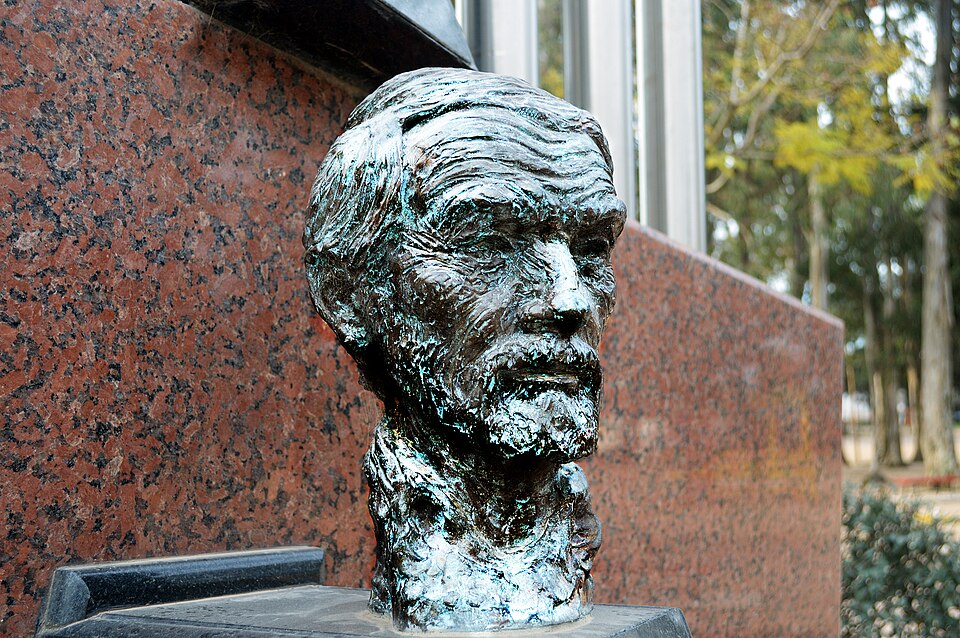
Raúl Sendic, founder of the Tupamaros and Uruguay's foremost revolutionary, who organised sugar cane workers, built Latin America's most sophisticated urban guerrilla movement, and spent thirteen years in brutal prison conditions before returning to political life.
Uruguay · Latin America

Raúl Sendic

Raúl Sendic Antonaccio was born in 1925 in Chamizo, in the department of Flores in rural Uruguay, and died in Paris in 1989, his health destroyed by thirteen years of imprisonment under conditions that the Inter-American Commission on Human Rights subsequently described as torture. Between those two endpoints he lived one of the most consequential political lives in South American history: a law student turned sugar workers' organiser who concluded that the legal structures of Uruguayan democracy were insufficient to protect the working class from the structural violence of the state, and who founded in response the Movimiento de Liberación Nacional — Tupamaros — the urban guerrilla organisation that became the most sophisticated and, for a period, the most effective of its kind anywhere in the world. The Tupamaros robbed banks and distributed the money in poor neighbourhoods. They broke into government archives and published the evidence of official corruption. They kidnapped politicians and financiers and held them in a clandestine "People's Prison" while broadcasting interviews with them on the question of why Uruguay's wealth was so unequally distributed. They built an underground tunnel system beneath Montevideo that their enemies found almost incomprehensible. They were eventually broken by the military, their leadership imprisoned under conditions designed to produce psychological and physical destruction. Sendic himself spent years in solitary. He emerged in 1985 with his health gravely damaged and his commitment entirely intact, and continued to organise until his death four years later. The Frente Amplio that the Tupamaros eventually joined as a political party won the Uruguayan presidency in 2004, and José Mujica — another long-term Tupamaro prisoner — governed Uruguay from 2010 to 2015. The arc from Sendic's sugar workers to Mujica's presidency is one of the most remarkable in Latin American political history.

Uruguay Tupamaro Founder Sugar Workers' Organiser MNL-Tupamaros Leader Thirteen Years Imprisoned Frente Amplio

Born: 16 March 1925, Chamizo, Flores, Uruguay  |  Died: 28 April 1989, Paris, France — Law student; sugar workers' union organiser 1950s; MNL-Tupamaros founder c.1963; captured 1972; imprisoned 1972–85; released at democracy's restoration; continued political work; died of Parkinson's disease aggravated by torture

At a Glance

The Sugar Workers of the NorthSendic's political formation began not in the university seminar room but in the sugar cane fields of northern Uruguay, where he went in the late 1950s to organise the UTAA — the Union of Sugar Cane Workers of Artigas. The sugar cane workers of Artigas were among the most exploited agricultural labourers in a country that considered itself the Switzerland of South America: seasonal workers, many of them indigenous or of indigenous descent, living in conditions of poverty and insecurity that the Uruguayan welfare state — which functioned reasonably well for urban workers — had never reached. Sendic spent years building their union, marching with them to Montevideo, pressing their demands on a political system that was consistently responsive to urban middle-class concerns and consistently indifferent to the rural poor. The experience confirmed his emerging analysis: that the Uruguayan state was not the neutral arbiter between social classes that liberal democratic theory claimed, but an instrument of the propertied classes that would use its power to protect their interests against the organised demands of the poor.
The Founding of the TupamarosThe exact founding moment of the Tupamaros is contested, but the organisation that became the MNL coalesced around Sendic and a group of associates in the early 1960s, drawing together people from various strands of the Uruguayan left who had concluded that electoral politics was insufficient. The name — Tupamaros — was taken from Tupac Amaru II, the 18th-century Peruvian indigenous leader who led a massive revolt against Spanish colonialism and was executed in 1781. The choice of name was deliberate: it connected the urban revolutionary movement to an indigenous anti-colonial tradition, claimed a specifically Latin American rather than European revolutionary genealogy, and gestured toward the racial and class dimensions of the inequality the movement was fighting. The organisation that developed under this name became one of the most operationally innovative guerrilla movements in modern history.
The People's Prison and Political TheatreThe Tupamaros were distinguished from most contemporary guerrilla organisations by the sophistication of their political theatre — their understanding that the purpose of dramatic action was not primarily military but communicative. When they kidnapped a banker or a senior government official and held him in the "People's Prison" — an actual clandestine cell beneath Montevideo's streets — they were not primarily seeking ransom or prisoner exchanges (though they sought those too). They were creating a situation in which the captive could be made to answer, on tape, for the policies and practices that had produced Uruguayan inequality. The recordings were then broadcast, distributing the content of those answers to an audience that had never previously had access to what the powerful said when they were held accountable. It was a form of investigative journalism conducted at gunpoint, and it was extraordinarily effective at exposing the gap between Uruguay's self-image as a social democracy and the reality of how its economy actually worked.
Capture and the Long ImprisonmentSendic was captured in 1972, after years of evading the Uruguayan security forces, and imprisoned when the military took power in 1973. He and eight other Tupamaro leaders were held as hostages — the military explicitly threatened to kill them if guerrilla operations resumed — in conditions of extraordinary brutality: years in solitary confinement, denial of adequate food and medical care, physical abuse, and the systematic psychological destruction that prolonged isolation is designed to produce. The Inter-American Commission on Human Rights investigated the conditions of their imprisonment and documented what it found. Sendic developed the neurological disease — probably Parkinson's, possibly aggravated by the physical treatment he received — that would kill him four years after his release. He was imprisoned for thirteen years.
Release and the Democratic TransitionSendic was released in March 1985, as part of the amnesty that accompanied Uruguay's transition back to democratic government following the military's defeat in the 1980 plebiscite and the subsequent negotiated transition. He emerged into a Uruguay that had changed in important ways during his thirteen years in prison: the dictatorship had inflicted enormous economic and social damage, but it had also generated a more unified and politically sophisticated opposition than had existed before 1973. The Frente Amplio — the broad left coalition that the Tupamaros would eventually join as a legal political party — had been founded in 1971 and survived the dictatorship. Sendic participated in the political debates about how the Tupamaros should relate to the democratic transition, advocating for integration into the Frente Amplio rather than the resumption of armed activity, before his health deteriorated to the point where sustained political work became impossible.
Death and the Long ArcSendic died in Paris on 28 April 1989, where he had gone to seek medical treatment for the neurological disease that had made his daily functioning increasingly difficult. He was sixty-four years old. The official cause of death was the disease itself, but the disease had been substantially advanced by the treatment he received during his imprisonment, and it is accurate to say that the Uruguayan military dictatorship killed him on a delayed schedule. He died before seeing the Frente Amplio win the presidency in 2004, before seeing his former comrade José Mujica govern Uruguay from 2010 to 2015 and become, in his old age, one of the most admired political figures in the world. That arc — from the sugar cane fields of Artigas to the presidential palace of Montevideo — was the arc that Sendic's life had made possible, even if he did not live to see it completed.

The Switzerland of South America: A Myth That Had to Break

Uruguay in the mid-twentieth century was widely described as the Switzerland of South America — a small, stable, literate, welfare-state democracy that had pioneered social reforms that the rest of Latin America was still fighting for. There was truth in this description, and the truth was important: Uruguay had introduced universal suffrage, public education, labour rights, and welfare provision earlier and more thoroughly than almost any country in the region. The Batllista welfare state, built in the early twentieth century by President José Batlle y Ordóñez, was genuinely a social achievement that the Uruguayan working class and middle class had genuine reason to value and defend.

But the Switzerland comparison concealed as much as it revealed. The welfare state that functioned for the urban working class of Montevideo had never reached the agricultural workers of the north and east, the sugar cane cutters of Artigas, the seasonal labourers whose poverty was as grinding as anything in the continent. The economic model that funded the welfare state — based on cattle ranching and agricultural export — was going into crisis in the 1950s and 1960s, producing inflation, fiscal pressure, and the erosion of the middle-class living standards that the Batllista settlement had established. The political system that was supposed to manage these tensions was increasingly sclerotic, dominated by the two traditional parties — the Colorados and the Blancos — whose competition had structured Uruguayan politics for over a century and whose combined inability to address the structural economic crisis was generating both left-wing radicalisation and right-wing impatience. Sendic's conclusion that the system was insufficient was reached in this specific context, and it was not an unreasonable conclusion.

The Tupamaros: What They Were and What They Did

The Tupamaros combined, more successfully than most Latin American guerrilla organisations of the period, the military and the political dimensions of their project. Their operational security was remarkable: the underground tunnel system they constructed beneath Montevideo, the clandestine infrastructure of safe houses and medical facilities and communications networks, the counter-surveillance techniques they developed, all represented a level of organisational sophistication that distinguished them from the more improvised armed groups that proliferated across Latin America in the same period. When security forces raided what they believed to be the organisation's entire network, they would discover that they had captured only one layer of it, and that another layer was already operating.

Their political actions were calculated for maximum communicative effect. The 1969 raid on the town of Pando — in which Tupamaro columns briefly seized control of a small Uruguayan city to demonstrate the state's vulnerability — was a statement rather than a military objective. The repeated exposure of government corruption files — obtained by breaking into official buildings and photographing records — was journalism conducted by a guerrilla organisation but journalism nonetheless, reaching audiences that conventional investigative reporting had failed to reach. The "People's Prison" interviews with kidnapped officials produced confessions of a kind that courts and parliamentary committees had never been able to extract. For a period in the late 1960s and early 1970s, the Tupamaros were the most effective accountability mechanism operating in Uruguayan public life, which says as much about the failures of the legitimate institutions as it does about the guerrillas' capabilities.

The Hostage-Leaders: Thirteen Years

The military government that took power in Uruguay in 1973 understood that the Tupamaro leadership — most of whom were in prison by the time of the coup — represented a continuing symbolic threat even behind bars, and it responded to that threat with a strategy designed to break them psychologically and physically before eventually killing them if the strategy succeeded or releasing them as destroyed men if it did not. Sendic and eight other Tupamaro leaders were designated "rehenes" — hostages — and held under conditions that went systematically beyond ordinary imprisonment into the territory of deliberate torture by deprivation and isolation.

The conditions included years of solitary confinement in tiny cells, inadequate and deliberately poor-quality food, denial of medical care for the conditions that developed as a consequence of confinement, prohibition on books and writing materials for extended periods, psychological humiliation by guards, and the specific cruelty of allowing family visits only under conditions designed to be degrading rather than sustaining. The Inter-American Commission on Human Rights conducted an investigation and documented these conditions. The Uruguayan military government denied them. The international solidarity campaign that developed around the Tupamaro prisoners — particularly around Sendic and Mujica, whose cases were most prominently publicised — kept international pressure on the dictatorship through the darkest years and contributed to the political cost of continuing the imprisonment that eventually made release a better option than martyrdom.

From Guerrilla to Democratic Politician: The Transition

The question of how a guerrilla organisation should relate to a democratic transition after the dictatorship that had defeated it was removed is one that the Uruguayan left navigated with more sophistication than most. The Tupamaros could have resumed armed activity after the transition — they had the organisational heritage and the political motivation. They chose not to. Sendic's own position, developed in the last years of his imprisonment and the brief period of political activity after his release, was that the conditions that had made armed struggle seem necessary in the 1960s had changed, that the democratic transition offered real political space that the left should occupy, and that the Frente Amplio was the appropriate vehicle for doing so. This was not capitulation or the abandonment of the movement's goals — it was a revised strategic judgment about how those goals could be pursued in changed conditions.

The subsequent history vindicated the judgment. The Frente Amplio won the Uruguayan presidency in 2004 under Tabaré Vázquez. José Mujica — the Tupamaro who had spent fourteen years in even more brutal conditions of solitary confinement than Sendic, emerging to become first a senator and then a president whose personal lifestyle of radical simplicity made him an unlikely global icon — governed from 2010 to 2015 and implemented some of the most progressive social legislation in Uruguayan history: the legalisation of marijuana, same-sex marriage, abortion. The arc from the sugar cane workers of Artigas, whom Sendic had organised in the late 1950s, to these achievements was not straight — it ran through bank robberies and kidnappings and torture cells and democratic elections — but it was continuous. The commitment to changing the fundamental conditions of Uruguayan social life survived the transformation of its methods, and the transformation of its methods was itself a political achievement.

The Lawyer Who Gave Up the Law

There is something worth pausing on in the fact that Sendic was a law student when he began organising the sugar workers, and that what he found in the north of Uruguay converted him from someone who believed the law could be the instrument of social justice to someone who concluded it would not be. He was not naive about the law's limitations when he began — he was already on the political left, already reading the structural analyses that described Uruguayan politics as a system that protected elite interests under a democratic form. But there is a difference between reading the analysis and watching the law fail in the specific case of the sugar workers of Artigas, whose poverty was legal, whose exploitation was legal, whose exclusion from the welfare state that other Uruguayan workers enjoyed was entirely within the law. The law was not failing them by accident or corruption — it was working exactly as designed, protecting the property rights of the landowners and leaving the workers with the market outcome that the property structure produced.

The decision to found an armed organisation was therefore not, for Sendic, primarily a tactical choice about which method was most effective at achieving political goals. It was a conclusion about the nature of the system he was trying to change: that it would not yield to the methods it formally permitted, that its formal permissions were themselves part of the mechanism by which it reproduced itself, and that changing it required a different kind of pressure. That conclusion may or may not have been correct — the subsequent history, in which the Frente Amplio achieved real change through electoral politics, suggests it was at least partly wrong. But it was a serious conclusion, reached after serious engagement with the evidence, and it deserves to be understood as such rather than dismissed as the romanticism of people who had read too much Che Guevara.

Also Profiled — Brazil, Argentina, Chile & Uruguay

Southern Cone Andrés Pascal Allende MIR leader and Salvador Allende's nephew; post-coup resistance architect Southern Cone Bautista van Schouwen MIR physician; disappeared by Pinochet's DINA December 1973 Southern Cone Carlos Marighella Afro-Brazilian communist; MR-8 founder; Minimanual of the Urban Guerrilla Southern Cone Eva Perón Evita — First Lady; women's suffrage 1947; welfare state; body stolen by military Southern Cone Haydée Tamara Bunke Tania la Guerrillera — killed at Vado del Yeso alongside Guevara's column 1967 Southern Cone Luciano Cruz MIR co-founder; died in accident 1971 aged 28, two years before the coup Southern Cone Luís Carlos Prestes Knight of Hope — Prestes Column; PCB leader; 9 years in prison; Olga deported to Nazis Southern Cone María Esther Gatti Uruguayan human rights activist; 38 years searching for disappeared granddaughter Southern Cone Miguel Enríquez MIR secretary-general; refused exile; killed by DINA October 1974 aged 30 Southern Cone Salvador Allende Chile's socialist president; died defending La Moneda in Pinochet's 1973 coup Southern Cone Víctor Jara Chilean folk singer; hands broken, then shot in Chile Stadium after the coup
Share X Facebook WhatsApp LinkedIn