At a Glance
The Kaguvi Spirit and the World Kaguvi Was Born Into
Gumboreshumba grew up in the Hartley District of Mashonaland in the 1860s and 1870s — the period when the Shona communities of the central plateau were living in the last decades of the pre-colonial political order, before the Portuguese incursions from the east, before the Ndebele raids from the south-west, and before the BSA Company occupation that would end the political autonomy of both the Shona and the Ndebele peoples in the 1890s. The world of his childhood was not a world without conflict — the Shona communities of Mashonaland experienced the pressures of their regional neighbours throughout the nineteenth century — but it was a world in which the spiritual and political frameworks that the mhondoro tradition embodied were genuinely operative, in which the authority of the spirit mediums was the authority to which communities turned for guidance in crises of governance, drought, disease, and conflict.
He received the Kaguvi spirit in adulthood and was confirmed as its medium through the community validation process that Shona spiritual practice required. The Kaguvi mhondoro — a male ancestral spirit of the central plateau — was understood to be the guardian of the communities under its protection, with the specific responsibility of maintaining the relationship between the land, its spiritual owners, and the living people whose wellbeing depended on that relationship being properly maintained. The medium who housed this spirit was not simply a religious figure in the way that term is understood in Western Christian tradition; he was a political authority, a judicial figure, an intermediary between the living and the dead, and ultimately the voice through which one of the land's foundational spiritual owners spoke to the community it had created and sustained.
By the time the BSA Company's occupation began in 1890, Kaguvi was an established medium of recognised authority in the central Mashonaland region. The occupation — with its systematic land alienation, its hut tax, its forced labour, and its destruction of the political structures that had organised Shona community life — was an assault not just on the material welfare of the communities under his protection but on the spiritual order that his authority was constituted to defend. The uprising that he co-led with Nehanda in 1896 was, from the perspective of the Shona spiritual framework, not a political rebellion against an established government but the defence of a sacred order against an intrusion that had no spiritual legitimacy and no right to the land it was occupying.
The First Chimurenga: Kaguvi as Military Organiser
The distinction between Kaguvi's role in the First Chimurenga and Nehanda's is one that the historical literature has established with reasonable clarity: where Nehanda provided the uprising with its primary spiritual authority and its political legitimation — the voice of the most powerful female mhondoro speaking the spirit world's endorsement of the resistance — Kaguvi was more directly involved in the practical military organisation of the uprising's operations. He coordinated attacks, maintained communications between the uprising's different geographic nodes, and provided the tactical command that the resistance needed if it was going to impose genuine costs on the BSA Company's forces rather than simply expressing symbolic defiance.
The Shona uprising began in June 1896, following the Ndebele uprising of March 1896 in Matabeleland — the two risings distinct in their organisation and their specific grievances but connected by the shared experience of BSA Company occupation and by the spirit mediums' role in legitimising both. In the Mashonaland area, the uprising was concentrated in the Mazoe and Hartley districts — Nehanda's and Kaguvi's respective territories — and its most intense phase involved coordinated attacks on settler farms and mining operations that drove many settlers out of the countryside and into the fortified laagers of the towns.
Kaguvi's operations in the Hartley area were among the most sustained and most militarily effective of the Shona uprising's regional campaigns. He organised and directed attacks that destroyed farms, killed settlers, and demonstrated that the BSA Company's grip on the countryside was far less secure than the administration had claimed. The tactics were those of guerrilla warfare — ambushes, hit-and-run attacks, the use of terrain knowledge that the local fighters possessed and the BSA Company's forces did not — and they were conducted with a discipline and a strategic coherence that reflected Kaguvi's practical military intelligence as well as the spiritual authority that gave the fighters their motivation and their confidence.
He maintained communication with Nehanda throughout the uprising's most active phase, coordinating between the different regional commands and ensuring that the uprising's spiritual and military dimensions remained integrated. The BSA Company's forces, reinforced from the Cape Colony and eventually numbering in the thousands, gradually suppressed the uprising through a combination of military operations and the deliberate destruction of the food supplies and community structures that sustained the resistance. By late 1897, Kaguvi was operating with severely reduced resources and a narrowing operational space, evading the pursuing forces while attempting to maintain what remained of the resistance.
Capture, Trial, and the Faith of a Condemned Man
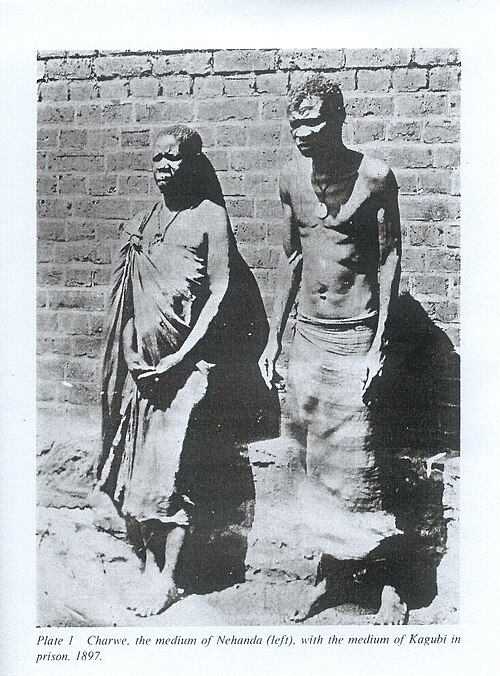
Kaguvi was captured in late 1897, several months after the uprising's most intensive phase had been broken by the BSA Company's military campaign. The manner and circumstances of his capture — whether through military operation, betrayal, or exhaustion of the resources needed to continue evading pursuit — are not consistently documented in the sources available. What is documented is that he was brought to Salisbury, held in colonial detention, tried before the colonial courts, and sentenced to death alongside Nehanda.
In the period between his capture and his execution — the weeks in which the Catholic missionaries attended him in his cell — Kaguvi converted to Christianity. He received Catholic baptism and took the name Dismas, after the penitent thief in the Gospel account of the crucifixion who expressed contrition for his crimes and was promised paradise. The choice of name was the missionaries', or was made in consultation with them, but it carried a specific meaning: Dismas is the figure who dies alongside the person he had wronged the world alongside, who acknowledges his wrongdoing in his final moments, and who receives the promise of redemption.
The conversion has generated more historical and cultural commentary than almost any other single act in the history of Zimbabwe's liberation struggle, because it stands in such direct contrast to Nehanda's absolute refusal. The explanations offered by historians range from the genuinely spiritual — that the crisis of facing death, in a context where the Shona spiritual framework had demonstrably failed to protect the uprising from defeat, created an opening for the Christian message that the missionaries' pastoral care was able to fill — to the pragmatic and psychological: that a man facing death might accept comfort from whatever source offered it, regardless of the metaphysical commitments that comfort required. None of these explanations is obviously correct, and the most honest position is that we cannot know what Kaguvi experienced in those final weeks with sufficient certainty to characterise it definitively.
The Gallows, the Contrast, and What Both Deaths Mean
Kaguvi and Nehanda were hanged on the same morning — 27 April 1898 — in the public gallows of colonial Salisbury. The execution was a public event, witnessed by settlers and by any Africans present in the capital, and it was intended as a demonstration of the finality of the BSA Company's suppression of the uprising: the spiritual leaders who had given the resistance its authority were dead, the authority was extinguished, and the occupation would continue on its own terms.
The colonial government's calculation was wrong in the specific way that colonial calculations about African spiritual life consistently were: they assumed that the death of a medium ended the spirit's involvement in the world, when the Shona spiritual framework held precisely the opposite — that the spirit was not contained in the medium's body and would survive the medium's death to find new vessels and to continue its work. Nehanda's prophecy — "my bones will rise again" — was the explicit statement of this understanding, and it proved accurate in the sense that the spirit of resistance the uprising had embodied did, across the following eight decades, find new vessels and new forms and eventually produce the liberation that both Kaguvi and Nehanda had died trying to achieve.
Kaguvi's conversion means that he did not make the same dramatic final statement that Nehanda made. He died within the Christian framework he had accepted, expressing a contrition whose specific content the historical record does not fully document. The contrast between the two — the defiant Nehanda, refusing conversion, prophesying resurrection; the repentant Kaguvi, accepting Christianity, dying within its consolations — has shaped their respective places in Zimbabwe's liberation mythology in ways that are understandable and in other ways incomplete.
Legacy: The Warrior Who Deserves His Own Complete Accounting
Sekuru Kaguvi deserves to be assessed on the full record of his life rather than on the single dramatic contrast of his final act with Nehanda's. The uprising he co-led was one of the most serious armed challenges to the BSA Company's occupation that the colonial period produced. The military operations he organised and directed imposed real costs on the settler community and demonstrated the fragility of the colonial government's claim to have pacified Mashonaland. The spiritual authority he brought to the uprising gave it a legitimacy and a durability that purely military organisation could not have sustained for the year and a half it lasted against vastly superior firepower.
His conversion at the point of death is part of his story — an authentic part, not one to be explained away or dismissed — but it is not the whole of his story, and the whole is considerably larger and more significant than the part by which he is most often remembered. He was thirty-eight years old when he was hanged. He had spent two years actively resisting one of the most heavily armed colonial occupations in southern African history, using the tools available to him — spiritual authority, community networks, tactical intelligence, and personal courage — with an effectiveness that his opponents grudgingly acknowledged and his subsequent historical treatment has insufficiently honoured.
Zimbabwe placed his image on its currency alongside Nehanda's in the years after independence — a recognition that his contribution to the First Chimurenga warranted inclusion in the founding mythology of the independent state. The Harare statue unveiled in 2021 included both Nehanda and Kaguvi, placing them side by side on the plinth as they had stood together in their resistance and together on the gallows where their resistance ended. That pairing is the correct historical representation: the First Chimurenga was their joint work, its spiritual authority derived from both of them, and the independent Zimbabwe that their sacrifice helped make possible owes both of them the full accounting that honest history requires.