At a Glance
Manicaland, Mission Schools, and the Formation of a Pioneer
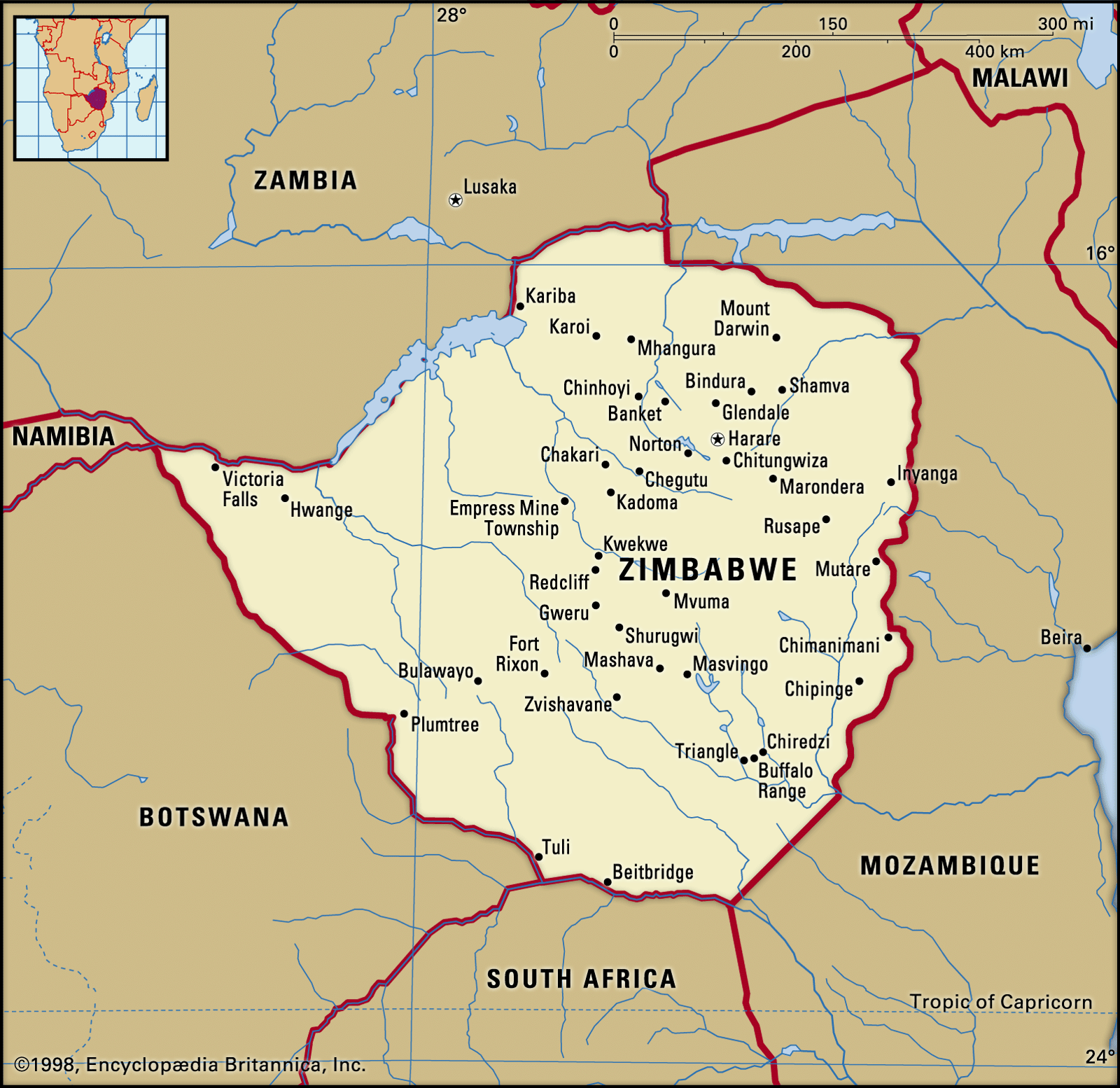
Herbert Chitepo was born in the Mutasa District of Manicaland — the Eastern Highlands country whose forested mountains and dramatic escarpments form the border between Zimbabwe and Mozambique. It is some of the most beautiful landscape in southern Africa, and some of the most politically charged: the Eastern Highlands had been among the first regions to experience the land alienation that drove African communities off their agricultural land and into the reserve system, and the proximity of Mozambique — where FRELIMO's liberation struggle would eventually create the secure external base that ZANLA needed — gave the region a strategic importance in the liberation war that Chitepo would come to understand with particular intimacy.
He attended mission schools in the region — Waddilove Mission school and then St Augustine's at Penhalonga — and distinguished himself academically with a consistency that made the path to Fort Hare University a natural progression. At Fort Hare, he encountered the same pan-African intellectual community that had formed Nelson Mandela, Oliver Tambo, Julius Nyerere, and the generation of southern and eastern African leaders whose careers would define the continent's decolonisation. The connections forged in that community, and the tradition of serious African intellectual engagement that Fort Hare embodied, shaped his understanding of the liberation cause in a continental frame that extended well beyond the borders of Southern Rhodesia.
From Fort Hare he went to London and Lincoln's Inn — the training that produced the qualification of barrister-at-law. His time in London placed him among the generation of African nationalists studying in Britain who were simultaneously building their professional qualifications and deepening their political commitments. The connections between the African independence movements and the communities of African students in London in the late 1940s and early 1950s were dense and consequential, and Chitepo moved easily in those circles. He was called to the Bar and returned to Southern Rhodesia as the first person of African descent from that colony to hold the qualification — a fact whose political significance in the context of a legal system built on racial exclusion was not lost on anyone present.
At the Rhodesian Bar: Law as Living Resistance
Practising as a barrister in Southern Rhodesia in the early 1950s meant operating within a legal system that was, in its fundamental structure, an instrument of racial domination — one in which the ostensible principles of British common law coexisted with a comprehensive apparatus of racial legislation that denied those principles to anyone who was not white. The Land Apportionment Act, the pass laws, the colour bar in employment and accommodation, the restriction of African political activity — all of these were maintained by legal mechanisms that a trained lawyer could see through with complete clarity, which made the clarity all the more enraging.
Chitepo's presence at the Rhodesian bar was a challenge to the racial logic of the system he was working within. His very existence as an African advocate of the highest professional qualification contradicted the foundational premise of Rhodesian racial ideology, which held that African people were not capable of the intellectual and professional achievements that the colour bar was supposedly designed to protect. He used his legal position in defence of African clients and in the service of the political causes he believed in, building a reputation for technical excellence and absolute professional integrity that his colleagues — across the racial lines of Rhodesian professional life — consistently acknowledged.
He also practised, for a period, as a barrister in Tanganyika (now Tanzania) — broadening his legal experience and his connections across the liberation movements of eastern Africa at a moment when Tanganyika's independence under Julius Nyerere was making it an important node in the network of support for southern African liberation. This period outside Southern Rhodesia deepened his pan-African connections and reinforced his understanding of the Zimbabwean struggle as part of a continental project rather than an isolated national dispute.
ZANU, Exile in Zambia, and the Direction of Armed Struggle
When the logic of colonial intransigence made armed struggle the only remaining avenue for liberation, Chitepo committed himself fully to that path and eventually went into exile — first to Tanzania and then to Zambia, which became ZANU's principal external base after Kenneth Kaunda's government extended sanctuary to the movement. In Lusaka he built the external infrastructure that prosecuting the armed struggle required: the offices, the communications networks, the relationships with the Zambian government and with international supporters, the logistical chains that moved personnel and materiel to the operational areas inside Rhodesia.
He served as ZANU's national chairman and as the head of the Dare reChimurenga — the war council that directed military operations. This dual role required him to manage simultaneously the political work of maintaining ZANU's external relationships and the military work of directing ZANLA's operations inside the country — a combination of demands that would have exhausted a less disciplined intelligence. His combination of strategic insight, political authority, and personal integrity made him the most effective overall director of ZANU's liberation war effort, and the escalation of ZANLA's operations through the early 1970s — the expansion into the north-eastern operational areas, the development of the guerrilla networks that would sustain the war through its most intense phase — reflected his strategic direction.
The internal tensions within ZANU during this period were real and often violent. The Nhari rebellion of late 1974 — an uprising within ZANLA by a faction that challenged the external leadership's authority over the military command — was suppressed with considerable force, and the tensions it expressed and created left marks on the movement's internal politics that persisted into the months immediately before Chitepo's assassination. These internal conflicts would later be cited as potential motives for the killing, complicating the attribution of responsibility in ways that have never been fully resolved.
The Car Bomb: An Assassination Without Closure
On the morning of Monday 18 March 1975, Herbert Chitepo walked from his home in the Riverside suburb of Lusaka to his Volkswagen. The car bomb detonated. He died at the scene. His wife Victoria, who was nearby, was critically injured and survived. He was fifty-one years old and at the peak of his strategic effectiveness — the man directing a military campaign that was, for the first time in the liberation war's history, producing results that the Rhodesian state genuinely feared.
The Zambian government's response was swift and in some respects counterproductive. It arrested the entire leadership of ZANU's external structure — including figures who would later become central to the movement's eventual victory, among them Josiah Tongogara — and held them for extended periods while investigating the assassination. Several ZANU members were tried and convicted. The investigation focused heavily on internal ZANU factional violence and on the Nhari rebellion's aftermath as the probable source of the conspiracy.
The problem with this framing is its incompleteness. The Rhodesian Central Intelligence Organisation was the most powerful intelligence service operating in the region, had extensive networks in Zambia, had both the technical capability to construct and plant sophisticated explosive devices and the overwhelming strategic motive to eliminate ZANU's most effective commander. The South African security services, which maintained extensive covert operations across the region and had their own complex interests in the outcome of the Zimbabwean liberation struggle, cannot be excluded from the analysis. The international commission of inquiry established after the assassination reached conclusions that pointed toward Rhodesian involvement, while acknowledging the limits of what could be definitively established.
Fifty years later, the truth remains contested and incompletely established. Zimbabwe has never conducted the kind of comprehensive official investigation that the killing demands — the political complexities of doing so, given the involvement of ZANU figures in various accounts of the assassination, have made such an investigation persistently inconvenient for those who control the state. The mystery remains, and so does the injustice of an unsolved political murder that robbed Zimbabwe of one of the most gifted people the country has ever produced.
The Shona Poet: A Humanity Beyond Politics
Herbert Chitepo wrote poetry in the Shona language — a fact that the conventional political biography tends to mention briefly and move past, but which deserves more attention than it usually receives. His poem Soko Risina Musoro is considered a significant work in the Zimbabwean literary tradition — a narrative poem that draws on the resources of the Shona oral tradition while bringing to it the formal literary consciousness of a man whose education had exposed him to the possibilities of written poetic form in two cultural traditions simultaneously.
The poem's existence tells us something important about Chitepo that the political record alone cannot: that he understood the liberation struggle as a cultural project as much as a political and military one — that what was being liberated was not merely territory or political sovereignty but a people's relationship to their own language, their own stories, their own ways of making meaning. A man who writes poetry in the language of the people he is fighting to liberate has understood something about what liberation is for that not all liberation leaders grasp, and the Shona literary tradition is richer for his contribution to it.
Legacy: What Was Lost, and What Endures
Herbert Chitepo's death created a vacancy in the Zimbabwean liberation movement's leadership that the subsequent years demonstrated could not be adequately filled. The internal conflicts within ZANU that followed his assassination, the detention of the external leadership by the Zambian government, the Frontline States' intervention to restructure ZANU's command, the eventual emergence of Robert Mugabe as the dominant figure — all of these unfolded in the shadow of the loss of a man whose combination of legal brilliance, strategic vision, and personal authority had kept the movement's internal tensions manageable while directing its external military operations with increasing effectiveness.
What Zimbabwe would have looked like with Chitepo alive to the independence negotiations and to the construction of the post-independence state is one of those historical counterfactuals that cannot be answered but refuses to be dismissed. He was a man who understood both the content of liberation and the legal and institutional forms in which that content needs to be embedded to be durable. His legal formation gave him tools that most of the liberation movement's military commanders lacked, and his political authority gave him the ability to use those tools in ways that would have mattered enormously in the complex negotiations of the late 1970s and the state-building of the early 1980s. The Zimbabwe that emerged from those years was built on foundations whose chief architect was killed before he could complete the work.
He is remembered in Zimbabwe through institutions and places that carry his name, and he is remembered in the Shona literary tradition through the poem that outlives the strategist. Both forms of memory are appropriate and both are insufficient. The most complete memory would be the honest accounting of his assassination that his country has never delivered — and the recognition that among all those who gave their lives for Zimbabwe's liberation, this particular death, at this particular moment, at the hands of forces that have never been fully identified and held accountable, represents one of the deepest unresolved obligations in the country's history.