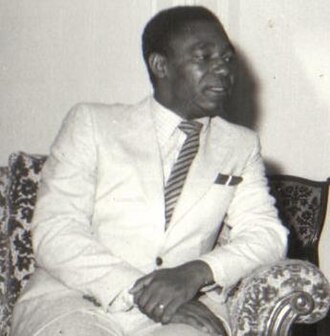
At a Glance
Nyanga, Mission Education, and the Radicalisation of a Young Nationalist
Edgar Tekere was born and raised in the Nyanga District — the rolling highlands of Manicaland that form Zimbabwe's eastern border with Mozambique — a landscape whose physical grandeur sat in sharp contrast with the material conditions of African life under Rhodesian colonial rule. The Nyanga area had been heavily affected by the land alienation policies that drove African communities off their ancestral land and into the labour pool that the settler economy required; the evidence of dispossession was visible in the landscape of reserves and European farms that the young Tekere grew up navigating.
He attended mission schools and displayed the combination of academic aptitude and argumentative temperament that made him a natural candidate for political leadership once the conditions of the late 1950s and early 1960s created the opportunity for mass nationalist mobilisation. The National Democratic Party of 1960 and ZAPU of 1961 represented the first serious attempt to build an African nationalist movement in Zimbabwe capable of challenging settler rule, and Tekere — in his early twenties and already politically alert — moved naturally into the orbit of the emerging movement.
When ZAPU split in 1963 and ZANU was formed, Tekere was among those who aligned with the new organisation. The split was painful and in some respects never fully healed — the rivalry between ZAPU and ZANU would define Zimbabwean nationalist politics for the next two decades and leave wounds that shaped the post-independence political landscape in ways that are still visible. But Tekere threw himself into ZANU with the total commitment that characterised everything he did, and the organisation's more militant political direction suited both his temperament and his analysis of what the liberation of Zimbabwe required.
Detention, the Liberation War, and the Flight with Mugabe
Like most of the significant figures in Zimbabwe's nationalist movement, Tekere spent time in Rhodesian detention — periods of imprisonment that were intended to neutralise political leadership but which often intensified the political commitments of those imprisoned and produced networks of solidarity that outlasted the conditions that had created them. He was detained at various points during the 1960s as the Smith regime tightened its repression of nationalist activity, and he emerged from these experiences with his commitments sharpened rather than broken.
The most significant episode of his liberation-war career came in 1975, when Robert Mugabe was released from detention and Tekere was among the small group that accompanied him on the dangerous journey through Mozambique to take command of the liberation war from outside Rhodesia's borders. This was not a comfortable administrative manoeuvre — it involved crossing hostile territory, evading Rhodesian security forces whose interest in eliminating ZANU's leadership was active and well-resourced, and establishing functioning command structures in the most difficult circumstances. Tekere played a central role in this operation, and the experience bonded him to Mugabe in a way that would take years to fully unravel.
From Mozambique, Tekere worked to build the organisational and military infrastructure that ZANLA — ZANU's armed wing — needed to carry the war into Rhodesia with increasing effectiveness. He was a political organiser as much as a military commander — his strength lay in building commitment, in communicating the movement's goals, in the kind of direct and forceful engagement with cadres and supporters that his personality made natural. The Eastern Highlands region where he had grown up became one of ZANLA's most important operational areas, and his knowledge of the terrain and the communities there was an asset that the movement used throughout the war's later stages.
Independence, the Killing of Adams, and the Beginning of the Break
Zimbabwe achieved independence in April 1980, and Edgar Tekere became one of the most powerful figures in the new state. He served as ZANU-PF's secretary-general and as a minister in Mugabe's first cabinet, occupying a position at the very centre of the new government. He had fought for this moment for two decades, had risked his life for it, had sacrificed years of freedom for it. The independent Zimbabwe that now existed was not exactly what any of the liberation movement's more idealistic visions had promised, but it was real and it was theirs, and the task now was to build it.
What happened in August 1980 — the killing of Gerald Adams, a white farm manager, by members of Tekere's personal security detail — was the incident that broke his trajectory in the new state. The precise circumstances of the killing have been disputed and the legal proceedings that followed turned on the specifics of the indemnity legislation under which Tekere was charged and eventually acquitted. But the political meaning of the episode was clear enough: a senior minister in the new government had been involved in the death of a white Zimbabwean at a moment when the government was trying to build confidence among the white community that Zimbabwe's transition would be orderly and safe. Mugabe removed him from the cabinet.
The removal was the beginning of a political estrangement that would take almost a decade to produce its final rupture. Tekere remained within ZANU-PF's structures for most of the 1980s, but his relationship with Mugabe deteriorated steadily. He became increasingly critical of the direction the government was taking — the corruption he saw developing, the authoritarianism that was hardening, the distance between the liberation movement's stated ideals and the realities of post-independence governance. He was a man who found it constitutionally impossible to stay silent when he believed something important was being betrayed.
The Zimbabwe Unity Movement: First Voice of Internal Opposition
When Tekere founded the Zimbabwe Unity Movement in 1989, he did something that no one within the liberation movement's inner circle had previously done: he organised an explicit political challenge to ZANU-PF and to Robert Mugabe from within the tradition of Zimbabwean nationalism itself. This was not the same as the existing ZAPU-derived opposition, which had always been characterised by ZANU-PF as representing an ethnic or regional interest rather than a national political alternative. Tekere's challenge came from inside ZANU's own founding generation — from a man whose liberation credentials were beyond dispute — and it asked questions about ZANU-PF's governance that the party's origins made it particularly difficult to dismiss as counter-revolutionary.
The 1990 election in which Tekere stood as ZUM's presidential candidate was not free or fair by any rigorous standard. The resources of the state were deployed in Mugabe's favour; the media was overwhelmingly controlled; the intimidation of ZUM supporters and candidates was real and documented. In this context, the seventeen percent of the vote that Tekere received represented not just a personal achievement but evidence of a substantial constituency that was prepared to vote against Mugabe even under those conditions. It was a crack in what the government had been trying to present as a seamless national consensus.
ZUM did not survive as a significant force. The pressures it faced were too great, and Tekere's own personality — brilliant and brave but also volatile and prone to the kind of spectacular public eruptions that made sustained organisational building difficult — contributed to its decline. But it had established a precedent: that internal opposition to Mugabe from within the nationalist tradition was possible, that it could attract meaningful support, and that the aura of liberation credentials that Mugabe claimed to possess exclusively was in fact contested ground.
Later Years, the Memoir, and a Legacy of Uncomfortable Truths
Edgar Tekere spent the last two decades of his life politically marginalised — outside the structures of power, without the resources that office provides, watching the country he had fought to liberate deteriorate under the governance of the man he had once followed into the most dangerous operations of the liberation war. He wrote a memoir, A Lifetime of Struggle, that recorded his version of events with a directness that the official historiography of the liberation struggle carefully avoids. The memoir's account of the internal conflicts within ZANU, of the personal dynamics between the movement's leaders, and of the decisions that shaped the liberation war is valuable precisely because it comes from someone who was present and who, unlike most survivors, had no remaining political interest in softening what he remembered.
He remained a figure of genuine moral authority in Zimbabwe even in his marginalisation — not because he was without fault or contradiction, but because he had done something that few people in similar positions have done: he had seen his movement go wrong, had said so publicly, had paid the price for saying it, and had not recanted. In a political culture defined by the accommodation of power and the silence of those who know better, that is a form of courage that outlasts the specific positions it defends.
He died in June 2011, having seen the long economic collapse of Zimbabwe's farms and cities, the hyperinflation that destroyed ordinary people's savings, the political violence that made each election cycle a campaign of terror. The Zimbabwe he had fought for — non-racial, economically just, politically free — had not been built. Whether it ever will be is a question that belongs to the generations that come after him. What belongs to him is the fact that he fought for it, and that when it began to be betrayed, he was among the first to say so.