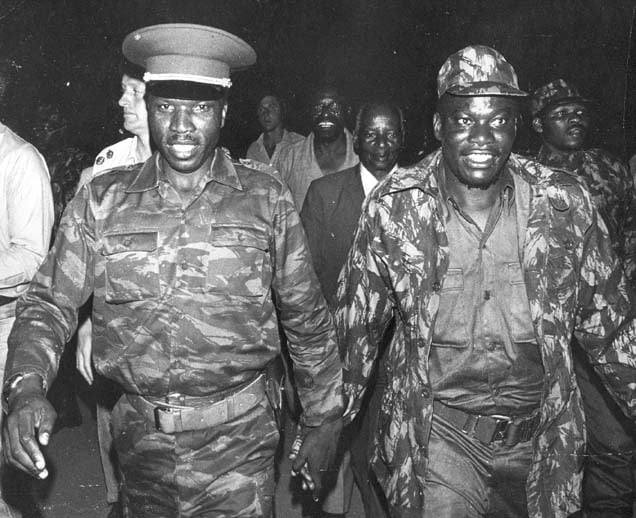
At a Glance
Matabeleland, Soviet Training, and the Making of a Professional Soldier
Lookout Masuku grew up in Matabeleland in the 1940s and 1950s, in the Ndebele-speaking communities of the south-west that carried the historical memory of conquest and dispossession with a particularity and a vividness that communities farther from the original events sometimes lost. The 1893 conquest of the Ndebele kingdom by the British South Africa Company's forces, the 1896 uprising and its brutal suppression, the land alienation that followed and that stripped Ndebele communities of their agricultural heartland — these were not distant historical facts in the communities of Masuku's childhood. They were family stories, the memories of grandparents, the explanation for the landscape of dispossession that surrounded the reserves to which African families had been confined.
He came to the liberation movement through the path that the conditions of his time and place made available — through the nationalist politics of the early 1960s, through the commitment to the armed struggle that ZAPU's development of ZIPRA represented, and through the decision to undergo the military training that would make him useful to the liberation campaign in the most direct possible way. He was sent to the Soviet Union, where the professional military education that ZIPRA was building its entire character around was available from trainers whose experience of conventional and unconventional warfare was extensive and whose commitment to the liberation movements of southern Africa — as aligned forces in the Cold War's southern African theatre — gave their training a political as well as a professional dimension.
The Soviet training transformed Masuku from a committed nationalist into a professional military officer — someone who understood not just the political case for liberation but the technical requirements of military organisation, command, logistics, and strategy that the actual prosecution of a liberation war demands. He returned to ZIPRA's structures with the combination of political commitment and military competence that the organisation needed in its command positions, and he rose through those structures with the consistency of a man whose abilities were matched by his dedication.
Operational Command: ZIPRA's General in the Field
As ZIPRA's deputy commander in the liberation war's most intense phase, Masuku carried the operational responsibilities that Jason Moyo's assassination in January 1977 had concentrated in his hands. The departure of Moyo — who had been the most operationally experienced figure in ZAPU's military leadership — placed extraordinary demands on those who remained, and Masuku's capacity to manage those demands was the test that determined whether ZIPRA could maintain its effectiveness through the war's final and most critical period.
He managed it. The years between Moyo's death and the Lancaster House ceasefire of December 1979 were years of intensifying ZIPRA operations inside Zimbabwe — years in which the organisation's training in Zambia and Angola was producing a steady flow of fighters for deployment, in which the weapons and equipment supplied through the Soviet connection were giving ZIPRA capabilities that the Rhodesian security forces were increasingly struggling to counter, and in which the political conditions in southern Africa — the independence of Mozambique, the growing isolation of the Rhodesian regime — were creating a strategic environment that favoured the liberation movement's continued pressure.
Masuku's command of these operations required him to manage simultaneously the training pipelines, the infiltration routes, the intelligence networks, the command structures of fighters deployed inside Zimbabwe, and the political relationships with the Zambian and other governments whose support ZIPRA's external infrastructure depended on. He did this with the professional thoroughness and the personal authority that the role required. By the time of Lancaster House, ZIPRA was a genuinely formidable military force — not the equal of the Rhodesian security forces in every technical dimension, but capable of imposing costs on those forces that made the war's continuation untenable for the Rhodesian government.
Independence, Arrest, and the Perversion of Justice
When Zimbabwe became independent in April 1980, Lookout Masuku had a legitimate expectation of integration into the new Zimbabwe National Army at a senior command level that reflected both his rank within ZIPRA and his record of effective military leadership during the liberation war. The integration of ZANLA, ZIPRA, and the Rhodesian security forces into a unified national army was one of the most significant challenges of the post-independence period, and doing it well required the participation of the most experienced and respected commanders that each of the merging forces could provide.
Masuku was arrested in February 1982. The arrest was part of the same operation that detained Dumiso Dabengwa — the government's use of the arms cache discoveries on ZAPU-associated farms as the basis for treason charges against ZIPRA's leadership. The charges were serious: treason, in the political climate of the early 1980s, was not a procedural matter. It was an accusation that carried the possibility of the death penalty and that, in a political environment where the government controlled the prosecutorial machinery and where the courts were under pressure, was not obviously going to be resolved by the evidence.
It was resolved by the evidence. The High Court acquitted Masuku and Dabengwa. The charges were found to be unsubstantiated. The legal process produced the outcome that the legal process is supposed to produce when the evidence does not support the charges: acquittal. In a state governed by the rule of law, acquittal would have been followed by release. In Zimbabwe in 1982, it was followed by re-detention under emergency regulations — the legal instrument that allowed the government to hold people without charge, without trial, and without the constraint of the evidentiary requirements that the court had just found the government could not meet.
Re-Detention, Illness, and the Calculated End
The emergency regulations under which Masuku was re-detained after his acquittal were the same regulations that the Smith regime had used to hold nationalist leaders for years — a legal instrument that the liberation movement had condemned as a tool of political oppression when it was used against them, and that the post-independence government now deployed against the very people who had fought to end it. The irony was noted at the time by those who were paying attention, and it has been noted repeatedly in the subsequent historical literature. It did not change the outcome.
Masuku's health deteriorated during his continued imprisonment. He had a brain tumour — a condition that requires specialist medical treatment and that, left untreated or inadequately treated, follows a predictable and terminal course. The accounts of his final years in custody consistently describe delays in the provision of adequate medical care, deteriorating physical condition, and the progressive narrowing of the window within which effective treatment might have been possible.
He died on 5 April 1986. He had been in custody for four years. He had been acquitted by the courts. He had never been re-tried or re-charged. He had simply been held until the tumour that the conditions of his imprisonment had allowed to progress unchecked had completed its work. He was forty-five years old. He had fought a liberation war, had commanded thousands of fighters, had helped bring an independent Zimbabwe into existence, and had been killed by that Zimbabwe in the most legally grotesque way available to a government that had already failed to convict him of anything.
Legacy: The General Zimbabwe Used and Discarded
Lookout Masuku's story is one of the most direct illustrations available of what the post-independence Zimbabwean state did to the people of Matabeleland and to the liberation movement's ZAPU-aligned figures in the years following independence. It is not an abstract story of political marginalisation or institutional discrimination. It is a specific account of a specific man who was arrested on fabricated charges, acquitted, held anyway, denied adequate medical care, and left to die in custody — all within five years of the independence his fighting had helped create.
He is remembered in Matabeleland with the grief and the anger that his story deserves. His name is among those that the communities of the south-west invoke when they speak of what Gukurahundi took from them — not only the twenty thousand civilians killed in the massacres but the military and political leadership whose imprisonment and death removed from Ndebele community life the people best positioned to protect it.
The Zimbabwe that Masuku fought for — non-racial, democratic, governed by law — did not materialise. What materialised instead was a state that used the legal system to persecute him, used emergency regulations to hold him when the legal system failed to convict him, and used the conditions of imprisonment to kill him when the emergency regulations alone were insufficient. That is the Zimbabwe his memory indicts. The accounting it requires remains, nearly four decades after his death, substantially undelivered.