At a Glance
The Shona Spiritual World and the Authority of the Mhondoro
To understand Nehanda Charwe Nyakasikana's significance — both in her own time and in the century of liberation struggle that followed her execution — requires understanding the Shona spiritual framework within which she lived, acted, and died. The Shona religion centred on the belief that the spirits of important ancestors — the mhondoro, the lion spirits of great chiefs and founders — remained active in the world after physical death, continuing to concern themselves with the welfare of the people and the land with which they had been associated in life. These spirits communicated with the living through mediums — people whom the spirit chose and possessed, speaking through them to offer guidance, adjudicate disputes, intercede with the creator spirit Mwari, and assert the land's spiritual sovereignty against those who threatened it.
The Nehanda spirit was among the most powerful and most ancient of these mhondoro. Associated with the Mazoe Valley and the broader Mashonaland plateau, the Nehanda spirit was understood as a female guardian of particular authority — one of the founding ancestors whose connection to the land predated the historical memory of any living person. The medium who housed this spirit was not simply a spokesperson or a ritual specialist; she was, in the most literal sense of Shona cosmology, the vehicle through which one of the land's ultimate owners continued to speak and to act in the world of the living.
Charwe Nyakasikana received the Nehanda spirit in adulthood and became recognised as its medium through the process of initiation and community validation that Shona spiritual practice required. Her authority was not self-proclaimed — it was the product of a complex social process through which the community tested and eventually confirmed the genuineness of her possession, and it was continuously maintained through the practical demonstrations of spiritual power that the role required: accurate predictions, successful mediations, effective intercessions in the crises of community life that brought people to consult her. By the time the British South Africa Company's occupation created the conditions for the First Chimurenga, Nehanda was one of the most respected and widely consulted spiritual authorities in Mashonaland.
The British South Africa Company and the Conditions for Uprising
The British South Africa Company occupied Mashonaland in 1890 and Matabeleland in 1893, establishing the colonial administration that would govern Southern Rhodesia until 1923 and that set in motion the processes of dispossession, forced labour, and cultural destruction that drove the 1896–1897 uprising. The land alienation was immediate and comprehensive: the BSA Company awarded itself and its shareholders vast tracts of the best agricultural land, assigned African communities to reserves, and began the construction of the racial hierarchy that would define Southern Rhodesia for nearly a century.
The hut tax — a tax levied on every African household, payable only in cash — was among the most effective instruments of the dispossession regime, because it forced African men into the cash economy as the only means of meeting a monetary obligation that subsistence agriculture could not discharge. The practical effect was to compel African labour into the mines, farms, and service industries of the colonial economy on terms entirely dictated by the employers, because the alternative — failing to pay the tax — carried penalties that were enforced with whatever violence was required. The combination of land alienation and labour coercion, implemented with the practical force of a well-armed company administration, constituted an assault on Shona and Ndebele community life whose full scope was apparent within five years of the occupation's beginning.
The mhondoro spirits were, in Shona cosmology, the guardians of the land and the ultimate authorities on its use and ownership. An occupation that alienated the land and dispossessed its people was therefore not merely a political or economic outrage — it was a spiritual offence of the most serious kind, an assault on the sacred order that the guardian spirits existed to protect. For Nehanda, whose authority derived precisely from her role as the voice of one of the most important of those guardian spirits, the BSA Company's occupation was an offence that required a response commensurate with its scale.
The First Chimurenga: Spiritual War and Physical Resistance
The First Chimurenga began in March 1896 with the Ndebele uprising in Matabeleland — a rising that drew on the military traditions of the Ndebele kingdom whose destruction in 1893 had left tens of thousands of fighting men without the social and political structures that had previously given their lives meaning, and that was sustained by the spiritual authority of the Ndebele spirit mediums who validated the uprising's legitimacy. The Shona uprising followed in June 1896, beginning in the Mazoe Valley area — Nehanda's primary territory — and spreading across Mashonaland in the weeks and months that followed.
Nehanda's role in the Shona uprising was the role that a mhondoro medium of her authority was expected to play: she provided the uprising with its spiritual and political legitimacy, communicated the spirits' support for the resistance, performed the ceremonies that prepared fighters for battle and sustained their commitment through the inevitable setbacks and losses that a guerrilla campaign against a well-armed colonial force produced, and exercised the political authority that her position conferred to make the decisions — including the authorisation of targeted killings of colonial officials — that the uprising's military leadership brought to her.
Henry Hawkins Pollard, the Native Commissioner for the Mazoe area, was killed in June 1896 — his death authorised, according to the testimony that emerged at Nehanda's trial, by Nehanda herself. The killing was not random violence; it was the targeted removal of the colonial official most directly responsible for implementing the policies of land alienation and labour coercion in the area under Nehanda's spiritual authority. In the Shona political framework, it was an act of governance — the legitimate decision of the highest authority in the region to remove someone whose presence was incompatible with the welfare of the people and the land. In the BSA Company's legal framework, it was murder.
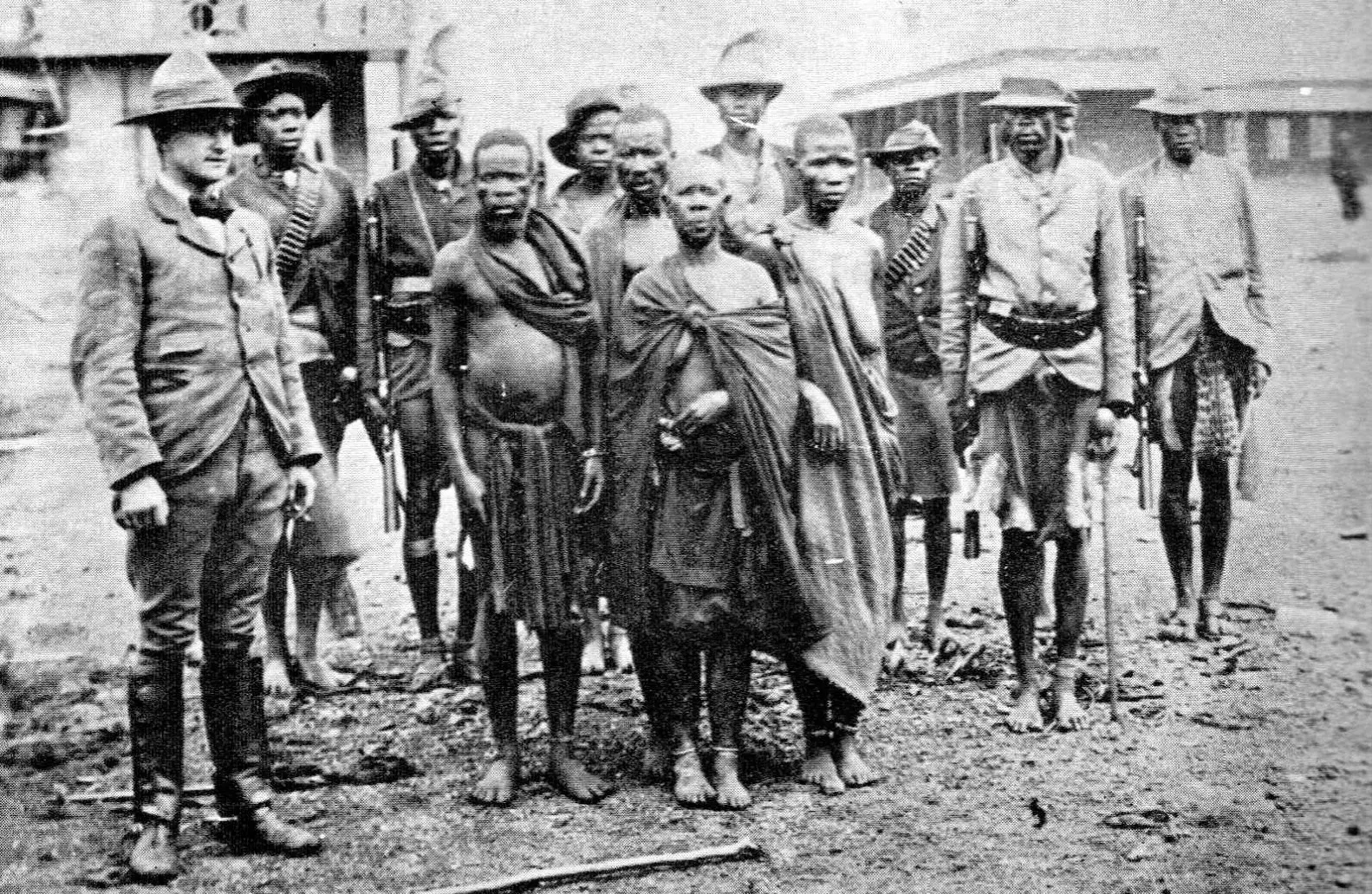
The First Chimurenga was eventually suppressed — the BSA Company's forces, reinforced from the Cape Colony and supported by settler militia, were better armed and ultimately more numerous than the uprising's fighters, and the scorched-earth tactics used to destroy the food supplies and the community structures that sustained the resistance gradually reduced the uprising's capacity to continue. By early 1897, the most active phase of the Shona uprising was over, and the BSA Company's forces were hunting down its leaders. Nehanda was captured in December 1897.
Trial, Execution, and the Making of a Legend
Nehanda's trial before the colonial courts was conducted on the BSA Company's legal terms — the terms of a system that did not recognise the spiritual authority through which her entire public life had been conducted and that translated the political decisions she had made as a medium into the criminal category of murder. She was convicted and sentenced to death. Sekuru Kaguvi, the male spirit medium who had played a comparable role in coordinating the uprising from the Ndebele side, was convicted alongside her.
Before the execution, the colonial authorities made a sustained effort to persuade Nehanda to convert to Christianity — an effort that was both genuinely pastoral in the intentions of the missionaries involved and profoundly political in its implications. Conversion would have acknowledged the spiritual authority of the colonial order over the Shona spiritual framework, would have been an admission that the universe in which Nehanda's authority was grounded was false or superseded, and would have represented the symbolic submission of the land's spiritual guardian to the power that was destroying her people's relationship with their land. Nehanda refused. Sekuru Kaguvi, by contrast, did convert — a difference whose significance has been extensively discussed in the historical and cultural literature, and that the liberation movement's subsequent invocation of Nehanda rather than Kaguvi as the primary symbol of the uprising reflects.
She was hanged on 27 April 1898 in Salisbury. Her last words — "my bones will rise again" — were recorded by the missionaries present, who understood them as a refusal of the Christian resurrection they had been offering and a reaffirmation of the Shona spiritual framework she had maintained throughout her captivity and her trial. The prophecy was understood immediately and across generations of Zimbabweans as something more than personal defiance: it was the declaration that the spirit of the land, and the people's right to it, was indestructible — that the colonial occupation could kill the medium but could not kill the spirit, and that the spirit would find new vessels and new voices in every generation until the land was returned to its people.
The Prophecy Fulfilled: Nehanda Across Eight Decades of Liberation
The invocation of Nehanda in Zimbabwe's liberation struggle is not a modern invention or a retrospective mythologisation — it is documented from the earliest years of organised nationalist politics and runs continuously through the liberation war to independence and beyond. The nationalists of the NDP and ZAPU era drew explicitly on the Chimurenga tradition and on Nehanda's memory to connect their political project to the spiritual legitimacy of the land's ancestral guardians. The ZANLA fighters who underwent political education in the training camps of Mozambique and Tanzania were taught that they were the children of Nehanda — that the guerrilla war they were conducting was the Second Chimurenga, the fulfilment of the prophecy that the bones of the First Chimurenga's martyrs would rise again.
The relationship between the liberation war's ZANLA fighters and the spirit mediums of the communities through which they operated was not merely symbolic — it was practically important. The mediums of the rural communities were the people best positioned to communicate to the fighters which community leaders could be trusted, which were collaborating with the Rhodesian security forces, and how the spiritual authorities of the land judged the fighters' conduct and the legitimacy of their campaign. Fighters who showed proper respect to the spirit mediums and to the protocols of the communities they moved through were affirmed in their mission. Those who did not were not.
Nehanda's image — reconstructed, since no authenticated photograph of her survives, from historical accounts and artistic imagination — became one of the most reproduced images of Zimbabwean cultural and political life. Her name was given to a maternity hospital in Harare — a choice whose resonance, connecting the spirit of the land's reproduction to the physical reproduction of its people, was not accidental. Songs were written about her. Poems invoked her. The liberation war's fighters marched with her name on their lips. When Zimbabwe achieved independence in 1980, the bones that she had promised would rise had, in the metaphorical sense that the prophecy demanded, risen.
Legacy: The Indestructible Spirit of the Land
Nehanda Charwe Nyakasikana died in April 1898, more than eighty years before the independence whose achievement she had prophesied. She was a woman of her specific time and culture — a Shona spirit medium operating within a cosmological framework that the colonial power she resisted did not recognise, making political decisions through spiritual authority in ways that the colonial legal system translated into criminal acts and executed accordingly. Her historical significance begins there and extends enormously beyond it.
She is the foundational figure of Zimbabwean resistance — not because she was the first person to resist colonial rule, but because the spiritual framework through which she acted gave that resistance a legitimacy and a continuity that purely secular political organisation could not have generated. The mhondoro spirit she embodied was, in Shona cosmology, older than the colonial occupation, older than the historical memory of any living person — the accumulated authority of the land itself, speaking through the woman it had chosen. When the colonial power killed her, it could not kill that spirit. The prophecy was the recognition of this fact, stated in terms that every generation of Zimbabweans who grew up hearing her story would understand.
In independent Zimbabwe, her image has been on banknotes, her name on streets and institutions, her story in school curricula. In 2021, a bronze statue of her was erected in Harare — the first statue of a woman in the city's public spaces, an acknowledgment, however belated, of the foundational debt that Zimbabwe's liberation owes to the woman who first declared, with her life, that the bones of resistance would rise again. The Zimbabwe she died for remains imperfect and contested and in many respects unworthy of the sacrifice she made for it. But the spirit she embodied — the conviction that the land belongs to its people and that that belonging is indestructible — is still alive in the country that bears the name she helped make worth fighting for.