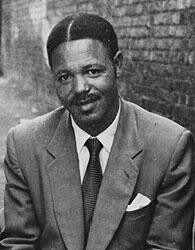
At a Glance
Port Elizabeth, SACTU, and the Making of a Liberation Movement Organiser
Port Elizabeth was one of the most politically charged cities in apartheid South Africa. Its industrial economy — built around the motor assembly plants, the harbours, and the manufacturing sector — had produced a large and concentrated Black working class, and the South African Congress of Trade Unions had been building organised labour power in this workforce through the 1950s in conditions of extreme difficulty and danger. The apartheid state regarded trade union organisation as inherently subversive, and SACTU organisers faced harassment, banning orders, detention, and violence from both the security forces and from employers who used every available means to prevent their workforces from organising.
Into this environment Vuyisile Mini had moved from his birthplace in the Transkei, and in this environment he developed the combination of skills that would define his contribution to the liberation movement: the organisational work of building trade union and ANC structures in the industrial communities of the Eastern Cape, and the cultural work of composing and performing the freedom songs that gave those communities their collective voice and their political identity.
The two forms of work were not separate. In the liberation movement of the 1950s and early 1960s, music was a political technology. Freedom songs were not decoration or entertainment — they were tools of organisation and mobilisation. A song that could be learned quickly and sung by hundreds of people at a rally or in a march gave those people a shared political experience that created solidarity and communicated political messages that could be understood by people who had not attended the formal political meetings where the movement's analysis was set out. Mini understood this instinctively and deployed it with extraordinary skill.
Ndodemnyama we Verwoerd: The Song That Named the Enemy
Of all the freedom songs that Mini composed, Ndodemnyama we Verwoerd is the most famous and the most enduring. The song — its title meaning roughly "Watch out, Verwoerd" or "Beware, Verwoerd" in Xhosa — named Hendrik Verwoerd, the Prime Minister who was the principal architect of the apartheid system's theoretical and legislative structure, and demanded that he answer for what he had done. It was a remarkable act of political directness: to put the name of the most powerful man in South Africa into a song that hundreds of thousands of people were singing in the townships and at political meetings was to refuse the apartheid system's demand for deference and silence, to insist on naming power and holding it accountable even from the position of the powerless.
The song's musical structure was accessible enough to be quickly learned and powerful enough, in communal performance, to generate the emotional intensity that the liberation movement required from its cultural forms. Mini's bass voice gave the song its original authority, but the song's power did not depend on any individual performer — it belonged to the communities that sang it, and they sang it for decades. It was sung at the funerals of liberation movement members killed by the apartheid state. It was sung in the cells on Robben Island where Mandela and his comrades were imprisoned. It was sung at the rallies and protests of the 1970s and 1980s when a new generation had taken up the struggle. It was sung at the celebrations of 1994 when apartheid finally fell.
The fact that the man who composed it was hanged by the government it named — and that he sang it as he walked to the gallows — gave the song a historical weight that few political anthems anywhere in the world have acquired. It became not just a song of resistance but a monument to the courage of the person who composed it and who died singing it.
Umkhonto we Sizwe in the Eastern Cape
When the ANC made the decision in 1961 to move beyond non-violent resistance to sabotage — a decision driven by the Sharpeville massacre of 1960, the banning of the ANC, and the state's escalating repression — Umkhonto we Sizwe was formed as the armed wing that would conduct the sabotage campaign. The decision to begin with sabotage rather than guerrilla warfare reflected the ANC's strategic judgment that the first priority was to create pressure on the apartheid economy and to signal to the world that the liberation movement was capable of armed resistance, while avoiding the civilian casualties that would give the apartheid state justification for even more extreme repression.
Mini was one of those tasked with building MK's Eastern Cape structures and organising the sabotage operations in the region. The Eastern Cape networks were among the most active in MK's early campaign. Mini had the organisational experience from his SACTU and ANC work — he understood how to build clandestine networks in communities under surveillance, how to maintain security, how to recruit and train people for underground work while managing the risk of infiltration. He applied these skills to the MK structures with the same competence he had brought to the trade union and ANC work.
The security forces were hunting MK's Eastern Cape networks from the beginning of the sabotage campaign. Mini was arrested in 1963. The charges against him included organising the sabotage campaign and the murder of Gerhardus Loewe — an alleged informer whose killing Mini and his comrades were accused of ordering. The murder charge was central to the prosecution's case for the death penalty. The liberation movement maintained that the evidence for the murder charge had been extracted under torture and was unreliable. The court convicted and sentenced all three — Mini, Khayingo, and Mkaba — to death.
The Trial, the Appeals, and the Decision to Execute
The decision by the apartheid government to proceed with the execution of Mini, Khayingo, and Mkaba in November 1964 was made in a specific political context. The Rivonia Trial had ended in June 1964 with the conviction of Mandela, Sisulu, Mbeki, and their co-accused — but the judge had not imposed the death sentence, choosing instead life imprisonment. The apartheid government was under enormous international pressure over the treatment of liberation movement prisoners, and there had been widespread expectation — and fear — that Mandela and the Rivonia trialists would be hanged.
The execution of Mini and his co-accused came five months after the Rivonia sentence was announced. It was a message — a demonstration that the government retained the will to use the death penalty against liberation movement activists, even in the face of international pressure. The international appeals for clemency in the Mini case, as in the Rivonia case, were rejected. The government hanged three men while the world watched.
Within the liberation movement, the executions produced grief, outrage, and intensified commitment. The image of Mini singing his freedom songs as he walked to the gallows — first reported through the networks of liberation movement solidarity and later confirmed through oral testimony and historical research — became one of the most powerful stories in the movement's internal culture. It was the story of what courage looked like in its most extreme form: not the absence of fear, but the decision to face death with the political dignity of the cause that had given one's life its meaning.
The Cultural Legacy: Songs as Monuments
Vuyisile Mini's cultural legacy is inseparable from his political legacy. The freedom songs he composed are monuments of a different kind from the statues and buildings that typically memorialise historical figures — they are living things, requiring human voices to exist, renewed in each generation that learns to sing them. Ndodemnyama we Verwoerd has been sung for sixty years and more, and as long as there are South Africans who remember what the liberation struggle was and what it cost, it will continue to be sung.
The relationship between music and resistance that Mini's work exemplified was central to the South African liberation movement in ways that are not always appreciated in the standard historical accounts. The movement's musical culture — the freedom songs, the protest choirs, the political hymns that drew on both African musical traditions and Christian church music — was not a supplement to the political organising. It was part of the organising itself, a technology of solidarity and identity formation that sustained communities through decades of repression by giving them shared forms of expression that the apartheid state could not easily destroy. Mini was one of the movement's most gifted practitioners of this technology, and his compositions remained in active use long after his death.
Legacy
Vuyisile Mini was hanged at forty-three, when his organisational experience, his musical gifts, and his leadership capacity were at their peak. What he might have contributed to the liberation movement through the 1970s and 1980s — to the underground networks, to the cultural work, to the trade union organising, to the communities of the Eastern Cape — is a question that the apartheid state's decision to hang him made unanswerable. He is among the many people whose potential contribution to South Africa was ended by the gallows, the bullet, or the detention cell before they could see the democratic order they had worked toward.
What he did leave is substantial: the organisational structures he built in the Eastern Cape contributed to the movement's capacity in a critical period; the trade union work he did with SACTU helped to build the labour movement that would become one of the most powerful forces in the anti-apartheid struggle through COSATU in the 1980s; and the songs he composed gave the liberation movement cultural resources that sustained its communities through six more decades of struggle after his death.
He walked to the gallows singing. The song has not stopped. That is his memorial, and it is enough.