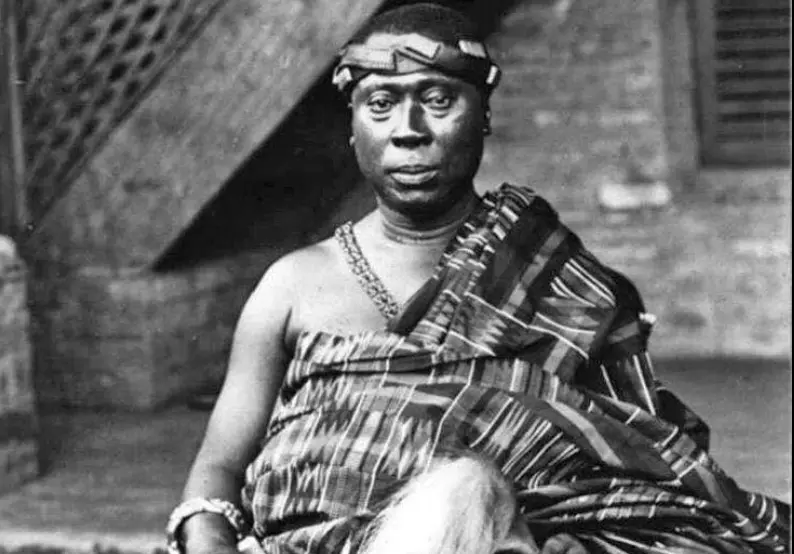
At a Glance
Ejisu, the Asante World, and the Formation of a Queen Mother
Yaa Asantewaa was born around 1840 in Ejisu — one of the divisional states of the Asante Confederacy, located in the forest zone east of Kumasi that formed the heartland of the most powerful African political entity in West Africa. The Asante Confederacy that she grew up in was at or near the zenith of its political and military reach: a state of perhaps three to four million people, controlling trade routes across a vast territory, maintaining a professional military force of formidable effectiveness, and managing a complex political structure that balanced the authority of the Asantehene against the semi-autonomous power of the divisional chiefs through the institution of the confederacy itself.
Her position as queen mother of Ejisu — the Ejisuhemaa — placed her within the Akan political system at a level of real authority. The queen mother's role in Akan governance was not the ornamental dignity that the title might suggest to Western ears. In the matrilineal Akan system, the queen mother was the head of the royal lineage — the woman whose knowledge of the lineage determined who was eligible to become chief, whose counsel on matters of state was constitutionally required before decisions were made, and whose political judgment carried the weight of both traditional authority and practical knowledge accumulated over decades of close engagement with the state's affairs. She was not a subordinate figure managing a ceremonial role; she was a constitutionally significant actor in the governance of Ejisu and, through the Ejisu connection, in the affairs of the broader Asante Confederacy.
The Asante that Yaa Asantewaa knew was not yet the Asante that the British would subjugate. The first Asante-British wars of the 1870s had demonstrated British military superiority but had not destroyed the Confederacy — the British had withdrawn after sacking Kumasi in 1874, and the Asante had rebuilt their military capacity and maintained their political structures through the following two decades. The deposition and exile of the Asantehene Prempeh I in 1896 — which the British justified as the suppression of human sacrifice and the establishment of order, and which the Asante experienced as an act of political decapitation — had been a severe blow, but it had not yet been followed by full annexation. The Asante state, its institutions, and its sacred objects — including the Golden Stool — remained.
Governor Hodgson's Demand and the Moment Everything Changed
On 28 March 1900, British Governor Frederick Mitchell Hodgson assembled the Asante chiefs and queen mothers at Kumasi and delivered a speech that was either an act of spectacular diplomatic incompetence or a calculated provocation — historians have debated which ever since. He demanded, explicitly and publicly, that the Golden Stool be brought to him so that he could sit upon it as the representative of Queen Victoria. He had come, he declared, to sit upon the Stool, which was now the property of the British Crown.
The demand demonstrated a misunderstanding of Asante political culture so profound that it is difficult to attribute entirely to ignorance. The Golden Stool — the sika dwa kofi — was not a throne. It was not a seat at all, in the functional sense. No person sat upon it; even the Asantehene did not sit upon it but sat beside it, the Stool hovering above its own cushion, never touching the ground, never carrying human weight. It was the physical embodiment of the sunsum — the spiritual essence — of the Asante nation, the object that had descended from the sky in the founding legend of the Confederacy and that contained, in Asante belief, the collective soul of the Asante people. To sit upon it would not be to occupy a throne; it would be to desecrate and extinguish the spiritual basis of Asante collective existence.
The Asante leaders' response to Hodgson's demand was silence — the stunned, horrified silence of people confronting a demand whose nature they could not immediately articulate because the demand was not political but spiritual, not about authority over territory but about the erasure of identity. In the secret meeting that followed Hodgson's speech, the Asante leadership faced the question of how to respond. The Asantehene and the most senior paramount chiefs were already in exile; the military capacity of the Confederacy had been degraded by years of British pressure; the odds against successful armed resistance were long. It was in this meeting, according to the tradition preserved in Asante oral history, that Yaa Asantewaa delivered the speech that changed everything.
The Speech, the War, and the Military Campaign
The speech that tradition attributes to Yaa Asantewaa at the secret meeting of Asante leaders in April 1900 has been quoted, rendered, and debated across a century. Its essential challenge — if the men will not fight, the women will — is the element preserved most consistently across different versions. Whether the speech occurred exactly as tradition records it, whether it was as decisive in prompting the military response as the tradition suggests, and what Yaa Asantewaa's precise role in the decision to fight was are questions that historical scholarship has engaged with carefully. What is clear is that she became the supreme commander of the Asante military force that besieged the British fort at Kumasi, and that this position reflected a genuine exercise of military leadership rather than a merely symbolic appointment.
The War of the Golden Stool — known in British accounts as the Ashanti Expedition of 1900 — began in April 1900 when Asante forces surrounded the British fort at Kumasi, trapping Governor Hodgson and his garrison inside. The siege continued for months; the British garrison was reduced to starvation rations and was only relieved by a column that fought its way into Kumasi in July 1900 after Hodgson managed to break out of the fort and make his way south to British territory. The relief of Kumasi did not end the war; the Asante forces regrouped and continued fighting across the forest zone for several more months before British reinforcements progressively suppressed the resistance.
The military achievement was more substantial than British colonial accounts, which emphasised the eventual suppression of the rebellion, tended to acknowledge. The Asante forces maintained the siege of Kumasi for months, came close to capturing the fort on multiple occasions, and required the deployment of a significant British military force — drawn from across West Africa and reinforced from Britain — before the resistance was finally broken. The campaign demonstrated that the Asante military capacity, even without the Asantehene and most of the paramount chiefs, even facing British regulars with rifles and artillery, remained formidable enough to require a serious military effort to overcome. Yaa Asantewaa directed that effort as supreme commander, making the military decisions and maintaining the organisational coherence of a campaign that lasted nine months against a superior military force.
Capture, Exile, and the Long Death Far from Home
Yaa Asantewaa was captured in October 1900 as the British military forces completed their suppression of the resistance. She was tried for rebellion against British authority — a charge whose irony was not lost on observers who noted that the rebellion had been triggered by a British demand to desecrate the most sacred object in Asante culture — and sentenced to exile. She was transported to the Seychelles, the Indian Ocean archipelago that Britain used as a place of exile for African leaders whose political removal from their home territories was necessary for colonial order but whose execution would have been politically costly.
The Seychelles exile was populated, at various points, by a remarkable group of African leaders who had resisted British colonialism and paid for that resistance with permanent removal from their people. Yaa Asantewaa joined there other Asante leaders, including those who had been exiled following the deposition of the Asantehene Prempeh I in 1896. The community of exiles maintained what social and cultural life was possible in a climate and landscape utterly unlike the Asante forest — the Indian Ocean's tropical islands bearing some superficial resemblance to the Gold Coast's coastal environment but nothing like the inland forest and the political culture of the Asante Confederacy.
She died on 17 October 1921 in the Seychelles, at approximately eighty years of age. She had lived in exile for twenty-one years, consistently requesting repatriation to Asante and consistently being denied. The Asante Confederacy whose Golden Stool she had fought to protect was formally annexed by the British Crown in 1901, the year after her capture, completing the subjugation she had fought against. The Golden Stool itself was not captured — it was hidden by the Asante throughout the war, and when it was accidentally discovered in 1921, the British handled the discovery with more political caution than Hodgson had brought to his original demand. The Confederacy was eventually restored in 1935 with the return of Prempeh I's successor from exile — fourteen years after Yaa Asantewaa's death.
Symbol, Memory, and the Long Afterlife of Resistance
Yaa Asantewaa's place in Ghanaian and African historical memory is of an entirely different order from that of any other figure in this collection — not because her historical significance is necessarily greater than that of Nkrumah or Danquah, but because the nature of her significance is different. She is not primarily a political figure whose ideas and decisions shaped institutions that lasted; she is a symbol — the embodiment, in a single act of military defiance, of the principle that colonial subjugation was not to be accepted without resistance, that the dignity and sovereignty of an African people were worth defending even against overwhelming odds, and that the courage to resist was not the exclusive property of those in formal positions of military or political authority.
The specific dimensions of her symbolic significance have been differently emphasised in different periods and contexts. In the independence era, she was claimed as a precursor of the nationalist movement — evidence that African resistance to colonial rule had deep roots that predated the educated class's constitutional campaigns. In the feminist tradition, she has been claimed as a demonstration that African women's political agency predated the colonial era's limitations on that agency — that the capacity for political and military leadership was present in African women long before the independence movement's formal politics opened space for women's participation. In the Pan-African diaspora, she has been claimed as a symbol of African dignity and African resistance that transcends any specific national context.
All of these claims are legitimate — none captures the full complexity of what she was and what she did. She was a queen mother in a specific political system with specific constitutional functions, who exceeded those functions in a moment of crisis and led a military campaign for nine months against the British Empire. She did this to protect a sacred object whose seizure would have meant the spiritual destruction of her people's collective identity. She was captured, exiled, and died far from home, never having seen the Asante she had fought for. The Golden Stool she fought to protect remained hidden through the war and survived into the independent Ghana that Nkrumah and Danquah and Gbedemah and the others of this collection helped build — still the most sacred object in Asante political and spiritual life, still carried in procession at Asante state occasions, still the physical emblem of the Asante Confederacy's identity and continuity.
Yaa Asantewaa's remains were returned to Ejisu after Ghana's independence and reinterred in the homeland she had never been allowed to return to in life. The Yaa Asantewaa Museum in Ejisu commemorates her life and her resistance. Her name is invoked across Ghana and across the African diaspora wherever the question of how African people responded to colonial subjugation is asked. The answer she gave — with everything she had, for as long as she could, for the defence of the most sacred thing her people possessed — is the answer that Ghanaian and African memory has chosen to honour above the answers of acquiescence and accommodation that the colonial period also produced in abundance. She fought. She lost the war. She won the memory. And the memory, in its way, is a form of victory that outlasts the war's result.