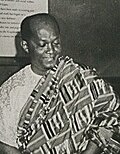
At a Glance
Tongu, the Volta, and an Ewe Political Career in an Akan-Dominated Movement
Komla Agbeli Gbedemah was born on 6 September 1913 in the Tongu area of the Volta Region — the lower Volta floodplain whose Ewe communities had engaged with mission education since the late nineteenth century and whose political traditions were distinct from the Akan chieftaincy systems that dominated the Gold Coast's southern politics. Growing up Ewe in a political world dominated by Akan social structures and Akan political networks meant growing up with an acute awareness of how power was distributed and how communities without the Akan establishment's connections navigated the structures of colonial and subsequently post-colonial politics.
His education through the mission school system and his subsequent career as a teacher gave him the professional formation that his political generation shared — the literacy, the English fluency, the organisational experience, and the community connections that made teachers the natural political organisers of colonial West Africa. His teaching career in the Volta Region built the local networks and the administrative habits that his subsequent political work would require at a very different scale.
When Gbedemah joined the Convention People's Party after Nkrumah founded it in 1949, he brought to the organisation something that it urgently needed: the organisational discipline and systematic competence that could translate Nkrumah's charismatic political vision into the operational reality of a mass political party. Nkrumah could inspire audiences to demand independence; he was less reliably able to ensure that the branch membership records were accurate, the constituency organisations were properly staffed, the election registration procedures were followed, and the campaign materials reached the right places at the right times. Gbedemah could do all of these things, and his ability to do them was as essential to the CPP's success as Nkrumah's ability to inspire.
The 1951 Election: Running a Winning Campaign Without the Candidate
The moment that most completely demonstrated Gbedemah's political abilities came in 1950 and 1951, when Nkrumah's Positive Action campaign — the CPP's strategy of strikes, boycotts, and civil disobedience designed to press the colonial government for immediate self-government — led to Nkrumah's arrest and imprisonment. Nkrumah was sent to James Fort Prison in Accra, and the colonial government confidently expected that the CPP, deprived of its dominant personality, would lose momentum, fracture, and perhaps collapse entirely.
The calculation was wrong, and it was wrong primarily because of Gbedemah. He kept the CPP operational through the months of Nkrumah's imprisonment, maintaining the party's branch structures, managing its communications with the public and with its membership, ensuring that its political demands remained clearly articulated, and — most critically — overseeing the party's participation in the 1951 elections that the British had scheduled under the new Coussey Constitution. Gbedemah registered CPP candidates across the country, organised the campaign in every constituency, and managed the election that the CPP needed to win to demonstrate both to the Gold Coast's population and to the British government that independence was the democratic will of the people.
The result was one of the most decisive electoral victories in the history of West African politics. The CPP won 34 of 38 elected seats in the Legislative Assembly. Nkrumah, campaigning from his prison cell and winning his Accra Central constituency by a margin that left no doubt about the political message the Gold Coast electorate was sending, emerged from prison to be named Leader of Government Business by a colonial administration that now had no option but to negotiate the transfer of power. Ghana's independence was not certain in 1951, but it was substantially more inevitable than it had been the day before the election, and the election's outcome was the product of Gbedemah's organisational work as much as of Nkrumah's political inspiration.
Finance Minister: Building the Economic Architecture of Independence
Gbedemah's tenure as Finance Minister in the independence government brought to economic management the same systematic, detail-oriented competence that had characterised his political organising. The challenges he faced were considerable: the new state needed to establish its own monetary and fiscal institutions, manage the transition from the colonial currency arrangement that had linked the Gold Coast pound to the pound sterling, build the revenue systems that would fund the development ambitions of the Nkrumah government, and maintain the confidence of international creditors and aid donors without whom the development programme could not proceed.
The institutions he helped build — the Bank of Ghana, the fiscal framework for the independent state, the budgetary systems that allocated government revenues across the competing priorities of a newly independent country — were genuine achievements of the independence government's early years. Ghana at independence was better positioned economically than most African states that followed it into independence, with cocoa revenues providing a fiscal base that, managed carefully, could have funded sustainable development. Gbedemah's management of these resources in the early years was, by most assessments, relatively careful — more constrained by the realities of what the economy could support than the government's development ambitions were beginning to demand.
The tensions between the Finance Ministry's fiscal caution and the political imperative to deliver development rapidly were a persistent feature of the early independence government. Nkrumah's vision of Ghana as the vanguard of African development required spending at a pace that Ghana's cocoa-dependent revenues could not sustainably support; Gbedemah's role as Finance Minister included the difficult task of managing this tension — trying to deliver the development that political promises required while maintaining the fiscal discipline that long-term economic viability demanded. That he eventually lost this argument — that the government's spending trajectory in the early 1960s moved away from the fiscal caution he had tried to maintain — was one dimension of the broader failure of the CPP government's economic management.
Breakfast at the White House: Ghana's New International Standing
In October 1957, Gbedemah was travelling through the United States as part of a Ghanaian government delegation when he stopped at a Howard Johnson's restaurant in Dover, Delaware, and was refused service because of his race. The incident was not extraordinary by the standards of Jim Crow America — African Americans were refused service at such establishments routinely — but its application to the Finance Minister of an independent African state that the United States was cultivating as an ally in the Cold War competition for African alignment created a diplomatic problem of an entirely different order.
Gbedemah reported the incident to Nkrumah and to the Ghanaian government. The story became international news. President Dwight Eisenhower, embarrassed by the implications of an incident that demonstrated the incompatibility between American racial practices and American foreign policy ambitions in Africa, invited Gbedemah to breakfast at the White House — a personal gesture of apology and a signal to the international community that the US government regarded the treatment of Ghanaian officials with a seriousness it did not extend to African American citizens.
The episode illustrated several things simultaneously: the racial realities of 1950s America, which the Civil Rights Movement was only beginning to challenge; the new international standing that Ghanaian independence had created, in which the treatment of Ghanaian officials in the American South was now a matter of US foreign policy rather than merely of domestic racial convention; and the specific irony of a country that was presenting itself as the champion of freedom against Soviet totalitarianism while maintaining Jim Crow racial segregation in its own territory. Gbedemah navigated the incident with the dignity and political intelligence that characterised his public conduct, and the White House breakfast became one of the most-cited illustrations of how Ghana's independence had changed the terms on which African people could engage with the world's most powerful nation.
The Break: When Capability in the Wrong Direction Has to Stop
Gbedemah's break with the Nkrumah government in the early 1960s was the most consequential political decision of his career — more consequential, in some ways, than the organisational work that had built the CPP, because it required giving up everything that the CPP had given him and facing the consequences that breaking with an increasingly authoritarian government carried. The specific triggers for the break — the Preventive Detention Act's use against political opponents, the suppression of press freedom, the direction toward a declared one-party state — were the same issues that had driven Joe Appiah and others into opposition, but Gbedemah's break was more significant because he had been more central to the CPP project than any of them.
He went into exile, which was the safest available response to breaking with a government that had demonstrated its willingness to imprison critics without trial. From outside Ghana he maintained his opposition to the direction the government was taking, contributing to the international critique of the Nkrumah government's human rights record that was building through the early 1960s and that Danquah's detention and death would dramatically intensify. His presence in exile, as a man who had been the CPP's most important operational figure and who had now concluded that the government he had built had taken a fundamentally wrong direction, gave the opposition's critique a credibility that purely external critics could not provide.
The 1966 coup that removed Nkrumah from power ended his exile and opened the possibility of returning to Ghanaian politics. His return demonstrated that the political skills he had deployed in building the CPP were intact and could be deployed in the different political environment of post-Nkrumah Ghana — but also that the factional politics of the transition period, and the specific legal obstacles that the Second Republic's constitutional arrangements placed in his path, could prevent those skills from achieving their natural outcome.
The 1969 Disqualification and the Long Democratic Engagement
Gbedemah's near-return to the presidency in 1969 — the election that established the Second Republic under Kofi Busia's Progress Party — remains one of the most striking might-have-beens of Ghanaian political history. He led the National Alliance of Liberals, an Ewe-supported party that drew on the networks he had built across his long political career, and his party was competitive enough to make the election genuinely contested. His own presidential candidacy, however, was struck down by the Supreme Court on residency grounds — he had not been continuously resident in Ghana for the period the constitution required, his years of exile being the disqualifying factor.
The disqualification was widely seen as politically motivated — an attempt by the transitional government, which had CPP-era connections to exploit, to remove the candidate most likely to pose a genuine challenge to the Progress Party's dominance. Whether this assessment is correct is impossible to establish definitively from the historical record. What is clear is that the removal of Gbedemah from the presidential contest left the 1969 election without its most capable opposition figure, and that the Second Republic established by that election was the less democratic for his absence from its founding competition.
He continued to engage with Ghanaian politics through the subsequent decades — through the Acheampong years, the Akuffo transition, the Rawlings interventions, and eventually the democratic consolidation of the Fourth Republic. He contested the 1992 elections under the People's National Party, bringing to post-transition politics the same organisational energy and democratic convictions that had characterised his career throughout. He had spent his political life arguing, in one way or another, that Ghana's people deserved democratic governance — that the independence the CPP had won should mean something more than the transfer of authoritarian power from colonial hands to Ghanaian ones. By the time he died in September 1998, the Fourth Republic had been operating for six years, Jerry Rawlings had won two democratic elections, and the pattern of competitive democratic politics that Gbedemah had always advocated was beginning to take root.
The Organiser's Legacy: What Building a Movement Actually Means
Komla Gbedemah's contribution to Ghanaian independence is one of the clearest illustrations of a truth that the political history of liberation movements often obscures: that movements are built by organisers as much as by visionaries, and that the organisational work is not less important than the inspirational work simply because it is less visible. Nkrumah's speeches and Nkrumah's imprisonment and Nkrumah's charisma are the stuff of historical narrative; Gbedemah's membership records and candidate registrations and campaign schedules are the stuff of administrative files. But without the membership records and the registrations and the schedules, the speeches and the imprisonment and the charisma would not have produced the 1951 election result that made independence inevitable.
His Finance Ministry work — building the fiscal institutions of the independent state, managing the transition to monetary sovereignty, attempting to maintain fiscal discipline against the pressure of political spending — was the economic equivalent of his political organising: systematic, competent, and focused on the institutional infrastructure that made everything else possible. The economists who have assessed the early years of Ghana's independence consistently note that the fiscal management of the late 1950s was more careful than what followed — that the economic deterioration of the early 1960s was partly a product of the departure from the discipline that the Finance Ministry had tried to maintain.
And his break with Nkrumah — the willingness to walk away from everything that the CPP had given him, to go into exile rather than remain in a government whose direction he had concluded was wrong — demonstrated that the organisational competence was in the service of genuine political principle rather than merely of personal advancement. He had built the machine; he left when the machine was being used for purposes he could not endorse. That act of principled departure, whatever its personal costs, is the thing that most completely distinguishes Gbedemah from the loyalists who stayed and gives his career its particular moral shape.