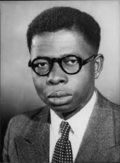
At a Glance
Odumase Krobo, Lincoln University, and the Making of a Nationalist
Ako Adjei was born in 1916 in Odumase Krobo, the principal town of the Krobo people in what was then the Gold Coast's Eastern Province. The Krobo occupied a distinctive position within Gold Coast colonial society — a people whose adoption of Christianity and engagement with the cocoa and palm oil economy from the mid-nineteenth century onward had produced a commercially active and educationally ambitious community that punched considerably above its demographic weight in producing the Gold Coast's educated professional class. Growing up in Odumase in the 1920s meant growing up in a society where education was understood not as a luxury but as the necessary instrument of advancement, where the mission schools that dotted the landscape were pathways to a world of professional possibility that the colonial economy made available to Africans in a limited but real way.
His trajectory through Achimota School placed him among the Gold Coast's educational elite at a formative moment. Achimota, opened in 1927 under the principalship of A.G. Fraser with the explicit purpose of producing an educated African leadership class, was one of the most intellectually serious secondary schools in British West Africa, and the students who passed through it in the 1930s and 1940s formed a network that would subsequently dominate Gold Coast and Ghanaian public life across every professional field. To attend Achimota was to enter a social world of high ambition and high expectation, and to leave it with a scholarship was to join the handful of Gold Coast Africans whose education would take them beyond the colony's borders into the wider world.
The scholarship to Lincoln University in Pennsylvania was the pivot of Adjei's formation. Lincoln — founded in 1854 as the first degree-granting historically Black university in the United States — had, by the time Adjei arrived in the 1930s, accumulated a remarkable record of producing African and African American leaders. Kwame Nkrumah was already enrolled when Adjei arrived, and the two Ghanaians studying together at an American institution dedicated to the intellectual development of people of African descent found themselves in a context that was simultaneously educationally rigorous and politically radicalising. The United States of the 1930s was a country of systematic racial oppression — the Jim Crow system was in full operation, the Great Depression was ravaging Black communities with particular severity — and encountering that oppression as an educated African man shaped political consciousnesses in ways that a more comfortable colonial education could never have done.
The friendship between Adjei and Nkrumah at Lincoln was not merely the casual companionship of two men from the same country studying abroad. It was an intellectual and political partnership formed in a context — the African American intellectual and political milieu of the late 1930s, with its debts to W.E.B. Du Bois, Marcus Garvey, and the traditions of Pan-African thought — that gave both men a framework for understanding the Gold Coast's colonial situation within a broader global struggle against racial capitalism and European imperialism. When both men subsequently moved to London — Nkrumah to the London School of Economics and Adjei to the Middle Temple to train as a barrister — they continued the intellectual and political conversations begun at Lincoln, moving through the same Pan-African circles, attending the same meetings, and developing the same sense of what African independence required and what it would mean.
Return to the Gold Coast: Barrister and Political Organiser
Adjei returned to the Gold Coast before Nkrumah, completing his legal training, being called to the Bar at Middle Temple, and establishing a legal practice in Accra. The Gold Coast bar in the 1940s was a small and distinguished professional community — the African barristers who practised in Accra were among the most educated and most influential Africans in the colony, their professional standing giving them the financial independence and the public credibility that political organising required. They were also, almost without exception, political — the profession that required one to argue cases before colonial courts, to navigate a legal system designed to serve colonial interests, and to represent African clients whose interests were systematically subordinated to those of European business and government produced a political consciousness that mere commercial success could not.
The United Gold Coast Convention, founded in August 1947 at a meeting in the office of J.B. Danquah, was the most ambitious political organisation the Gold Coast's professional class had yet attempted to build. Its six founding members — Danquah, Adjei, Edward Akufo-Addo, William Ofori Atta, Kwesi Plange, and Emmanuel Obetsebi-Lamptey — represented the Akan intellectual elite at its most organised and most politically serious. Their programme was constitutionalist rather than revolutionary: they sought self-government through the negotiation of constitutional reforms, progress through the established channels of British imperial politics rather than through the mass mobilisation that Nkrumah would bring to the movement. They were, in important respects, the Gold Coast equivalent of the Indian National Congress's moderate wing in the pre-Gandhi era — capable, principled, and insufficiently radical for the moment they were operating in.
Adjei's most consequential act within the UGCC was a piece of personnel management rather than political strategy. The convention needed a full-time organising secretary — someone who could build branch structures across the colony, run the daily operations of a national political organisation, and maintain the momentum of the campaign for self-government between the periodic meetings of the organisation's founding members, most of whom had professional practices to run. Adjei recommended Kwame Nkrumah for the role, writing to his Lincoln University friend in London to urge him to return to the Gold Coast and take up the position. Nkrumah accepted, arrived in the Gold Coast in November 1947, and began the work that would, within a few years, transform not only the UGCC but the entire character of the Gold Coast independence movement.
The recommendation was an act of genuine political generosity, made in the knowledge that Nkrumah was an extraordinary organiser and political figure who would likely dominate any organisation he joined. Whether Adjei fully anticipated that Nkrumah would break with the UGCC's constitutionalist approach and build his own mass movement is impossible to establish at this distance. What is clear is that the recommendation brought into the Gold Coast political field the figure who would redefine its terms — and that this transformation, however uncomfortable it was for the UGCC's founding members, was necessary for independence to happen on the timeline it did.
The 1948 Riots and the Big Six Arrest: When British Repression Made Heroes
The Accra riots of February 1948 began with a boycott of European goods that escalated into widespread civil disorder after colonial police fired on a veterans' march, killing three ex-servicemen who had fought for Britain in the Second World War and were demanding that the colonial government honour its promises of better post-war conditions. The riots spread from Accra to other towns; colonial property was damaged; the colonial government's authority was publicly and dramatically challenged in ways it had not been before. Governor Gerald Creasy, facing a crisis that threatened the entire edifice of colonial order, decided on a response that combined security measures with political decapitation: he would arrest the leadership of the organisation he judged responsible for stirring up political discontent.
On 12 March 1948, Adjei, Danquah, Nkrumah, Ofori Atta, Lamptey, and Obetsebi-Lamptey were arrested and detained under emergency regulations. The six were separated and sent to remote detention locations in the Northern Territories — Adjei to Lawra, among the most isolated stations in the colony. The British expected that removing the leadership of the UGCC would allow the political temperature to cool, that the mass of the Gold Coast's population would return to the acquiescent relationship with colonial authority that had characterised the previous decades, and that the professional politicians would be taught a lesson about the limits of permissible political activity.
The miscalculation was total. The arrest of six prominent and respected professionals — barristers, businessmen, educated men with international reputations — galvanised Gold Coast public opinion in a way that years of constitutional lobbying had failed to do. The detention made the Big Six into martyrs; it generated international press attention that highlighted the gap between Britain's post-war rhetoric about self-determination and the realities of colonial rule; and it created the mass political sympathy that the UGCC and then, more effectively, Nkrumah's Convention People's Party would convert into electoral support for independence. The Watson Commission, established to investigate the riots, produced a report that effectively validated the nationalists' demands and recommended constitutional reform — the opposite of the outcome the arrests had been designed to produce.
Adjei spent weeks in detention at Lawra before being released. The experience was formative in ways that went beyond the personal discomfort of remote imprisonment: it established, permanently, his status as a nationalist whose commitment to Gold Coast self-government had been tested and demonstrated at personal cost. The Big Six detention was the credential that defined his generation — a shared experience of colonial repression that bound together men who would subsequently diverge politically in significant ways.
The Parting of Ways: UGCC, CPP, and the Question of Method
The period between the 1948 arrests and Ghanaian independence in 1957 was one of escalating political differentiation within the nationalist movement, and Adjei's positioning during these years illustrates the difficulty of navigating the space between the UGCC's constitutionalist approach and Nkrumah's mass mobilisation strategy. Nkrumah broke with the UGCC in 1949, accusing its leadership of moving too slowly and of failing to build the genuinely mass movement that independence required, and founded the Convention People's Party with the explicit aim of achieving self-government immediately rather than through the gradual constitutional reform the UGCC sought. The CPP's strategy of Positive Action — strikes, boycotts, mass demonstrations — proved far more effective at extracting constitutional concessions from the British than the UGCC's careful diplomacy had been.
Adjei's own path through these years was not that of the UGCC's hardline constitutionalists who remained implacably hostile to Nkrumah throughout. His Lincoln University friendship with Nkrumah, his intellectual respect for Nkrumah's political abilities, and his pragmatic recognition that the CPP's mass base was the reality of Gold Coast politics created a more complicated relationship than simple factional loyalty allowed. He eventually aligned with the CPP and served in the independence government that Nkrumah led — a trajectory that distinguished him from Danquah, who remained the CPP's most persistent and principled opponent and who would eventually die in Nkrumah's detention.
This trajectory placed Adjei in an awkward historical position: too closely associated with the UGCC's founding to be straightforwardly claimed as a CPP figure, but sufficiently aligned with Nkrumah to have served in his government and therefore to share in both the achievements and the failures of the Nkrumah era. It is a position that resists the simple categorisations that nationalist historiography prefers — neither pure constitutionalist nor pure revolutionary, neither simply a hero of independence nor simply a victim of its distortions.
Ghana's Foreign Minister: Representing the Black Star of Africa
When Ghana became independent on 6 March 1957 — the first sub-Saharan African country to achieve independence from European colonialism — the new state's foreign policy was an immediate and central preoccupation of its government. Nkrumah's vision of Ghana was not of a small West African state pursuing narrow national interests within the existing international system; it was of an exemplary African state whose independence demonstrated to the rest of the continent and to the world that Black African self-government was possible and whose foreign policy would actively support the liberation of the rest of Africa from colonial rule. Ghana was to be the Black Star of Africa — a beacon, a catalyst, a proof of concept for the continental liberation movement.
As Foreign Minister from 1959 to 1962, Adjei was the operational instrument of this vision. His legal training, his international education, his familiarity with British institutional norms, and his personal dignity made him an effective representative of the new state in the diplomatic contexts where Ghana's Pan-African ambitions had to be pursued through the protocols of international relations. He participated in the negotiations that shaped the Organisation of African Unity's founding architecture, engaged with the emerging Non-Aligned Movement that Ghana joined as one of its leading voices, and managed the complex diplomatic relationships with the United States and the Soviet Union that Cold War politics required of a small state attempting to maintain genuine independence from both superpowers.
The foreign policy of the Nkrumah years was simultaneously visionary and overextended — driven by a Pan-African idealism that consistently outran Ghana's material capacity to deliver on its ambitions, generating enemies among conservative African leaders who resented Nkrumah's support for opposition movements in their countries, and creating financial strains that would eventually contribute to the economic crisis that undermined the CPP government. Adjei operated within these constraints as best he could, bringing the technical competence of a trained lawyer and diplomat to a foreign policy whose direction was set by Nkrumah's ideological commitments rather than by the cautious calculation that Adjei's temperament preferred.
The Kulungugu Bomb and the Preventive Detention Act: Imprisoned by the State He Built
On 1 August 1962, a bomb was thrown at Kwame Nkrumah at Kulungugu in the Upper Region of Ghana, killing a child and injuring several others but leaving Nkrumah unhurt. The assassination attempt, occurring in the context of a CPP government increasingly authoritarian in its response to opposition and increasingly paranoid about internal threats, produced a wave of arrests. Among those detained was Ako Adjei, removed from the Foreign Ministry and imprisoned under the Preventive Detention Act — legislation that allowed the government to hold individuals without trial, without charge, and without judicial oversight for renewable periods.
The irony of Adjei's detention under the Preventive Detention Act was not lost on those who observed it. The act drew directly on the colonial security legislation — the Emergency Regulations and the Deportation Ordinance — that the colonial government had used against the nationalist movement, including against the Big Six in 1948. The same logic of preventive detention without judicial accountability that had imprisoned Adjei and his colleagues as dangerous subversives in the colonial period was now being deployed by the independent Ghanaian state against members of its own founding generation. The structural continuity between colonial repression and post-independence authoritarianism, which critics of one-party African nationalism had predicted, was visible in the biography of one of independence's own founding figures.
Adjei spent nearly four years in detention. He was never brought to trial, never convicted, never presented with evidence that would have allowed him to mount a legal defence — because the logic of preventive detention required none of these things. The Kulungugu assassination attempt was eventually attributed by the courts to a different group entirely, but this finding did not result in Adjei's release; he remained imprisoned until the National Liberation Council's coup of February 1966 removed Nkrumah from power and released those held under the Preventive Detention Act.
The detention broke something in the political relationship between the founding generation and the state they had built — not in Adjei alone, but in the broader understanding of what the Nkrumah government had become. Men who had founded the nationalist movement, who had been detained by the British for their commitment to independence, who had served the independent government with ability and loyalty, found themselves imprisoned by that government on charges they denied and evidence they were never shown. The spectacle demonstrated with particular clarity the distance between the liberation movement's founding ideals and the political reality of the CPP state in its final years.
Release, Reflection, and a Long Afterlife in Ghanaian Democracy
Adjei was released in April 1966, two months after the NLC coup. He was sixty years old, had spent four years in detention for crimes he had not committed, and was emerging into a Ghana whose political landscape had been fundamentally altered. The CPP was banned; Nkrumah was in exile in Guinea, never to return; the first chapter of Ghanaian independence was over. What followed — the military-civilian oscillation of the next three decades, the Busia years, the Acheampong years, the Rawlings era — was the long, difficult, sometimes violent working out of what kind of political order Ghana could sustain.
Adjei participated in this aftermath with the measured dignity that had characterised his career throughout. He practised law, participated in public discourse, and lived long enough to see the Fourth Republic established under the 1992 constitution provide the democratic framework that the founding generation had sought but failed to secure. He saw Jerry Rawlings win two democratic elections and then transfer power peacefully to John Kufuor in 2001 — the kind of democratic consolidation that would have seemed wildly optimistic from the vantage point of Nkrumah's Ghana or Acheampong's Ghana or even early Rawlings.
He died on 17 May 2002, in Accra, at eighty-six years of age. His death was that of a man who had seen nearly everything the Ghanaian independence story contained — the optimism of the founding, the achievement of independence, the expansion of Pan-African ambition, the descent into authoritarianism, the imprisonment of the founders, the coups, the economic disasters, the gradual recovery, and at last the democratic consolidation that gave the story, against the odds, something approaching a hopeful ending. The fact that he lived to see that ending, after everything that had intervened, was itself a kind of political testimony to the resilience of the founding generation's original aspirations.