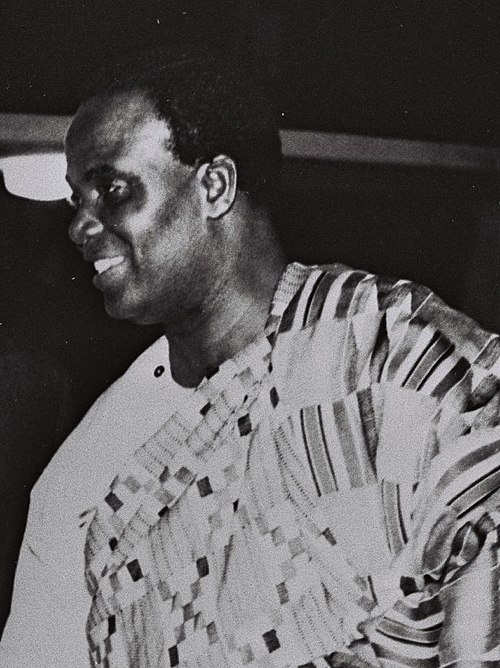
At a Glance
Saltpond, the Fante Coast, and the Education of a Loyalist
Kojo Botsio was born in 1916 in Saltpond, a Fante coastal town in what was then the Gold Coast's Central Province — a community whose history of engagement with mission education, the Atlantic trade, and the educated professional culture of the Gold Coast coast had produced, by the early twentieth century, a distinctive social environment. The Fante communities of the central coast had been among the first to engage with European commercial and educational institutions, and the professional class they had produced over generations of mission schooling was among the most accomplished in the Gold Coast. Saltpond was not the largest or the most prominent of these coastal communities, but it shared in the educational culture that made the Central Region a disproportionate contributor to the Gold Coast's educated class.
Botsio's education through the mission school system and his subsequent teacher training gave him the professional formation that his generation of Gold Coast nationalists shared — the combination of English literacy, familiarity with British institutional forms, and community embeddedness that made the teacher the ideal political organiser. Teachers in colonial West Africa were trusted by their communities, educated enough to navigate the colonial administrative world, and independent enough from direct colonial employment to engage in political activity without the career consequences that civil servants faced. Botsio's teaching career built the community connections and the professional skills that his subsequent political work required.
His journey to London for further education placed him in the remarkable community of West African and Caribbean students and intellectuals who were, in the 1940s, simultaneously pursuing their professional and academic qualifications and organising the political movements that would transform the colonial world. It was in this London milieu that he encountered Kwame Nkrumah — then also studying, then already organising, already the most charismatic and energetically political figure in the African student community — and formed the personal and political relationship that would define both men's subsequent careers. The friendship was genuine; the intellectual affinity was real; and the political commitment that Botsio made, in London in the 1940s, to the project that Nkrumah represented was a commitment he would maintain, with consistency that distinguished him from almost every other member of the independence generation, for the rest of the Nkrumah era.
Founding the CPP: The Break and the New Beginning
When Nkrumah returned to the Gold Coast in November 1947 as the UGCC's secretary, Botsio followed — part of the London cohort that returned with or shortly after Nkrumah to participate in the independence campaign that the UGCC was attempting to build. The subsequent eighteen months — the 1948 riots, the Big Six arrests (which did not include Botsio or Nkrumah among the original six detained, though Nkrumah was separately arrested), the Watson Commission, the constitutional reforms — demonstrated both the possibilities that mass politics opened and the limits of the UGCC's constitutionalist framework for exploiting them.
Nkrumah's break with the UGCC in June 1949, and the founding of the Convention People's Party, was the moment that sorted the Gold Coast independence movement into the constitutionalist camp of J.B. Danquah and the UGCC's founding members, and the mass mobilisation camp of Nkrumah's CPP. Botsio went with Nkrumah without hesitation — he was among the founding members of the CPP, present at the moment when Nkrumah articulated the party's programme of Positive Action and immediate self-government, and committed to the mass mobilisation strategy that the UGCC's constitutionalism had refused to adopt.
His role in the CPP's early years was that of the capable organiser rather than the charismatic platform speaker — building the branch structures, managing the party's day-to-day operations, and ensuring that the organisational infrastructure kept pace with the mass enthusiasm that Nkrumah's speeches and public presence generated. Political parties are built by organisers as much as by orators, and the CPP's extraordinary success in the 1951 elections — which gave it a decisive majority and brought Nkrumah out of prison to become Leader of Government Business — was as much the product of organisational work as of political charisma. Botsio was part of that organisational achievement.
Education Minister: Building the Schools That Independence Required
The portfolio of Education that Botsio held in the early independence government was one of the most consequential in the new state's Cabinet — the ministry responsible for delivering the educational expansion that was simultaneously a political promise of the independence movement and a practical necessity for the development that independence was supposed to enable. The Gold Coast at independence had a primary school system that reached a relatively small fraction of school-age children, a secondary school system of even more limited reach, and a tertiary sector that was only beginning with the establishment of the University College of the Gold Coast at Legon.
The education expansion of the late 1950s and early 1960s — the construction of new primary and middle schools across the country, the establishment of new secondary schools in regions that had previously been without them, the development of technical and vocational institutions, and the expansion of teacher training — was one of the genuinely transformative achievements of the Nkrumah government. Enrolment figures increased dramatically; communities that had previously lacked secondary education gained access to it; the educational infrastructure on which subsequent Ghanaian development would depend was substantially built during these years. As the minister responsible for implementing this programme, Botsio was directly involved in one of the independence government's most clearly beneficial achievements — the one that most directly served the interests of ordinary Ghanaian families whose children now had access to schooling that had not been available to their parents.
The expansion was not without problems. Quality was sometimes sacrificed to speed; teacher training could not always keep pace with the construction of classrooms; the curriculum remained more oriented toward producing clerks and administrators than the technical and scientific personnel that the government's development ambitions required. These were genuine limitations, and they reflected the difficulty of expanding educational provision very rapidly in a poor country with limited trained personnel. But the expansion itself — the political commitment to making education available to Ghanaian children as a matter of national priority — was a genuine achievement that Botsio's ministerial tenure contributed to building.
Foreign Affairs: Implementing Ghana's Pan-African Ambitions
The Foreign Affairs portfolio that Botsio subsequently held placed him at the operational centre of what was, for its scale and resources, one of the most ambitious foreign policies in the world. Nkrumah's vision for Ghana's international role went far beyond what a small West African nation of seven or eight million people might conventionally have been expected to attempt: Ghana was to be the vanguard of African liberation, the state that demonstrated continental federation was possible, the diplomatic force that kept the Cold War superpowers from dividing the continent between them, and the supporter and sanctuary of liberation movements across the continent. Implementing this vision required a Foreign Ministry capable of operating simultaneously in the United Nations, in bilateral relationships with both superpowers, in the emerging Non-Aligned Movement, and in the direct support of African liberation movements — an extraordinary range of diplomatic activity for any country's foreign service.
Botsio managed these responsibilities with the administrative competence that characterised his ministerial work across portfolios. He built the institutional capacity of the Foreign Ministry — training diplomats, establishing embassies in the capitals that Ghana's activist foreign policy required, developing the administrative systems that sustained sustained diplomatic engagement. He participated in the negotiations that shaped the Organisation of African Unity's founding architecture, representing Ghana's interest in a continental organisation sufficiently ambitious to advance the Pan-Africanist goals that Nkrumah's foreign policy sought while sufficiently practically grounded to gain the support of African states whose leaders were considerably less ideologically committed to Pan-Africanism than Nkrumah was.
The foreign policy he was implementing had genuine achievements — Ghana's moral leadership in the liberation movements, its role in the Non-Aligned Movement, its influence in shaping the OAU — alongside genuine overextension. The financial costs of supporting liberation movements across the continent, of maintaining a diplomatic presence far larger than Ghana's resources warranted, and of pursuing ideological ambitions that alienated conservative African leaders who resented Nkrumah's intervention in their countries' internal politics contributed to the economic strain that would ultimately undermine the CPP government. Botsio operated within these constraints as ably as anyone could, but the foreign policy direction was Nkrumah's, and the consequences of overextension were consequences of choices made at the ideological level that ministerial management could not entirely address.
The Loyalty That Held: Botsio in the Authoritarian Years
The early 1960s were the years in which the Nkrumah government's authoritarian trajectory became impossible to ignore. The Preventive Detention Act, used initially against opposition politicians, was extended to reach CPP members who had fallen out of favour. The one-party state was declared in 1964. Komla Gbedemah — once the CPP's most effective organiser and Finance Minister — had broken with the government and gone into exile. Ako Adjei had been imprisoned. J.B. Danquah was in detention and dying. The political environment of independent Ghana was becoming something that the independence movement's founding promises of democratic self-government had not predicted.
Through all of this, Botsio stayed. He continued to hold Cabinet positions; he continued to implement government programmes; he continued to appear at Nkrumah's side at the public events and international occasions that Ghana's activist foreign policy generated. Whatever his private reservations about the direction the government was taking — and the historical record does not preserve detailed evidence of his inner political life during these years — his public position was one of continued loyalty and continued service.
The interpretation of this loyalty is genuinely complex. One reading emphasises the moral dimension: that Botsio's continued service in a government that was imprisoning political opponents without trial made him complicit in those imprisonments, regardless of his personal responsibility for them. Another reading emphasises the institutional dimension: that remaining in Cabinet allowed him to exercise some moderating influence on decisions that, without him, might have been even worse. A third reading is more cynical: that loyalty to Nkrumah was the most rational available political strategy for a man whose career had been built entirely within the CPP framework and who had no obvious alternative political home. All three readings are probably partially correct, and none entirely captures the complexity of what loyalty meant in the political context of the CPP's final years.
The 1966 Coup and the Long Aftermath
The National Liberation Council's coup of February 1966 ended the Nkrumah government, banned the CPP, sent Nkrumah into exile in Guinea, and brought the first chapter of Ghanaian independence to an abrupt conclusion. Botsio, as one of the most senior surviving members of the Nkrumah government, faced the consequences that the coup's aftermath brought to CPP ministers — investigation of his tenure, restrictions on political activity, and the need to navigate the new political environment that the NLC created.
That he navigated this aftermath successfully enough to continue in Ghanaian public life — eventually returning to diplomatic and political roles in the post-Nkrumah configurations — is a testament to the genuine administrative competence that his ministerial years had demonstrated. Governments that succeed each other by coup inherit administrative problems alongside political ones, and men who know how to administer are valuable regardless of the ideology they had previously served. Botsio's experience across multiple portfolios made him useful to successors who shared neither his CPP credentials nor his personal loyalty to Nkrumah.
His post-1966 career — the specific roles he held, the specific contributions he made, the specific judgments he offered on the Nkrumah era and its consequences — belongs to a period of Ghanaian history that was working through the implications of what the independence movement had produced. He lived long enough to see the Fourth Republic established and the democratic consolidation that followed, witnessing in his final years the kind of constitutional governance that the founding generation had sought but that the CPP had ultimately failed to deliver.
What Loyalty Means in the History of Liberation
Kojo Botsio's career raises, in particularly clear form, a question that runs through the history of liberation movements everywhere: what is the proper relationship between loyalty to a leader and loyalty to the principles that the leader claims to represent? When those two loyalties align — when the leader is genuinely advancing the movement's principles — the question is easy. The difficulty comes when they diverge, when the leader's methods or decisions contradict the principles that justified the movement in the first place. Botsio's choice was to maintain loyalty to the leader even when that leader's government was imprisoning people without trial, suppressing political opposition, and building the kind of one-party authoritarian state that the independence movement had promised to supersede.
This choice can be criticised, and has been — most powerfully by those who argue that silence in the face of injustice is a form of complicity, and that Botsio's continued Cabinet service gave the Nkrumah government a legitimacy it did not deserve. The criticism has moral force. But it must be balanced against the recognition that the choices available to senior figures in authoritarian governments are not as clean as external criticism sometimes suggests — that the range of options between full public opposition (with its costs, as Danquah's fate demonstrated) and silent complicity is wider than the binary implies, and that the specific choices a man makes within that range are shaped by factors — personal relationships, institutional commitments, assessments of what is achievable — that are not always visible from outside.
What is clear is that Botsio's contribution to Ghana's independence era was real and significant — in the educational expansion that increased Ghanaian school enrolment dramatically, in the diplomatic work that gave Ghana a presence in international affairs far beyond what its size and resources warranted, in the organisational work that built the CPP into the mass movement that won independence. That these contributions were made in service of a government that also did things that deserve criticism is the complexity of the historical record, and the complexity of any honest assessment of Kojo Botsio's place within it.