At a Glance
Diébougou and the Military Path
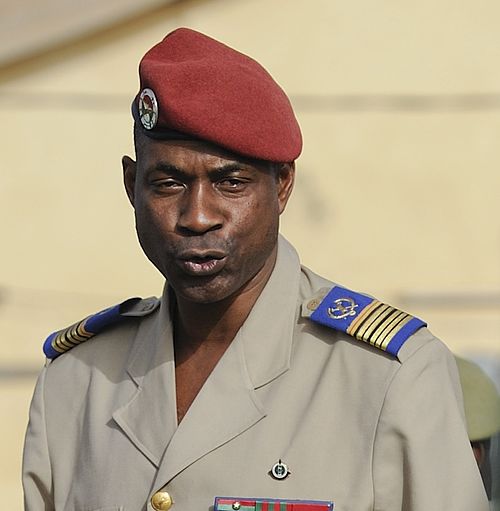
Gilbert Diendéré was born in 1960 in Diébougou — a town in the Bougouriba province of what was then Upper Volta, in the southwest of the country near the border with Ghana. His origins were in the rural provincial world of the Dagara people — one of the numerous ethnic communities of the south and west of Burkina Faso, distinct from the Mossi majority of the centre and north. He entered the military in the early 1980s, during the period of rapid political change that preceded and followed Sankara's August 1983 revolution — a period in which the military was the primary vehicle of political power in the country and in which military careers could be built with a speed that more stable institutional environments did not permit.
His rise within the revolutionary military was rapid — a reflection both of his specific abilities and of the specific character of Sankara's revolutionary government, which created opportunities for young officers of ability and commitment that the more cautious military hierarchies of conventional African armies did not. The appointment as commander of the Presidential Guard — the elite unit responsible for Sankara's personal security — was the position that placed him at the centre of revolutionary power and that would define everything that followed.
Under Sankara: The Revolutionary's Guardian
Thomas Sankara's government from 1983 to 1987 was one of the most genuinely revolutionary in African history — a government that combined pan-African solidarity, ecological consciousness, anti-imperialism, women's liberation, and a grassroots democratic programme of Committees for the Defence of the Revolution that attempted to build a participatory political culture from the village level upward. Sankara was a charismatic and principled leader whose personal lifestyle — riding a bicycle, refusing the trappings of the presidency, reducing his own salary — embodied the revolutionary values he proclaimed, and whose international standing — his friendship with Fidel Castro, his connections with the Libyan revolution, his public challenge to the World Bank and IMF in the name of African sovereignty — made him one of the most visible figures of the pan-African left in the 1980s.
Diendéré served as this man's personal protector. The specific trust that the role of Presidential Guard commander required — the absolute confidence that the man responsible for the leader's physical safety was personally loyal and professionally reliable — meant that Sankara had extended to Diendéré a degree of personal trust that the events of October 1987 would transform, in the historical memory of Burkinabè people, into the most devastating personal betrayal in their country's modern history.
15 October 1987: The Day the Revolution Died
The coup of 15 October 1987 was not a foreign intervention or an imperialist conspiracy of the kind that had ended other African revolutionary governments. It was a coup from within — carried out by Blaise Compaoré, Sankara's closest political colleague and one of the men who had made the 1983 revolution with him, using soldiers from within the same revolutionary military that Sankara had built. The specific political and personal dynamics that produced the coup — the growing tensions between Sankara and Compaoré over the direction of the revolution, the question of whether Sankara was planning to move against Compaoré, the specific roles of the various military factions — have been the subject of sustained investigation and debate since the opening of the Sankara assassination trial.
What the 2022 trial established — to the satisfaction of the military tribunal, with the conviction of Diendéré and other defendants — was that the coup was organised in advance and that specific individuals, including Diendéré, were implicated in its planning and execution to degrees that made them legally responsible for the murders. Sankara and twelve colleagues were shot. Diendéré was present at the National Revolutionary Council headquarters when the killings occurred. The trial's finding that he was complicit in the assassination — that his presence was not that of a horrified bystander but of a participant in what had been planned — was the historical judgment that his thirty-five years of subsequent career had been attempting to defer.
Twenty-Seven Years: The Shadow Power of the Compaoré Era
The Compaoré government that replaced Sankara's revolution governed Burkina Faso from 1987 to 2014 — twenty-seven years of increasingly conventional authoritarian rule, marked by periodic multiparty elections whose outcomes were managed, economic liberalisation under IMF and World Bank guidance that reversed much of the Sankara era's social programmes, and a regional foreign policy that made Burkina Faso a significant player in West Africa's conflict zones while making Compaoré one of the most useful intermediaries for Western powers attempting to manage the region's instability.
Diendéré was the operational intelligence of this period. His specific role — never fully public, always essential — combined the management of Burkina Faso's internal security with the specific foreign policy function that made Compaoré indispensable to his regional and international partners. He was involved in the peace negotiations in Côte d'Ivoire during that country's post-2002 civil conflict — serving as an intermediary between the Gbagbo government, the Forces Nouvelles, and the international community. He maintained connections to various armed movements across the Sahel and West Africa that gave the Compaoré government both intelligence value and leverage. He was, in the terminology of intelligence analysts, a key facilitator — the person who could make things happen because he knew who had what and what they wanted for it.
This role made him simultaneously valuable to his regional and international partners and deeply compromised in the judgment of those who believed that the connections he maintained — to armed groups, to illicit economic networks, to the specific political actors whose interests he was managing — were themselves a form of sustained political criminality. The specific allegations that have been made about his involvement in the trafficking networks and the armed group relationships of the West African borderlands are not fully resolved by the legal convictions he has received, which focused on the domestic crimes of the 1987 assassination and the 2015 coup rather than on the full scope of his regional activities.
The RSP: A Regime's Army Within the Army
The Regiment of Presidential Security that Diendéré commanded was the Compaoré regime's most reliable military instrument — an elite force that was trained, equipped, and paid at a level significantly above the rest of the Burkinabè army, and whose loyalty to Compaoré personally rather than to the Burkinabè state was the specific quality that made it useful as a regime instrument and dangerous as a post-Compaoré political problem. The RSP was, in military terms, one of the best-equipped and best-trained forces in Burkina Faso; it was also, in political terms, a private army of the former regime that had no legitimate function in the post-Compaoré transitional order.
The transitional government that took power after Compaoré's departure in October 2014 faced the specific problem of what to do with the RSP: dismantling it risked provoking the very coup that dismantling it was designed to prevent, while leaving it intact was accepting the continued existence of a regime force whose loyalty was to the deposed president rather than to the transitional government. The RSP coup of September 2015 was the consequence of the transitional government's failure to resolve this problem quickly enough — the RSP acting before it could be dismantled, attempting to restore the political order whose instrument it had been.
Thirteen Days: The Coup That Failed Completely
The RSP coup of September 2015 was one of the most completely failed coups in African history — not because it was poorly planned in the military sense but because the political conditions that might have sustained it did not exist. The Compaoré regime had been ousted by a genuine popular uprising, and the population that had taken to the streets to end twenty-seven years of his rule was not going to accept its restoration by military force. The regular Burkinabè army, which had ultimately sided with the popular uprising in October 2014, refused to recognise the RSP's seizure of power. ECOWAS applied immediate diplomatic and economic pressure. Regional governments that might have been sympathetic — Côte d'Ivoire, where Compaoré had taken refuge — calculated that recognition was too costly internationally to be worth the political benefit.
The thirteen days of the RSP coup produced one of the most dramatic images of the 2015 African political calendar: the crowds in Ouagadougou, burning and looting the headquarters of the Congress for Democracy and Progress — Compaoré's party — while the RSP's tanks sat in the streets unable to restore order. The popular rejection of the coup was overwhelming and unambiguous, and when the Burkinabè army finally moved against the RSP, Diendéré had no military option and no political support. He surrendered on 29 September 2015.
The 2022 Trial: Justice Deferred but Not Denied
The military tribunal that concluded in April 2022 with Diendéré's conviction for complicity in Thomas Sankara's assassination was a landmark event in Burkinabè and African political history — not only because it held one of the most powerful military figures of the Compaoré era accountable for one of the era's founding crimes, but because it demonstrated that African judicial systems could, under the right political conditions, pursue accountability for the political murders that authoritarian governments had committed and then suppressed for decades.
The trial had been in preparation for years — delayed repeatedly by the Compaoré government, which had no interest in investigating a crime that would implicate its own leadership, and then by the legal and logistical difficulties of assembling a case decades after the events and with the principal defendant, Compaoré himself, living in Côte d'Ivoire and declining to be extradited. Compaoré was tried in absentia and convicted; Diendéré was tried in person and convicted. The specific legal finding — complicity in murder, established through the evidence presented about his presence, his role, and the chain of command — was the judicial resolution of the question that Burkinabè people had been asking since the night of 15 October 1987.
Legacy: The Shadow That Darkened Two Eras
Gilbert Diendéré's significance to this project is uncomfortable in a specific way. He is not a liberation figure — he is a figure who was implicated in the destruction of one of Africa's most genuinely liberation-oriented governments and who spent the following three decades as the operational intelligence of the authoritarian regime that replaced it. His inclusion in a project about the struggle for human dignity and liberation requires the specific acknowledgement that liberation history includes the people who fought against liberation and whose stories are essential to understanding why liberation was so hard to achieve and so easily reversed.
He is also a figure of real historical significance in a region — West Africa — whose political history cannot be understood without understanding the specific role that military intelligence operators like Diendéré played in the management of the post-colonial order. The Compaoré era was not simply a story of one man's authoritarian ambition; it was a story of a specific political system — in which France, ECOWAS regional actors, international financial institutions, and local military power combined to maintain a form of post-colonial governance that served certain interests while suppressing others — and Diendéré was one of the key operational figures of that system. Understanding how the system worked requires understanding the people who made it work.
His conviction for Sankara's murder was the historical justice that the people of Burkina Faso had been demanding for thirty-five years, and the fact that it was eventually delivered — however inadequate any legal proceeding is to the moral dimensions of political murder — is a demonstration that accountability, however long deferred, is not impossible in African political life. Whether the conviction changes the historical memory that ordinary Burkinabè people have maintained of Thomas Sankara — the memory that has survived twenty-seven years of the Compaoré government's attempts to suppress it — is a different question. That memory does not need a court to sustain it.