At a Glance
Porto-Novo in 1913: The World That Made a Pragmatist
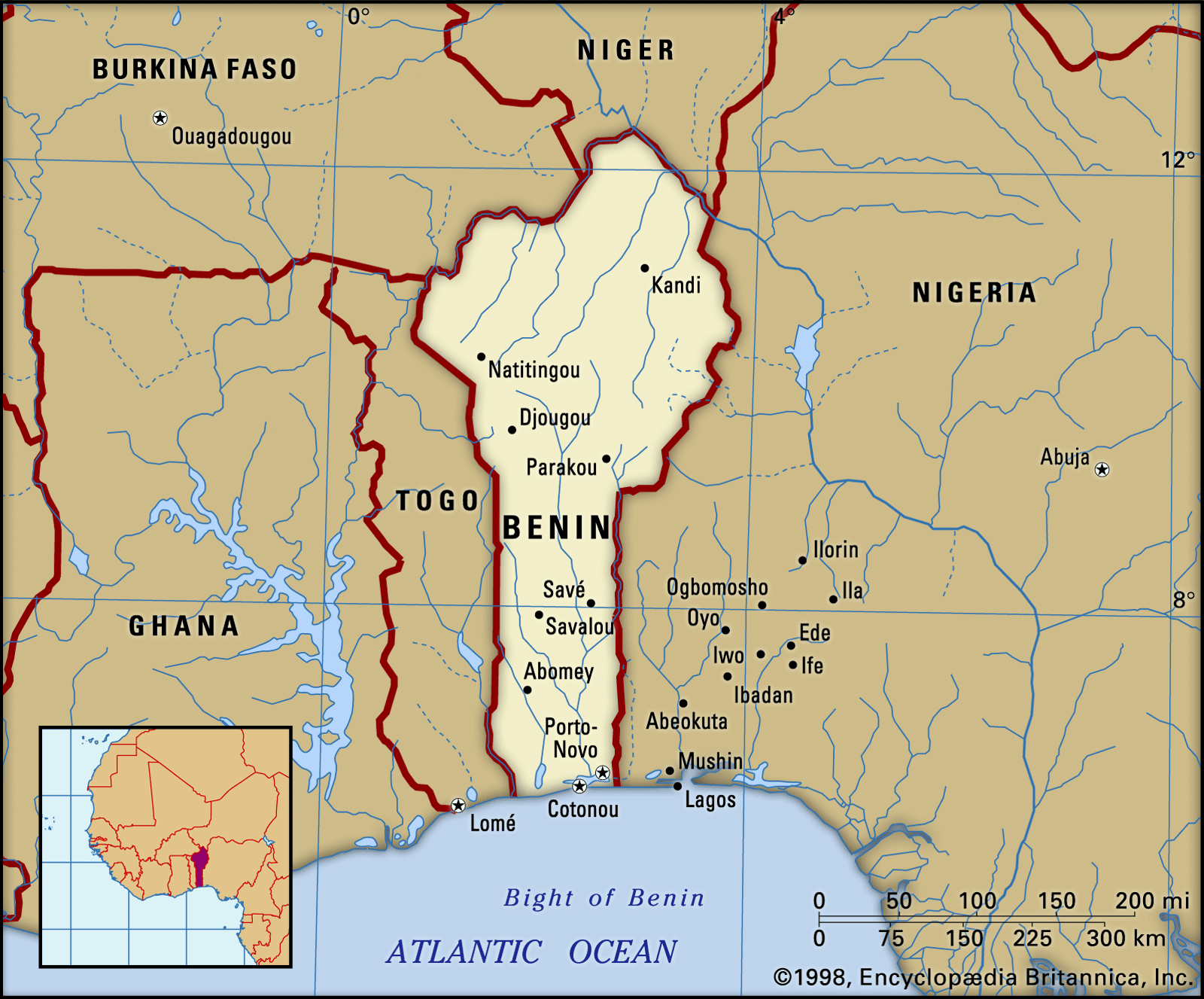
Sourou-Migan Apithy was born on 8 April 1913 in Porto-Novo — Dahomey's administrative capital and its most educationally advanced city, where the concentration of Catholic mission schools, the presence of the colonial administration, and the specific character of the Yoruba-influenced coastal community had produced the highest density of formally educated Africans in the territory. Porto-Novo's educational advancement reflected its specific colonial history: the city had been a centre of French colonial administration from early in the colonial period, and the missions that provided education had been established there before they had penetrated into the interior. The result was a community that had had more time to develop the educational institutions, the professional networks, and the political consciousness that colonial education eventually produced.
The Yoruba connection — Porto-Novo's Yoruba-speaking communities shared language, culture, and social networks with the Yoruba of neighbouring Nigeria — gave the city a cross-border dimension that most Dahomean cities did not have. The political and commercial connections that ran across the Dahomey-Nigeria border were a resource for the Porto-Novo community, giving it access to the much larger economic and political world of the Lagos hinterland and the connections to the broader Yoruba cultural world that gave it a cosmopolitan character beyond its size. Apithy grew up in this environment and his political career drew on it — both in the sense that his constituency in Porto-Novo gave him a base with these specific characteristics, and in the sense that his cross-border connections and his experience of the Yoruba world shaped his political horizons.
Paris, Economics, and the Formation of a Financial Mind
Apithy's decision to study economics and accounting in Paris — at the École Supérieure de Commerce, one of France's prestigious business schools — reflected both his specific intellectual inclinations and the practical calculation that financial expertise was among the most useful professional qualifications for someone planning to contribute to the governance of a postcolonial state. The colonial system had trained teachers and administrators in large numbers; it had trained very few accountants and economists. The gap between the supply of financial expertise and the demand that independence governance would create was one of the structural vulnerabilities of the postcolonial order, and Apithy's decision to fill part of that gap by acquiring financial training was a specific contribution to the independence generation's collective capacity.
His years working in the metropolitan financial world gave him something that formal education alone could not have provided: practical knowledge of how the French financial system actually operated, how French companies and financial institutions made their decisions about Africa, and what the specific mechanisms of financial dependency looked like from the inside. This knowledge shaped his approach to economic policy as a minister and as a president — not a programmatic vision of economic transformation but a practical understanding of the specific fiscal, monetary, and institutional constraints within which any Dahomean government would have to operate, and a realistic assessment of what was achievable within those constraints.
The First Deputy: Navigating the Metropolitan Political World
Apithy's election to the French National Assembly in 1945 placed him in a political world that no Dahomean had previously inhabited at the national level — the world of the French parliament, of metropolitan political parties, of the governmental negotiations and legislative processes through which France managed its relationship with its overseas territories. The fifteen years of metropolitan parliamentary experience that he accumulated between his first election and Dahomean independence in 1960 gave him a political formation that was simultaneously more sophisticated and more metropolitan in its orientation than those of the politicians who entered the independence era with less metropolitan experience.
He learned, in the Paris of the late 1940s and 1950s, how French politics actually worked: the coalition dynamics of the Fourth Republic's fragmented parliament, the specific interests and limitations of the different political parties, the ways in which African deputies could build alliances with metropolitan politicians across party lines to advance specific African interests, and the fundamental asymmetry of power between a metropolitan parliament where African deputies were a small minority and the colonial territories where those same politicians were the primary political figures. This asymmetry — the experience of being powerful at home and marginal in Paris — shaped his understanding of the relationship between formal political participation and real political power in ways that influenced his subsequent approach to independence.
The PRD and the Catholic Pragmatist's Programme
The Parti Républicain du Dahomey that Apithy founded was the institutional vehicle for his specific political vision — a Catholic, moderate, development-oriented nationalism that sought to advance Dahomean interests through the French institutional framework rather than in opposition to it. The PRD's programme emphasised economic development through continued French engagement, educational expansion, and administrative modernisation — a pragmatic agenda that prioritised the improvement of people's material conditions over the ideological assertion of sovereignty. It was not an exciting programme, and it was not designed to be: Apithy was not a politician who believed in exciting his constituency with visions of transformation. He was a politician who believed in managing the specific, technical, unglamorous work of development effectively.
The PRD's base in Porto-Novo and the Yoruba southeast rewarded this approach. The Porto-Novo community's educational sophistication meant that its political culture placed a relatively high premium on competence as a criterion for political support — voters who were educated enough to evaluate the quality of governance rather than simply the quality of the political performance that governance produced. This gave Apithy a constituency that was relatively loyal to him across the political instability of the independence decade, maintaining his political relevance even through the periods when the three-way competition had made effective governance impossible.
Vice President, President, Removed: The Revolving Door
Apithy's path through the independence decade's revolving political arrangements illustrates the specific character of Dahomean political instability with particular clarity. He was vice president under Maga's first government, president in his own right from January to November 1964, partner in the various coalition arrangements that the military governments imposed as they attempted to manage the three-way deadlock, participant in the rotating presidential council of 1970–72, and finally imprisoned along with his two rivals by Kérékou's 1972 coup. The specific duration and character of each phase reflected the specific balance of political forces at each moment — which of the three rivals had the most favourable coalition configuration, which had the military's current preference, which had made the political mistakes most recently.
His presidency of January to November 1964 — the shortest of the three rivals' formal presidential tenures — collapsed through the combined pressure of Ahomadégbé's opposition and the specific tensions that the Apithy-Ahomadégbé coalition government had generated. The coalition had been formed as a formula for managing the three-way competition by giving the two southern leaders joint control of the government, but the political logic of the arrangement was self-defeating: two men who each believed they should be president, governing jointly, with neither able to subordinate his political interests to the other's, produced not the functional government the coalition's designers had hoped for but the more intense version of the competition that had been the problem all along.
The Pragmatist in Retrospect: Moderate Nationalism and Its Vindication
Sourou-Migan Apithy died in Porto-Novo in December 1989 — three months before the National Conference of February 1990 that established Benin's democratic order, and six years before Benin's democratic consolidation had demonstrated its durability. He did not live to see the full institutional expression of the political tradition he had represented, but the connection between his moderate, pragmatic, Catholic nationalism and the specific character of democratic Benin is real and worth acknowledging.
The democratic Benin that the National Conference established — with its emphasis on competitive multiparty elections, rule of law, human rights protection, and the technical competence of government — was closer in spirit to Apithy's political programme than to the more radical visions of his rivals. The Benin model of democracy, which has been studied across Africa as an example of successful peaceful democratic transition, drew on a specific Beninese political tradition of civil society engagement, professional institutional capacity, and pragmatic compromise — the tradition that the Porto-Novo community's educational engagement and the Catholic institutional networks had sustained through the colonial and independence decades. Apithy was one of the founders of that tradition, and its eventual institutional expression in democratic Benin is part of his legacy, even though he did not live to see it fully realised.