At a Glance
Abomey: The Capital of a Kingdom That France Conquered
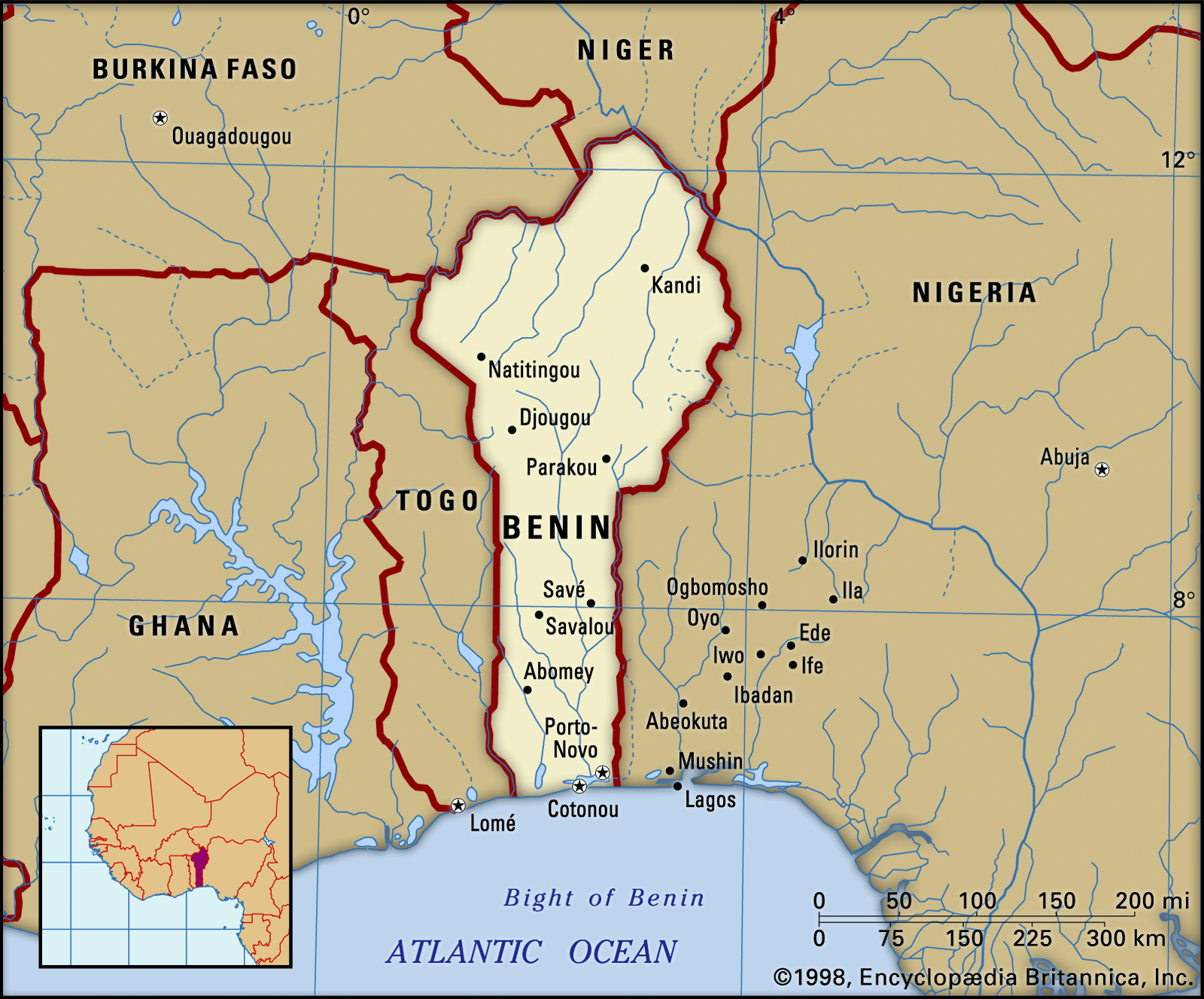
Justin Ahomadégbé was born in 1917 in Abomey — one of the most historically resonant cities in all of West Africa, the capital of the Fon kingdom of Dahomey that had been one of the region's most powerful and most sophisticated political formations from the seventeenth century until French conquest in 1894. The Fon kingdom had built an extraordinary state: a centralised monarchy with professional armies, an elaborate administrative system, a tradition of female soldiers — the Agojie, or Dahomey Amazons — that was unique in the military history of the continent, and a political culture that had maintained Fon sovereignty against neighbouring states and against the first French attempts at penetration for over two centuries before the military defeat of 1894.
The memory of this sovereignty — the knowledge that the Fon had governed themselves as a powerful state before French conquest, that they had been conquered rather than simply absorbed into the colonial framework, that they had traditions of political organisation and military achievement that predated and exceeded the colonial order — gave the communities of the Abomey plateau a specific political consciousness. The independence movement in the Fon heartland was not simply a demand for self-governance in the abstract; it was a demand for the restoration of a sovereignty that French conquest had interrupted and that the Fon historical memory kept alive as a reference point for what African political achievement had actually looked like before colonialism claimed to have brought civilisation to a people who had built one of West Africa's most sophisticated states without European assistance.
The Lawyer in a Political World of Schoolteachers
Ahomadégbé's training in pharmacy and then law gave him a professional formation distinct from the schoolteachers and administrators who dominated the Dahomean political class. In a political world where most of the significant figures had been formed through the William Ponty School's teacher-training programme and had built their careers in the colonial educational and administrative systems, the lawyer stood out — not only because of the specific intellectual skills that legal training provided but because of the professional independence that private legal practice offered relative to the dependence on civil service employment that characterised the careers of teacher-politicians.
The lawyer's specific intellectual contribution to political life was the ability to construct and demolish arguments with a precision and a rhetorical force that the more broadly generalist formation of the schoolteacher-politician did not always provide. Ahomadégbé brought to the debates of the independence decade the forensic precision of a man who had been trained to build cases from evidence, to identify the weaknesses in opposing arguments, and to make the strongest possible presentation of his own position in adversarial conditions. This made him a formidable debater and a difficult coalition partner — the combination of intellectual ability and combative style that made the three-way deadlock so intractable.
The Socialist Programme: What Made Ahomadégbé Different
Ahomadégbé's UDD programme was more explicitly socialist than those of his rivals in ways that reflected both his intellectual formation — the influence of French socialist thought, of the pan-African left's economic analysis, and of the trade union movement's class-based politics — and his specific political calculation that the language of economic sovereignty and workers' interests would resonate most strongly with the Fon communities and the urban workers who formed his core constituency. Where Maga offered northern representation and Apithy offered coastal pragmatism, Ahomadégbé offered a vision of economic transformation — of a Dahomey that used the instruments of state power to redirect the colonial economy's benefits toward the majority of the population rather than toward the French commercial interests and the small African political elite that the independence transition was threatening to empower at everyone else's expense.
The programme was genuine — it reflected real intellectual commitments that Ahomadégbé maintained consistently across his political career — but it was also a political strategy, a way of differentiating himself from his rivals in a three-way competition where regional identity alone was not sufficient to build a winning coalition. By claiming the socialist space that Maga's northern conservatism and Apithy's coastal pragmatism left open, Ahomadégbé positioned himself as the candidate most likely to attract the urban workers and the younger generation of educated Dahomeans whose political consciousness had been shaped by the socialist currents of the pan-African independence moment. The strategy was partially successful — it gave him a base that extended beyond the Fon heartland into the urban trade union world — but it also made him the most threatening of the three rivals in the eyes of the French government and the more conservative elements of Dahomean society, and it contributed to the specific hostility with which Kérékou's government treated him after the 1972 coup.
The Combative Style and the Cost of Confrontation
Ahomadégbé's confrontational political style was one of the most consistent elements of his political personality across his entire career — and it was simultaneously one of the sources of his political effectiveness and one of the primary reasons the three-way coalition politics of independence Dahomey proved impossible to manage. He was not a politician who believed in the quiet accommodation of competing interests through private negotiation; he was a politician who believed in the public assertion of position, the exposure of the opponent's weaknesses, and the demonstration of political will through sustained pressure rather than through the give-and-take of compromise.
This style energised his followers — who understood his confrontational energy as an expression of genuine commitment to their interests rather than as the willingness to trade those interests away for personal advantage — but it made working with him in coalition government an experience that his coalition partners found exhausting and often untenable. The specific dynamics of the coalition governments of the independence decade — in which each of the three leaders served simultaneously as the government's partner and as its most dangerous political opponent — were partly the product of the structural impossibility of the three-way competition and partly the product of the specific ways in which Ahomadégbé's confrontational style made compromise maximally difficult. His colleagues had legitimate grounds for finding him difficult to work with, and he had legitimate grounds for finding their accommodation with the status quo unsatisfactory. Both assessments reflected real political differences that political style expressed but did not create.
Eleven Years: The Price of Having Been Chairman When the Coup Came
Ahomadégbé was imprisoned for eleven years — from October 1972 to 1981 — the longest imprisonment of the three independence-era leaders who were imprisoned simultaneously by Kérékou's coup. The specific length of his imprisonment reflected several factors: his status as the sitting head of state at the moment of the coup, which made his political threat to the new government more immediate; his reputation as the most radical of the three leaders, which made him potentially more dangerous to a Marxist government that was competing for the same political space on the left; and possibly Kérékou's specific political calculation that the Fon communities of Abomey needed to have their most prominent political figure demonstrably under control before the new government could assert its authority in the region.
Eleven years of imprisonment — from the age of fifty-five to sixty-six — is not a trivial experience for any human being, and the specific conditions of Ahomadégbé's imprisonment under Kérékou's government, which was not known for treating its political prisoners with great consideration, are not fully documented in the available sources. What the duration of the imprisonment demonstrated was the seriousness with which Kérékou's government regarded him as a political threat, and the consistency with which he maintained his political identity through the imprisonment demonstrated the depth of his personal commitment to the values and the programme that had defined his political career.
Democratic Benin and the Completion of a Life in Politics
Ahomadégbé's participation in the National Conference of 1990 — the gathering that peacefully negotiated Benin's transition from Kérékou's Marxist single-party state to a democratic constitutional order — connected the democratic transition to the independence generation in the most direct possible way. He was present as a man who had been the country's head of state twice over, who had been imprisoned for eleven years for his political commitments, and who had survived to see the political order that had imprisoned him give way to the kind of democratic pluralism that he had, in his best political moments, been working toward. His presence in the conference gave it a historical depth and a moral weight that the participation of the younger generation alone could not have provided.
He died in Porto-Novo in October 2002, three years into democratic Benin's second decade, at eighty-five years old. He had outlived Maga — who had died in May 2000 — and had witnessed the consolidation of the democratic order that the National Conference had established. The Benin that he died in was not the Dahomey that he had tried to build — it was something different, shaped by the failures and the achievements of the entire political generation he had belonged to, by the Marxist interlude that Kérékou's government had imposed, and by the democratic experiment that the National Conference had begun. But it was a country with functioning institutions, a competitive political system, and a tradition of peaceful transfers of power that the Dahomey of the three-way deadlock had never achieved. That achievement was partly built on the foundations of the independence generation's struggles, however contradictory and self-defeating those struggles had often been, and Ahomadégbé's long, difficult, ultimately surviving life was one thread in the fabric from which it was woven.