At a Glance
Tessaoua and the Political Economy of Hausa Niger
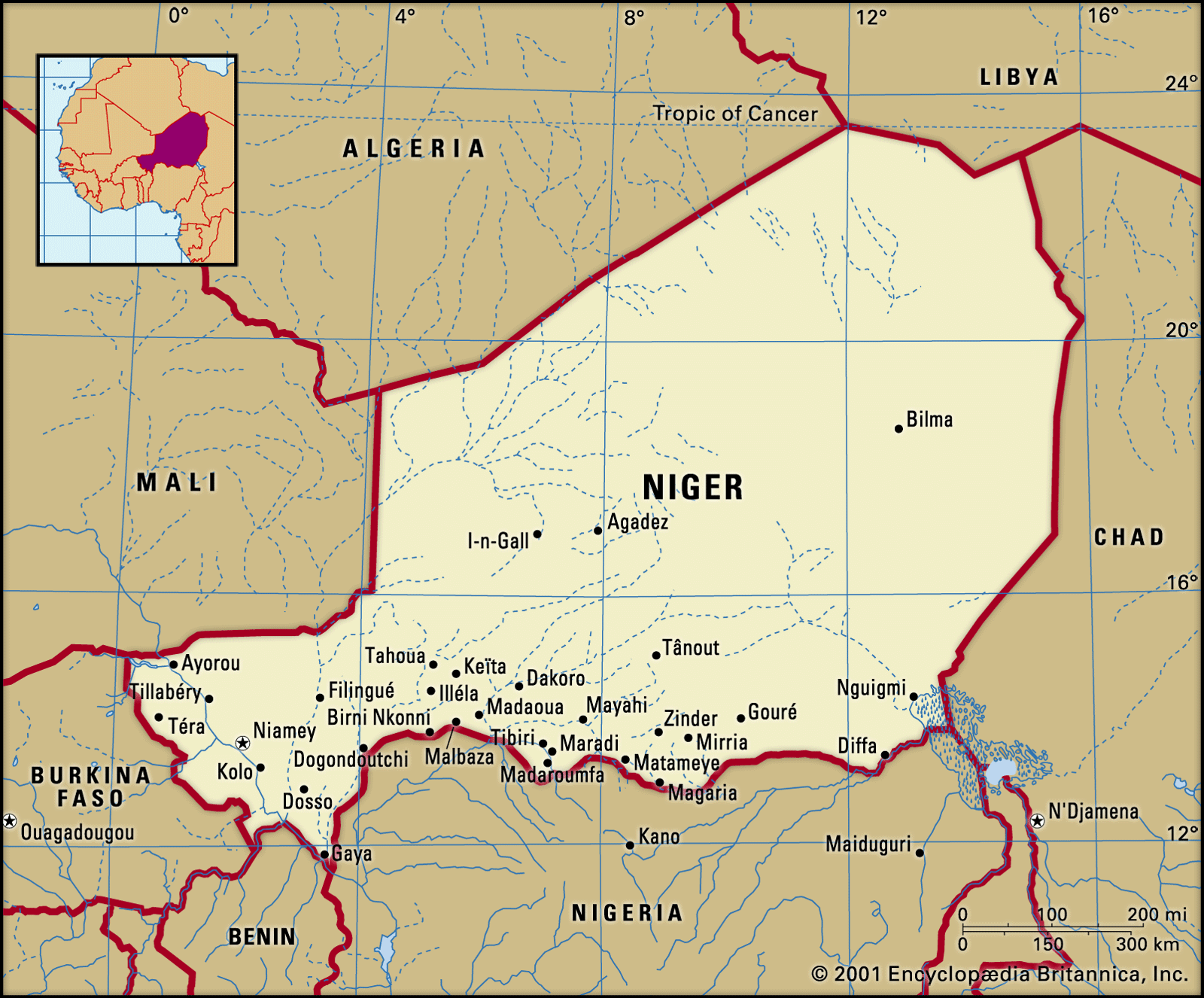
Djibo Bakary was born in 1922 in Tessaoua, in the Maradi region of what would become Niger — the southern, Hausa-speaking agricultural zone that was the most densely populated part of the territory and that had the most direct and most intensive experience of French colonial extraction. The Maradi region was groundnut country — the cash-crop economy that the French colonial system had imposed on Hausa farmers, requiring them to devote significant portions of their land and labour to the production of groundnuts for French processing companies rather than the subsistence crops that had sustained communities through the inevitable cycles of Sahelian drought. The colonial tax system reinforced this compulsion: taxes had to be paid in cash, and cash could only be earned through the sale of export crops, which meant that the structural poverty of the Hausa farmer was not an accident of nature but an outcome of deliberate economic organisation.
This was the world that formed Bakary's political consciousness. His trade union work brought him into contact with the urban wage workers of Niamey and the other towns — the railway workers, the postal employees, the government clerks, the teachers — who formed the organised labour base from which the radical wing of West African nationalism drew its energy. But his political roots in the Maradi region connected him to the mass of Hausa peasant farmers whose grievances were not about wages and working conditions but about land, crops, taxes, and the organised extraction of their agricultural surplus by a colonial system that they had not chosen and that they could not exit.
The CGT, the MSA, and the Trajectory of Radicalisation
Bakary's radicalisation followed the trajectory that many West African trade unionists of his generation took: from the CGT's colonial networks — which connected African workers to the French Communist Party's international labour organisation and through it to a specific tradition of political analysis that placed class exploitation at the centre of colonial power — to the development of an Africanised political programme that applied that analysis to the specific conditions of West African colonialism. The Mouvement Socialiste Africain that he helped to build was one of the vehicles for this Africanisation — an attempt to develop a West African socialist politics that was neither a mechanical transplant of European communist theory nor a moderate nationalism that left the economic structures of the colonial system intact.
His relationship with the Rassemblement Démocratique Africain — the dominant political organisation in French West Africa — was one of progressive estrangement. The RDA under Houphouët-Boigny had moved from a radical anti-colonial position in the late 1940s, when it was allied with the French Communist Party and conducted a sustained campaign against colonial abuses, to a more accommodationist position in the early 1950s, when the combination of French repression and the Cold War political climate persuaded Houphouët-Boigny to break with the PCF and pursue a more moderate path toward independence within a reformed French framework. For Bakary, this shift was a betrayal — a substitution of the interests of the African political elite who would benefit from managed independence for the interests of the African masses who needed the kind of economic transformation that accommodation with the French system would prevent.
The Referendum of 28 September 1958: The Most Important Vote in Niger's History
De Gaulle's constitutional referendum of September 1958 was the defining political event of the French African independence decade — the moment at which the territories of French Africa were required to choose, in a single vote, between the gradual path to autonomy within the French Community that a Yes vote offered and the immediate independence that a No vote would bring, along with all the costs that de Gaulle had made clear would accompany it. The choice was presented as a choice between orderly transition and precipitate rupture, between the security of continued French connection and the risks of immediate self-governance.
Bakary understood it differently. For him the referendum was a choice between genuine independence — however difficult its immediate consequences — and a form of managed autonomy that would preserve the essential structures of French economic control while providing the forms of political sovereignty without its substance. The French Community that a Yes vote would join was not, in his analysis, a path to genuine independence but a mechanism for indefinite continuation of the colonial relationship under a different institutional label. The immediate costs of No — the French withdrawal of administrators, technicians, and aid that de Gaulle had promised — were real but temporary, and the alternative, which was the permanent entrenchment of neo-colonial dependency, was worse.
He campaigned for No with the full resources of his government and his movement. He travelled across the territory arguing the case, mobilising the Sawaba's networks, attempting to persuade a population that had been told by the French administration and by the RDA's Yes campaign that No meant ruin. The French administration's response to his campaign was not neutral: administrators used their influence to promote the Yes vote, the RDA's extensive networks were mobilised against him, and the counting process in several regions was subsequently challenged as irregular. The Yes vote prevailed in Niger, but more narrowly than in most other French African territories — a result that reflected Bakary's genuine political base and the real support that the independence programme had in the Hausa-speaking south.
The Asymmetry of Consequences: Why Bakary Lost and Guinea Won
The comparison with Guinea is essential for understanding what happened to Bakary and why his No campaign ended his career while Sékou Touré's No campaign made Touré a continental hero. Guinea's No vote prevailed — 95 percent of Guinean voters chose No — while Niger's No vote lost. This asymmetry of outcomes produced an asymmetry of consequences that shaped everything that followed: Touré became president of an independent Guinea, received pan-African solidarity and Soviet and Chinese support to replace the French aid that was withdrawn, and managed the immediate post-rupture period well enough to establish Guinea as a functioning state. Bakary lost the vote, lost his government, and lost his country to the man who had campaigned against him.
The causes of this asymmetry were several. Guinea had a more unified political leadership behind the No campaign — Touré's Parti Démocratique de Guinée was hegemonic in Guinean politics in a way that the Sawaba, competing against the PPN-RDA, was not in Niger. Guinea had more developed trade union organisation and a more urbanised political culture that was more receptive to the radical programme. And Guinea's geographic position — on the Atlantic coast, with access to international trade routes — gave it more immediate economic viability as an independent state than landlocked Niger, where the French threat to withdraw all assistance was more immediately credible and more immediately frightening.
For Bakary, the lesson was brutal: the courage of the political choice was not sufficient to determine its outcome, and the consequences of a courageous choice that failed fell entirely on the person who made it. He had taken the risk, argued the case, and lost — and the loss was absolute. The French administration did not distinguish between a noble opposition and a criminal one: the man who had campaigned for No was removed from power, replaced by the man who had campaigned for Yes, and the political order that resulted was built on his exclusion.
Exile: Guinea, the Sawaba Guerrillas, and the Long Frustration
Bakary's years of exile from Niger — which lasted, in various forms, from the late 1950s until the 1970s — were years of sustained political frustration. Operating from Guinea under Sékou Touré's protection, and later from other African capitals, he attempted to maintain the Sawaba as a viable political force and to develop the capacity for clandestine operations inside Niger that might eventually dislodge the Diori government and restore the possibility of the genuine independence he had been working for.
The Sawaba guerrilla operations of 1964–65 were the most dramatic of these attempts — clandestine incursions into Niger by trained fighters attempting to build underground networks, establish liberated zones, and trigger the popular uprising that Bakary's analysis told him the conditions were ripe for. The operations failed. The Nigerien security forces, with French intelligence support, had penetrated the Sawaba's networks thoroughly enough to locate and suppress the guerrilla cells before they could establish themselves. The fighters who entered Niger were killed or captured. The hoped-for popular rising did not materialise — partly because the repression that followed the failed operations made visible political support for Sawaba extremely dangerous, and partly because the Diori government had successfully managed the political terrain in ways that left Bakary without the organised support base that the operation required.
The failure of the guerrilla operations was the effective end of the Sawaba as a force capable of challenging the Nigerien state from outside. Bakary continued in exile, attempting to maintain political connections and to find the international support that might give the movement a new opening, but the combination of Diori's domestic political consolidation and the shifting international climate — in which the major powers that might have supported a radical Nigerien opposition were finding other priorities — meant that the opening never came.
The Man Sékou Touré Sheltered and What He Stood For
The years in Guinea gave Bakary a close view of what the No vote had produced for Touré's territory — and the view was mixed in ways that complicated the simple comparison between Guinea's independence and Niger's continued dependency. Guinea under Sékou Touré was genuinely independent in the sense that mattered to Bakary: it had broken with the French Community, expelled the French administrators, refused the Franc Zone's monetary discipline, and pursued an explicitly socialist economic programme. It had also become, by the early 1960s, a one-party state of increasing authoritarianism — a state in which the independence that had been won against French colonial power was being used to suppress internal political opposition with methods that were not obviously different from those of the colonial system.
This created an intellectual tension that Bakary navigated without fully resolving. He was committed to the programme of genuine independence against French neo-colonialism. He was also, as a socialist, committed to the liberation of people rather than simply of territories. The gap between these commitments — the possibility that independence from France might be achieved at the cost of new forms of domination by independent African states — was the central problem that radical African nationalism of his generation never fully answered, and the example of Guinea under Touré made that problem vivid in ways that were uncomfortable for someone sheltered by Touré's government.
Return, Reconciliation, and the Question of What Was Worth It
Bakary's return to Niger in the 1970s — facilitated by the 1974 coup that had overthrown Diori and removed the specific political obstacle to his return — was an act of reconciliation with a political reality he had spent most of his adult life resisting. He accepted a form of participation in Nigerien political life that fell far short of the programme he had fought for, lived through the Kountché military government and the subsequent democratic transitions, and eventually achieved a degree of official recognition as a figure of the independence generation whose contribution to the national story deserved acknowledgement.
The acknowledgement was genuine but incomplete. Bakary was recognised as a man who had made a historically significant choice — who had voted No when the easier and safer choice was Yes, who had paid the price of that choice with decades of exile, and who had maintained his commitments through the long years of exclusion. What the official recognition was less willing to engage with was the substance of what he had been arguing — that the independence Niger received in 1960 was not the independence he had been seeking, that the Franc Zone and the uranium contracts and the French military presence that continued long after formal independence were the evidence that his analysis had been correct, and that the costs of the managed independence that Diori's Yes vote had produced were costs that the Nigerien people were still paying.
Legacy: The Road Not Taken
Djibo Bakary's legacy is the legacy of the road not taken — of the political choice that was made and then reversed by forces outside his control, and of the question that reversal leaves permanently open: what would Niger have looked like had the No vote prevailed? The question is unanswerable with any certainty, and the example of Guinea — which also voted No and which did not achieve the development outcomes that its independence was supposed to enable — provides a cautionary counterpoint to any simple celebration of the No vote as the obviously correct choice.
What can be said is that Bakary was right about the fundamental character of what France was offering in 1958: the Yes vote produced exactly the managed independence that he had argued was not real independence, and the subsequent history of Niger — the Franc Zone dependency, the uranium wealth that enriched France while Niger remained among the world's poorest countries, the French military interventions that protected compliant governments against their populations — confirmed his analysis more clearly than his opponents' analysis. He was right about the problem. He was unable to solve it. That combination — correct analysis, defeated programme — is one of the characteristic tragedies of the African independence generation, and Djibo Bakary lived it more completely than most.