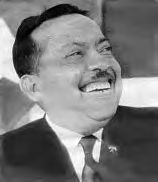
At a Glance
Vega Alta, Legal Education, and the Formation of a Democratic Nationalist
Gilberto Concepción de Gracia's path to the Puerto Rican independence movement ran through the legal profession — through the specific formation of a lawyer trained in the analysis of rights, sovereignty, and the relationship between political arrangements and legal principles, and possessing the practical skills of argument, organisation, and institutional engagement that effective legal advocacy requires. His legal education was not merely a professional credential; it was the intellectual framework through which he understood Puerto Rico's political situation and the means through which he would work to change it.
The Puerto Rico he grew up in was a territory in the process of being remade by American territorial rule — its educational system redesigned to teach in English and to promote American cultural values, its economy reshaped by American corporate investment and the displacement of the smallholder agriculture that had sustained the jibaro communities of the interior, its legal system reconstructed along American lines in ways that sometimes conflicted with the Spanish legal traditions the island had inherited. A legally trained observer of this transformation had specific tools for analysing it — for identifying the precise ways in which American colonial rule violated the legal principles that the United States itself claimed to uphold, and for making those violations legible to the international legal community in terms that the emerging post-war framework of international law recognised as significant.
His wartime service in the United States Army during the Second World War added a personal dimension to this analytical perspective. Puerto Ricans served in large numbers in the American military during the war — drafted as American citizens, but citizens of a territory without voting representation in the Congress that declared the war and without full participation in the democratic processes that their service was supposed to be defending. The experience of fighting for a democracy that did not fully extend to his own people gave Concepción de Gracia's subsequent independence advocacy a specific moral authority: he had done what the colonial power asked of him, and he was now asking the colonial power to honour its own principles.
The Break with Muñoz Marín and the Founding of the PIP
The critical political decision that defined Concepción de Gracia's career was his break with the Popular Democratic Party and its leader Luis Muñoz Marín in the years immediately after the war. Muñoz Marín was the dominant figure in Puerto Rican politics in the late 1940s — a charismatic populist whose jibaro-focused political culture and whose programme of economic development through American industrial investment had built the Popular Democratic Party into a mass movement with genuine popular support. He had once been an independence advocate himself, but he had moved away from independence in favour of the Commonwealth arrangement — a form of limited self-government within American sovereignty that he argued was the most practical path to improving Puerto Rican living standards while maintaining the economic relationship with the United States that Puerto Rico's development required.
Concepción de Gracia's rejection of this position was fundamental and principled. He regarded the Commonwealth as a form of colonial rule that had been given a new name — a solution that changed the form of Puerto Rico's subordination without changing its substance, that preserved American control over the fundamental political and economic decisions affecting Puerto Rico while packaging that control as self-government. He was particularly concerned about the international legitimacy that the Commonwealth arrangement was designed to provide — about the American strategy of using the Commonwealth status to have Puerto Rico removed from the United Nations' list of non-self-governing territories, thereby removing the international community's oversight of the decolonisation process.
The Puerto Rican Independence Party that he founded in 1946 was designed to pursue independence through the democratic processes that Puerto Rico now had — through elections, through legal advocacy, through the mobilisation of public opinion both on the island and internationally. The PIP was explicitly committed to democratic means and democratic accountability, distinguishing itself from the Nationalist Party's willingness to use armed force and from the Popular Democratic Party's accommodation with colonial rule. It was the independence movement's institutional home for those who believed that independence was the right goal and that democratic politics was the right means.
The UN Campaign: Internationalising the Puerto Rican Cause
One of Concepción de Gracia's most important strategic decisions was to bring the Puerto Rican independence cause before the United Nations — to situate Puerto Rico's claim to sovereignty within the framework of international law and the global decolonisation movement that was reshaping the political map of Asia and Africa in the 1950s. This strategy reflected his understanding that the Puerto Rican independence movement could not win its case within the American political system alone — that the balance of power between the independence forces and the forces supporting Commonwealth or statehood was too unfavourable for electoral politics alone to produce independence, and that the international community's recognition of Puerto Rico's right to self-determination was both a moral and a practical resource for the movement.
His arguments before the UN Decolonisation Committee drew on the specific language and principles of the UN Charter — the right of all peoples to self-determination, the obligation of member states not to maintain colonial arrangements — to make the case that Puerto Rico's relationship to the United States was a violation of these principles regardless of the Commonwealth status and regardless of the UN's 1953 decision to remove Puerto Rico from its list of non-self-governing territories. The American government's strategy of using the Commonwealth to foreclose international oversight was, in his argument, itself a form of manipulation — an attempt to use the institutions of international law to legitimise an arrangement that violated the principles those institutions were supposed to uphold.
The international dimension of his advocacy connected the Puerto Rican cause to the broader anticolonial movements of the mid-twentieth century — to the independence movements of Africa and Asia that were transforming the United Nations and the global political order in the 1950s and 1960s. Concepción de Gracia understood the Puerto Rican case as part of this global movement and argued for it in those terms, insisting that the principles the international community was applying to British, French, and Dutch colonial possessions should be applied with equal consistency to American ones.
Electoral Politics, Nineteen Percent, and the Long Institutional Presence
The PIP's peak electoral performance in the 1952 elections — approximately nineteen percent of the vote — was a remarkable achievement for a party whose platform required voters to choose a fundamental transformation of their political relationship to the United States at a moment when the Commonwealth was delivering tangible economic improvements and when the Nationalist uprising of 1950 had associated independence activism with violence in the minds of many Puerto Ricans. Nineteen percent represented a substantial constituency for independence — not a majority, but a significant political force that kept the independence option genuinely alive in electoral politics.
The subsequent decline of the PIP's electoral share reflected the multiple pressures that worked against the independence position: the genuine improvements in Puerto Rican living standards that the Commonwealth's industrialisation programme produced in the 1950s and 1960s, the association of independence with the Nationalist violence of 1950 and 1954, the political skill with which Muñoz Marín's Popular Democrats consolidated their dominance of Puerto Rican politics, and the difficulty of maintaining a movement committed to a fundamental transformation against the political and economic incentives for accommodation. But the decline in electoral share did not mean the disappearance of the independence conviction, and the PIP maintained enough of an institutional presence to keep the democratic independence option viable.
Concepción de Gracia ran for governor of Puerto Rico multiple times without success, accepting the defeats with the discipline of a democratic politician who understood that losing elections was not the end of political life but part of its texture. His consistency across two decades of electoral politics — building the institution, maintaining the argument, accepting the results while continuing to make the case — was the democratic complement to the armed independence tradition's more dramatic sacrifices, and it was in many ways more difficult to sustain across time.
Legacy: The Party That Outlasted Its Founder
Gilberto Concepción de Gracia died on 16 March 1968, at the age of fifty-eight — too young for a political leader who had spent twenty-two years building an institution that needed him. The Puerto Rican Independence Party that he had founded in 1946 survived him and continues to operate today as the principal democratic vehicle for the independence cause, maintaining in contemporary Puerto Rican politics the institutional presence that he built from the beginning. It is his most durable monument.
His significance in the history of the Puerto Rican independence movement lies precisely in what distinguishes him from the more dramatically celebrated figures of the tradition — from Pedro Albizu Campos and Blanca Canales and Lolita Lebrón and Filiberto Ojeda Ríos, whose martyrdoms and imprisonments give the movement's history its emotional intensity. Concepción de Gracia's contribution was less dramatic but in some respects more demanding: the patient, decade-long work of building a democratic institution in conditions that rewarded accommodation, maintaining an argument for fundamental change in a political culture that increasingly preferred the known benefits of the status quo to the uncertain prospects of independence, and demonstrating through consistent democratic practice that the independence movement was capable of the institutional discipline that genuine self-governance would require.
Puerto Rico's political status remains unresolved. The PIP he founded continues to make the case for independence through the democratic processes he committed it to. His argument — that Puerto Rico's sovereignty was a matter of right that the international community was obligated to recognise and that Puerto Ricans were capable of governing themselves if given the opportunity — has not been vindicated by events in the sense of having produced independence. But it has not been refuted either, and the institution he built to make it remains as the most persistent democratic expression of the conviction that Puerto Rico deserves to be free.