At a Glance
Abeokuta and the World That Made Her
Abeokuta — the city built around and beneath the great Olumo Rock by the Egba Yoruba who had fled the violence of the early nineteenth-century Yoruba wars — was by the time of Funmilayo Ransome-Kuti's birth in 1900 one of the most politically complex and culturally rich towns in colonial Nigeria. The Egba had negotiated a specific relationship with British colonial authority that preserved, at least formally, more of their political autonomy than most Yoruba kingdoms retained after the colonial conquest, and the result was a political environment in which the tension between traditional authority — the Alake's native court — and colonial administration — the British Resident and his staff — was a constant feature of daily political life. Into this tension the educated Yoruba professional class inserted themselves as interpreters, advocates, and eventually challengers, building the tradition of Lagos-Abeokuta nationalist politics that shaped the entire subsequent history of Yoruba political engagement with the colonial system.
The women of Abeokuta occupied a specific position in this political economy. The market women — the traders who dominated the retail economy of Abeokuta's markets, who travelled between farms and markets and between Abeokuta and Lagos carrying goods across the colonial transport network — were a significant economic force whose activity sustained the commercial life of the town. They were also, by virtue of their economic independence and their collective organisation through the market associations that regulated trade and maintained order in the markets, a social force of considerable cohesion. They were not passive figures waiting for the educated class to represent them: they had their own forms of organisation, their own traditions of collective action, and their own understanding of their interests.
What they lacked, in the context of colonial political structures, was access to the formal channels through which those interests could be expressed and, more importantly, through which the decisions affecting those interests were made. The Egba Native Authority — the traditional political structure through which British indirect rule operated in Abeokuta — excluded women entirely from its deliberations. The colonial administrative structures above it were similarly closed. The missionary-educated women's organisations that were the respectable face of educated Yoruba women's associational life concerned themselves with domestic education, church activities, and social welfare — important work, but work that did not engage with the political structures that determined the conditions under which the market women lived and traded.
From Education to Organisation: The Making of a Political Movement
Funmilayo Ransome-Kuti's transformation from teacher and domestic educator to political organiser was neither sudden nor simple. The organisation she built evolved over years from the Abeokuta Ladies' Club she had been involved with in the 1930s — a relatively conventional organisation of educated women focused on literacy and domestic skills training for poorer women — into something fundamentally different as she spent more time with the market women she was nominally educating and came to understand their grievances not as social problems to be addressed through self-improvement but as political problems to be addressed through organised collective action.
The specific grievances that galvanised the movement were concrete and immediate. The colonial wartime economy had imposed price controls on the commodities the market women traded, constraining their income at a moment when the cost of living was rising. The native authority tax system imposed direct taxes on women — a relatively new imposition that the market women experienced as both economically burdensome and politically unjust. And the Abeokuta Native Authority's system of administration required the women to obtain passes to trade in certain markets — a system of administrative control that the women experienced as an arbitrary imposition on their economic freedom by an authority in which they had no voice and no representation.
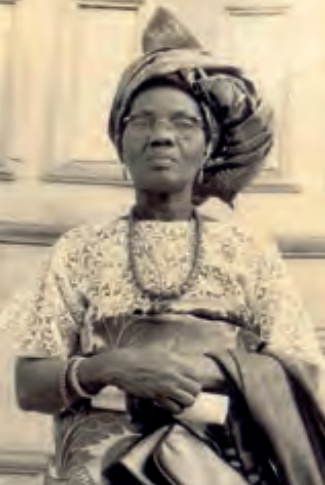
These were not abstract political principles — they were daily economic realities, and the women who experienced them were not in need of political education to understand that they were unjust. What they needed was organisation, and Funmilayo Ransome-Kuti provided it. The Abeokuta Women's Union that she founded in 1946 was explicitly designed to be an organisation not of the educated class but of all women — market women, traders, farmers, women of every social level whose interests the existing political structures ignored. At its height it had over 100,000 members, a figure that represented a substantial fraction of Abeokuta's entire female population and that made it one of the largest women's organisations in colonial Africa.
The Campaign Against Taxation and the Alake's Abdication
The AWU's campaign against the colonial tax system and the Alake's authority was one of the most sustained and strategically sophisticated political campaigns in the history of Nigerian anti-colonial resistance. It combined petitions to the colonial administration with mass demonstrations — gatherings of thousands of women outside the Alake's palace that used traditional Yoruba practices of public shaming to devastating political effect. It used economic pressure — strikes, market boycotts, the disruption of commercial activity in ways that made the political cost of inaction visible to all parties. And it used the legal and administrative channels of the colonial system itself, filing complaints, demanding inquiries, and holding the colonial administration to its own stated standards of justice and good governance.
The tactical sophistication of the campaign reflected Funmilayo Ransome-Kuti's understanding of the multiple audiences she was addressing simultaneously. For the market women themselves, the mass demonstrations and collective action were expressions of their own political agency — confirmations that they were not powerless in the face of authorities who treated them as if they were. For the colonial administration, the formal petitions and legal challenges were addressed in the language that colonial officials recognised as legitimate political communication. For the Alake and his traditional court, the demonstrations drew on deeply embedded Yoruba traditions of women's collective protest against rulers who had violated their obligations to the community — traditions that the Alake's authority could not dismiss as foreign or illegitimate without undermining its own cultural foundations.
The abdication of the Alake in 1949 — the moment when Oba Ladapo Ademola II, one of the most senior traditional rulers in Yorubaland, was forced out of his position by the sustained pressure of the women's campaign — was an event of extraordinary political significance. It demonstrated that women's organised collective action could achieve outcomes that the educated class's constitutional petitions had rarely managed: the direct removal of an authority figure from the position from which he had been causing harm. The Alake was eventually restored to his throne after the immediate political situation changed, but the episode had permanently altered the political landscape of Abeokuta and established Funmilayo Ransome-Kuti as a political figure of national and eventually international significance.
Women's Suffrage and the National Stage
The AWU's success gave Funmilayo Ransome-Kuti a national platform from which she pressed the broader demand for women's political participation — most urgently, for women's suffrage. In the constitutional negotiations of the late colonial period, as successive constitutional conferences progressively expanded the franchise and the structures of self-governance, the question of whether women would be included in the electorate was genuinely contested. The colonial administration, working through the indirect rule structures of the native authority system, had institutionalised the exclusion of women from formal political processes across most of Nigeria, and the constitutional reforms of the early 1950s did not automatically remedy this exclusion.
In the Western and Eastern Regions, women's suffrage was introduced in the early 1950s — in part as a direct consequence of the political pressure that Funmilayo Ransome-Kuti and the AWU had generated. In the Northern Region, where the combination of Islamic cultural norms and the conservative political interests of the NPC and the emirate system created stronger resistance, women's suffrage was not introduced until 1976 — a generation later and after the First Republic had already come and gone. The regional disparity in women's political rights was one of the deepest inequalities in the formal structure of Nigerian democracy, and Funmilayo Ransome-Kuti's advocacy against it was sustained across decades without the rhetorical concessions that less committed figures might have been tempted to make.
Pan-Africanism and the International Stage
Funmilayo Ransome-Kuti's political vision extended well beyond Nigeria's borders. Her participation in international women's conferences and her travels to the Soviet Union, China, and other countries in the 1950s and 1960s connected her to the global networks of anti-colonial, anti-imperialist, and women's liberation activism that were reshaping the political possibilities of the post-war world. She attended the World Congress of Women in Copenhagen in 1953, the World Congress of Mothers in Lausanne in 1955, and numerous other international gatherings where she represented not only Nigerian women but African women's political aspirations more broadly.
Her receipt of the Soviet Lenin Peace Prize in 1970 — one of the most prestigious international awards available to activists and leaders who had not been accommodated by Western establishment recognition — placed her in the company of figures like Pablo Picasso, Paul Robeson, and WEB Du Bois who had been honoured by the Soviet peace movement for their contributions to anti-imperialist and anti-war activism. The Nigerian government's repeated confiscation of her passport — its attempt to limit her international connections and the political embarrassment her activities caused — was itself a measure of how seriously the authorities took her international influence.
Fela's Mother: A Legacy That Multiplied
Funmilayo Ransome-Kuti was the mother of Fela Anikulapo-Kuti — the musician, political activist, and creator of Afrobeat who became one of the most important African cultural figures of the twentieth century and whose fierce, sustained opposition to Nigerian military rule and corruption made him a global icon of African resistance. The connection between mother and son was not merely biological: Fela's political consciousness was deeply shaped by his mother's example, and her influence on his understanding of what political commitment required — its costs, its demands, its non-negotiability — was evident throughout his career.
When soldiers attacked the Kalakuta Republic — Fela's commune in Lagos — in 1977, they threw his seventy-seven-year-old mother from an upstairs window. She never fully recovered from the injuries she sustained. She died the following year, in April 1978, from those injuries. The manner of her death — a woman who had spent her life fighting for the rights of ordinary Nigerians against authority, killed by the soldiers of the Nigerian state — was an indictment of everything that the military governments she had spent her later years opposing represented. Fela wrote the album Coffin for Head of State about her death and the military government that caused it, carrying her coffin to the gates of Dodan Barracks in Lagos in a final act of defiance that was, in its combination of grief and political fury, the most fitting tribute that her son could offer.
The Mother of Africa
Funmilayo Ransome-Kuti's image appears today on Nigerian currency — a recognition that she belongs to the small number of figures whose contributions to Nigerian national life transcend partisan identification and have been absorbed into the national self-understanding. The honorific by which she is most often remembered — "the Mother of Africa" — reflects both the scale of what she achieved and the specifically maternal framing that Nigerian and African culture has most readily applied to women of great political achievement. It is a framing she would perhaps have complicated: she was not, in the first instance, a mother figure but a political organiser, a strategic thinker, a woman who understood power and knew how to challenge it, whose career demonstrated that women's political agency was not contingent on maternal identity but was grounded in the same rights and the same moral authority that belonged to all human beings regardless of gender.
That argument — made not in abstract theoretical terms but through decades of practical organisation, sustained confrontation with authority, and the daily work of building and maintaining the political structures through which women's collective power could be exercised — is the most durable part of her legacy. She proved it was possible. She built the institutions that carried it forward. And she paid for it, ultimately, with her life — which is the measure of how seriously both she and her opponents took it.