At a Glance
The Niger Delta and Its Political Character
The Niger Delta — the vast, complex, ecologically extraordinary region where the Niger River breaks into its multiple distributaries before reaching the Atlantic — occupies a unique position in Nigerian history and politics. Its peoples — among them the Ijaw, the Itsekiri, the Urhobo, the Isoko, and numerous smaller communities — were the first Nigerians to encounter European commercial contact in force, their coastal position making them the intermediaries through which the Atlantic slave trade and later the palm oil trade flowed. This long history of contact with European commercial power had given the Delta's peoples both a cosmopolitan orientation and a deep experience of the exploitative dimensions of that contact — the memory of the slave trade, the disruption of traditional commercial structures by European monopoly companies, and the systematic subordination of Delta interests to external economic and political priorities ran through the political consciousness of the region's educated class.
The Delta's political situation in the colonial period was further complicated by its position between the three major regions — administratively part of the Western Region despite having little cultural connection to Yoruba political life, with significant Igbo-speaking communities in its eastern parts that connected it to the Eastern Region, and with its own diverse and politically assertive communities that resisted easy classification within any of the major ethnic frameworks. This complexity meant that Delta politicians had to operate across multiple political environments simultaneously, building coalitions that transcended the regional and ethnic boundaries that colonial administration had institutionalised.
Festus Okotie-Eboh was a product of this political environment. His Ijaw identity connected him to one of the most widely distributed peoples in the Delta — the Ijaw communities stretched from the western Delta through the central creeks to the eastern Delta, giving Ijaw politicians a potential constituency that was geographically extensive even if numerically modest relative to the major groups. His commercial base in Sapele placed him in a bustling, cosmopolitan timber town where the mixing of different Delta communities with Yoruba, Igbo, and other Nigerian migrants had produced a political culture more oriented toward practical accommodation than toward ethnic exclusivity.
Building Political Power in the Western Region's Minority Areas
The challenge of building NCNC political organisation in the Delta areas of the Western Region was considerable. The Action Group under Obafemi Awolowo dominated Western Region politics, and its resources — governmental patronage, organisational infrastructure, the backing of the traditional establishment in Yoruba areas — made it formidable competition for any party seeking to challenge its authority. In the minority areas of the Western Region's Delta fringe, however, the Action Group's Yoruba cultural identity was both an asset and a liability: it attracted Yoruba voters but gave non-Yoruba Delta communities reason to look for an alternative.
The NCNC's pan-ethnic nationalism, whatever its limitations in practice, provided a more credible home for Delta minority politicians than the Action Group's Yoruba-centred identity, and Okotie-Eboh's organisational work in Sapele and the surrounding communities built a genuinely effective NCNC presence in territory where the party might otherwise have had no foothold. His commercial connections gave him resources — the ability to support local organisations, to host meetings, to provide the practical backing that turns political sympathy into political commitment — that purely electoral politicians often lacked. His personality — direct, confident, socially accessible across community boundaries — made him an effective mobiliser in communities where personal relationships and community standing mattered as much as formal political argument.
Finance Minister of an Independent Nigeria
Okotie-Eboh's appointment as Federal Minister of Finance in 1957 — three years before independence — placed him in charge of one of the most consequential portfolios in Nigerian governance at one of the most consequential moments in Nigerian history. The financial challenge facing Nigeria in 1957 and through the independence transition was formidable: a colonial economy structured to export raw materials and import manufactured goods, a governmental budget heavily dependent on export revenues that fluctuated with commodity prices, a development agenda that required investment in infrastructure, education, and health on a scale that colonial revenue structures had never contemplated, and the political pressure to deliver on the material improvements that independence had promised to a population whose expectations were high.
Managing this challenge required both technical financial competence and political skill — the ability to make budget decisions that distributed resources across Nigeria's regional and ethnic constituencies in ways that maintained the political coalition supporting the federal government while also advancing the developmental goals that gave that coalition its purpose. Okotie-Eboh's decade in the Finance Ministry made him one of the most experienced figures in this kind of political-financial management in all of post-independence Africa. The budgets he presented, the revenue measures he proposed, and the developmental allocations he defended in the Federal Parliament constituted a sustained exercise in the governance of a newly independent country's most fundamental economic decisions.
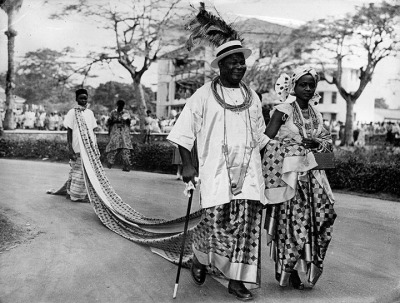
His style in this role — the confidence, the directness, the willingness to engage with criticism on its merits rather than retreating into bureaucratic evasion — was a genuine asset in a political system where the Finance Minister's public credibility mattered to investor confidence and to the population's sense of whether the government understood and was managing its economic responsibilities. The elaborate traditional dress that made him one of the most photographed men in Nigeria was not a distraction from serious governance but a statement about it — a refusal to adopt the grey European formal wear that colonial administrative culture had normalised as the appropriate dress for men of authority, an insistence that African cultural expression and governmental competence were not in tension.
The First Republic's Political Culture and Its Contradictions
Okotie-Eboh was a figure of the First Republic in both its achievements and its contradictions. The achievements were real: the maintenance of a working democratic system through the critical first years of independence, the construction of governmental institutions that had not existed before, the beginning of developmental investment in infrastructure and education that started to deliver visible improvements in Nigerians' lives. The contradictions were also real: a political culture in which the boundary between public resource and private accumulation was porous, in which patronage networks required feeding from governmental budgets, and in which the maintenance of the NPC-NCNC coalition that governed the federation required constant negotiation among interests that were not always compatible.
Okotie-Eboh navigated this political culture with the unsentimental pragmatism of a man who had built his career from a minority base in a majority-dominated system and understood that political survival required attending to the practical requirements of coalition maintenance as well as to the programmatic commitments that gave the coalition its public justification. He was not naive about what Nigerian politics required, and he did not pretend to be. His directness about political realities — including the political calculations behind budget decisions that less candid figures preferred to present as purely technical matters — was one of the things that made him both respected and, in some quarters, feared.
15 January 1966: The Night the First Republic Died
The military coup of 15 January 1966 — organised by a group of young army majors led by Kaduna Nzeogwu — was the single most consequential event in post-independence Nigerian history, ending the First Republic and beginning a cycle of military intervention and attempted civilian restoration that would define Nigerian political life for the next three decades. Its targets were carefully chosen: the Prime Minister, the Finance Minister, the premiers of the Northern and Western Regions, and senior military officers identified with the civilian political order. Okotie-Eboh was among those targeted and among those killed.
His death at his Lagos home in the early hours of 15 January, along with Abubakar Tafawa Balewa and others, removed from the scene the men who had built and operated the First Republic's governmental machinery. Whatever the failures of that republic — and they were real and serious — its summary destruction by military force, and the killing of its leading figures, was a catastrophe for Nigerian democratic development whose consequences echoed through decades of subsequent political history. Okotie-Eboh died as he had lived — at the centre of Nigerian power, the most visible target of those who sought to overturn the order he represented.