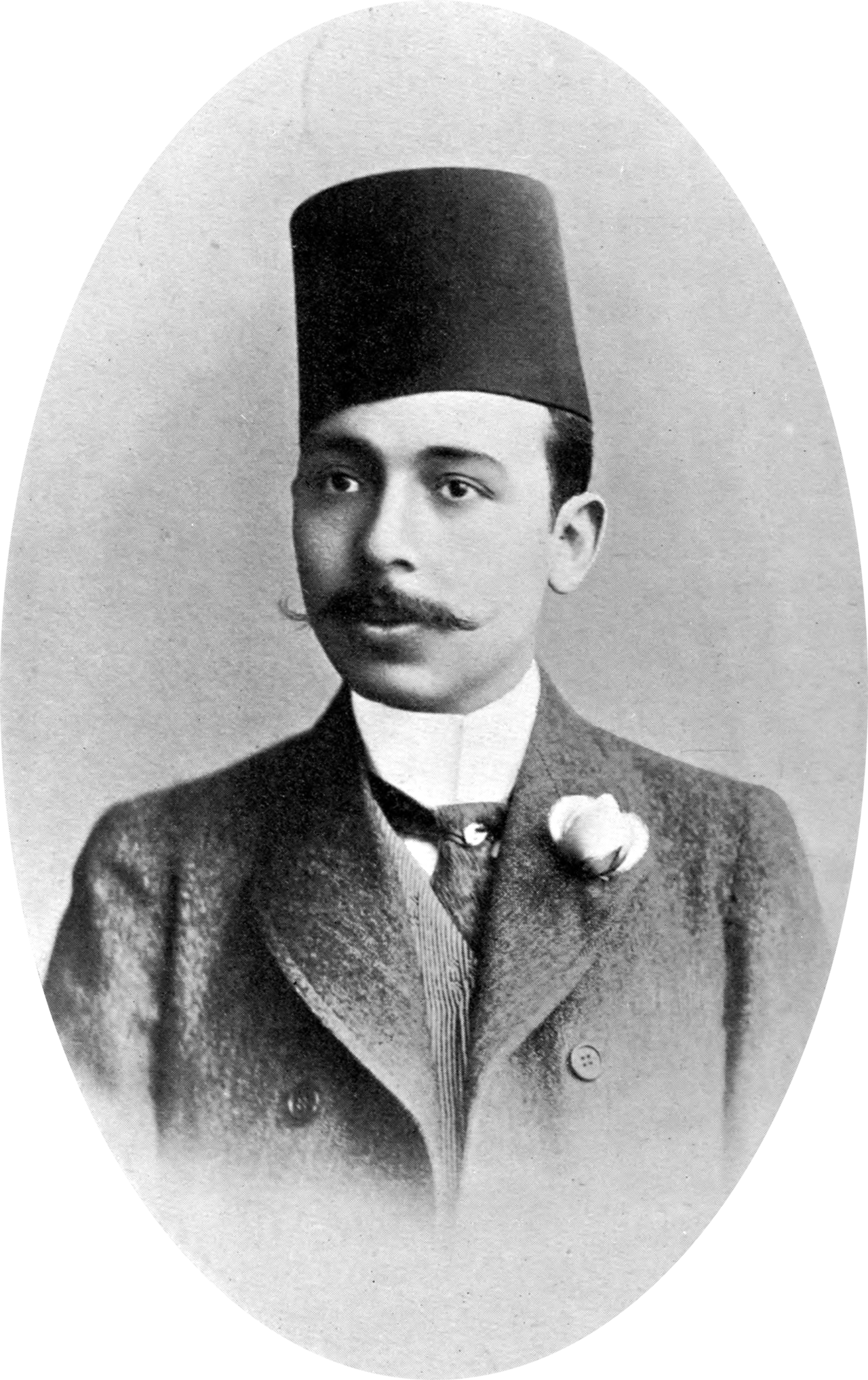
At a Glance
Cairo in 1874: The World That Made a Nationalist
Mustafa Kamil was born in August 1874 in Cairo — the Cairo that was being transformed by Khedive Ismail's modernisation programme into something that looked, from certain angles, like a European city: wide boulevards, European-style buildings, a new opera house, gaslit streets in the elite quarters. His father was a military engineer in the khedival army — a man of professional standing and some education, part of the Egyptian state apparatus that Ismail was expanding and modernising as part of the same programme. The family's social position was upper-middle-class without being grand: educated, professionally connected, urbane, but not at the level of the great landowning families whose fortunes were most directly tied to the khedival political economy.
The Egypt of Kamil's childhood was an Egypt in political crisis. Ismail's modernisation had been financed through European borrowing that produced the 1876 default, the Dual Control, and eventually the British occupation of 1882. The Orabi revolt had been crushed. The British were in occupation. Lord Cromer — the consul-general who effectively governed Egypt — was consolidating a system of indirect rule that maintained Egyptian forms while exercising British substance. The nationalist generation born in the 1870s and coming of age in the 1890s — when Cromer's power was at its zenith and the prospects of Egyptian independence seemed most remote — were the generation that had to decide whether to accept the occupation as a permanent condition or to begin the long work of building the political force that might eventually overcome it. Kamil was the most gifted of that generation, and he chose resistance from the beginning.
France and the Education of an International Advocate
Kamil's years of legal study in France — he attended the Toulouse law school and then the Paris law school, graduating in the mid-1890s — gave him a formation that was specifically useful for the kind of nationalist politics he was planning to conduct. He learned French to the level of an educated native speaker, which gave him access to the French press, French political society, and French intellectual life in ways that most Egyptian nationalists could not achieve. He developed the specific rhetorical and journalistic skills that would make him so effective as a public advocate — skills in argument, in emotional appeal, in the management of an audience's attention and sympathy.
He also developed, in France, the international connections that would prove invaluable to his subsequent career. He met and cultivated relationships with French politicians and journalists who were sympathetic to Egyptian independence for various reasons — French strategic interest in limiting British power, French anti-imperialism, French solidarity with Muslim peoples under British rule. The French nationalist press — particularly the papers hostile to British power — became an outlet for Kamil's writing about Egypt, giving his nationalist message a platform that the British-influenced Egyptian press could not provide and that reached European political audiences who might be persuaded to exert diplomatic pressure on Britain.
The Press as Politics: Building Consciousness Issue by Issue
When Kamil founded al-Liwa in January 1900, he was making a specific political calculation: that the creation of Egyptian nationalist public opinion — the development of the political consciousness that mass nationalism required — was the first and most fundamental task, and that the modern press was the instrument best suited to this task. He was right on both counts, and the success of al-Liwa over the following eight years of his editorship demonstrated his understanding of what the Egyptian political moment required.
The newspaper's content was calculated with precision. It published political analysis — explanations of British colonial policy, analyses of the international situation, arguments for Egyptian independence drawn from international law, history, and moral principle. It published Egyptian history — accounts of Egyptian civilisation from the pharaonic period through the Islamic era to the present that gave the educated Egyptian reader a sense of historical depth and historical dignity that the colonial narrative systematically denied. It published international coverage — reports on the independence movements of other colonised peoples, coverage of the pan-Islamic and pan-African currents of thought that were developing in this period, accounts of the Boer War and other anti-British conflicts that gave Egyptian readers a sense of the global context of their own struggle. And it published Kamil's own essays and speeches — pieces that combined emotional nationalist appeal with rational argument, that gave voice to Egyptian feeling without sacrificing intellectual rigour, and that established Kamil as the most compelling public writer in Egyptian politics.
The Oratorical Voice: Public Speaking as Political Art
Kamil was not only a journalist — he was one of the most effective public speakers of his era, in any language or political context. His speeches in Arabic drew thousands to public meetings across Egypt, in a period when mass public political gatherings were still relatively novel and when the experience of hearing a political leader speak directly and passionately about Egyptian dignity and Egyptian rights was itself politically transformative. The accounts of his speeches — the audiences' reactions, the specific rhetorical strategies he employed, the emotional and intellectual effect on the people who heard him — suggest someone with an exceptional gift for connecting personal feeling to political argument, for making the abstract claims of nationalism feel immediate and personal and urgent.
He spoke not only in Arabic but in French — in French political circles, before European audiences, in the international forums where he was advancing Egypt's case. The multilingual fluency was itself politically significant: it demonstrated to European audiences that Egyptian nationalism was not the simple anti-Western emotionalism that colonial discourse attributed to Muslim peoples in resistance, but a sophisticated political argument made by an educated Egyptian who understood European political culture and was engaging with it on its own terms. This was the specific quality of Kamil's international advocacy that made it more effective than any previous Egyptian nationalist's attempts at the same project.
Dinshaway: The Moment That Made a Movement
The Dinshaway incident of 1906 gave Kamil the political moment that his decade of press nationalism had been preparing for. The hangings and floggings ordered by the British after the incident — widely reported in the Egyptian press and described in international outlets partly through Kamil's own journalism — produced a wave of Egyptian public outrage that reached beyond the educated nationalist circles that al-Liwa had been cultivating and into the broader Egyptian public that had previously been less directly engaged with the abstract question of national sovereignty.
Dinshaway made the political abstract concrete: it showed, in the most visceral possible way, what British occupation actually meant for Egyptian people — that British soldiers could shoot Egyptian villagers with effective impunity, that British courts could hang Egyptian men for defending their own village, and that the Egyptian government had no effective power to prevent these things. Kamil's coverage and his speeches turned Dinshaway into the nationalist movement's most powerful symbol, and the movement's expansion in the years between 1906 and Kamil's death in 1908 was substantially the consequence of that transformation.
The National Party and the Four Months That Built a Legacy
The National Party that Kamil founded in October 1907 was in some senses the culmination of a decade's work — the institutionalisation of the movement he had built through journalism and public agitation into a formal political organisation with the structures that would allow it to survive beyond any individual leader. He knew by this point that he was dying: the tuberculosis had been advancing for years, and the pace of his political work had been conducted against the background of deteriorating health that he refused to acknowledge publicly.
The founding congress of the National Party was held in October 1907, and Kamil's address to it was one of his most important political speeches — a statement of the party's programme, its principles, and its vision for Egyptian independence that became a founding document of Egyptian nationalist politics. The party's specific commitments — complete independence without conditional phases, Egyptian sovereignty over Egyptian affairs, the rejection of any accommodation with the British occupation that fell short of its complete end — defined the pole of Egyptian nationalist politics that Muhammad Farid would maintain after Kamil's death and that the more radical wing of the nationalist tradition would continue to represent through the subsequent decades.
Kamil died four months after founding the party, in February 1908. The party survived him, managed less brilliantly but managed nonetheless by Farid, and continued to represent the uncompromising independence programme for another decade until Farid's own death in exile in 1919. The institutional legacy — the party, the newspaper, the political networks — was what Kamil's compressed decade of work had built, and it proved durable enough to outlast his death and to contribute to the conditions of the 1919 revolution that he did not live to see.
Thirty-Three Years: The Measure of a Life Fully Spent
Mustafa Kamil died at thirty-three years old. The question that his biography always raises — what he might have achieved had he lived — is unanswerable, and the very fact that it is so compelling is evidence of the scale of what he achieved in the years he had. He created Egyptian press nationalism as a modern political form. He developed the international advocacy strategy that placed Egyptian claims before European audiences. He built the National Party as an institution. He established, more clearly than anyone before him, the principle that Egyptian independence was a right that admitted no qualification and required no British permission. And he did all of this in a decade of active political work — from his early twenties to his death — while simultaneously managing the deteriorating health of a man whose body was giving out faster than his political programme was advancing.
The specific sadness of his death is not that he died young in general — many remarkable people die young — but that he died at precisely the moment when the movement he had built was achieving the critical mass that might have produced the results he had been working toward. The 1919 revolution — which vindicated so much of what Kamil had been arguing — came eleven years after his death. He had built the political culture that made 1919 possible without being present to participate in it. His legacy is the revolution he prepared but did not see, and the nationalist tradition that every subsequent generation of Egyptian independence fighters claimed to continue.