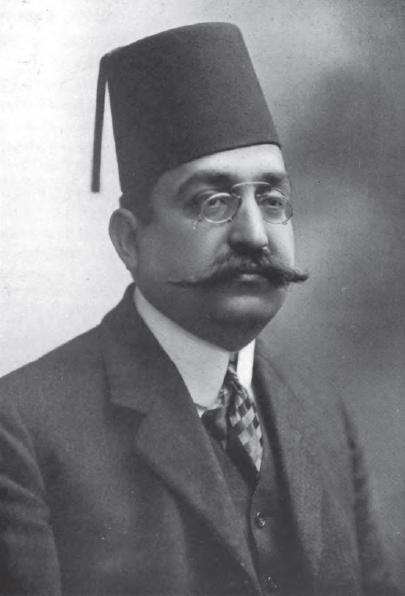
At a Glance
Cairo in 1868: The World the Khedivate Made
Muhammad Farid was born in October 1868 in Cairo — the Cairo of Khedive Ismail's modernisation programme, the city that was being transformed by wide boulevards, European-style buildings, the new opera house, and the infrastructure of the capitalist economy that European investment was building on the foundation of Egyptian cotton and Egyptian labour. The khedivate's relationship with European capital was simultaneously the source of the modernisation that was transforming Egyptian urban life and the source of the financial dependency that would eventually produce the British occupation — a paradox that the nationalist generation born in this era would spend their careers attempting to resolve.
Farid's family position — his father in the khedival administration — gave him a specific vantage point on this world: close enough to the state apparatus to understand how it worked, not quite at the level of the grandes familles whose fortunes were most directly tied to the khedivate's specific arrangements with European capital. He grew up in the educated professional stratum of Cairo society that was simultaneously the most exposed to European influence — through education, professional life, social interaction — and the most capable of developing the analytical consciousness that could understand that influence as a political problem rather than simply a cultural enrichment. The lawyers and journalists and schoolteachers who formed the nationalist movement's core were people of this stratum, and Farid was among them.
The National Party Under Kamil: Radical Nationalism Finds Its Voice
The National Party that Mustafa Kamil had built by the time of his death in February 1908 was one of the most significant political organisations in the Arab world — a movement with a press, a student organisation, a network of local branches, and a programme of uncompromising Egyptian nationalism that had made itself the most visible and most consistent voice of complete independence. Kamil had built this movement through his specific combination of journalistic brilliance, personal charisma, and political courage — through the newspaper al-Liwa that he had founded, through the passionate public speeches that drew crowds across Egypt, and through his determination to make Egyptian independence the question that the international community had to engage with rather than dismiss.
Farid's relationship with Kamil was close enough that he understood the party from the inside — its strengths and its structural vulnerabilities, the degree to which it depended on Kamil's personal authority and on the specific political moment that Kamil had created, and the degree to which that dependence was a vulnerability. When Kamil died, the question was whether the National Party could survive the loss of the person around whom it had been built, and whether a different kind of leader — one without Kamil's brilliance but with different organisational strengths — could maintain and develop what Kamil had created.
Succeeding the Impossible: The Heir's Dilemma
The specific difficulty of Farid's position as Kamil's heir was not primarily a matter of political programme — he shared Kamil's commitment to complete independence and maintained it consistently throughout his leadership — but of political style. Kamil had been a performer, a public intellectual, a man whose power came from his ability to give voice to Egyptian feeling in ways that resonated with audiences across class and education backgrounds. Farid was none of these things in the same measure. He was a systematic organiser, a methodical administrator, a lawyer's lawyer rather than a popular tribune.
This difference in political style was not a deficiency — it was a different kind of political ability, and the National Party needed both kinds. What Kamil had created in ten years of public agitation needed to be consolidated into durable institutions, connected to international networks, and maintained through years of British pressure that Kamil's charisma had partly insulated him against. Farid did this consolidating work with more success than the historical record typically credits him with. The party continued to function, continued to publish, continued to organise after Kamil's death — not at the same level of public visibility, but with a continuity of commitment that prepared the ground for the mass politics of 1919.
Dinshaway and the Radicalisation of Egyptian Nationalism
The Dinshaway incident of June 1906 — in which British officers on a pigeon-shooting expedition in the Delta village of Dinshaway killed a woman and wounded several villagers, triggering a confrontation in which one British officer died of heatstroke while fleeing; the British subsequently hanged four villagers, flogged others, and sentenced more to imprisonment in a trial that Egyptian public opinion experienced as a gross injustice — was the event that more than any other single act of the colonial period radicalised Egyptian nationalist sentiment and gave the National Party's uncompromising programme its widest popular resonance.
Dinshaway happened under Cromer's watch and was one of the acts that discredited the form of benevolent imperialism that Cromer claimed to represent. The hangings at Dinshaway were the British occupation's face stripped of its pretensions to civilisation — the demonstration that the colonial system's response to the most elementary assertion of Egyptian human rights was judicial murder. Mustafa Kamil made Dinshaway the centrepiece of the National Party's case against the British occupation, and the emotional impact was enormous. Farid inherited the political environment that Dinshaway had created — an Egyptian public more prepared than ever before to accept the uncompromising independence programme that the National Party was offering.
Exile and the European Years
Farid's exile from 1912 to his death in 1919 was spent in the specifically uncomfortable position of the nationalist in diaspora: physically removed from the country whose liberation he was working for, dependent on the resources and the goodwill of others, attempting to maintain political relevance and organisational capacity from a distance that the communications technology of the era made extremely limiting, and watching from abroad as the political situation in Egypt evolved in ways that his exile prevented him from influencing directly.
He lived in Geneva, where the Egyptian nationalist diaspora had some presence among the Egyptian students studying in Switzerland. He moved to Constantinople, attempting to use the Ottoman connection — the Ottoman Empire was the nominal sovereign authority over Egypt until the British declaration of the protectorate in December 1914 — to create international pressure on the British occupation. He eventually settled in Berlin, where German interest in undermining British power in Egypt and the broader Middle East created some political space for Egyptian nationalist activity, and where his health deteriorated through the difficult wartime years of food shortage and the specific stresses of exile politics.
The wartime collaboration with the Ottoman and German governments was the most controversial aspect of Farid's political career — the aspect that his critics have used to argue that his nationalism was more opportunistic than principled, willing to make common cause with autocratic and imperialist powers in pursuit of the goal of British expulsion. The defence of the collaboration — made by Farid himself and by sympathetic accounts of his career — is that he was using the available instruments to serve the cause of Egyptian liberation, that in the specific circumstances of 1914–18 the Ottoman and German governments were the only external forces with both the interest and the capacity to apply pressure on the British occupation of Egypt, and that the principle of national liberation sometimes requires working with imperfect allies.
April 1919: The Revolution He Did Not Live to See
The timing of Muhammad Farid's death — 15 April 1919, in Berlin, in the same month that the Egyptian Revolution of 1919 was reaching its peak — is the kind of historical coincidence that the writing of biography sometimes has to handle with care, because the temptation to over-romanticise it is obvious. A man who spent his life working toward a revolution, dying just as the revolution breaks out, having spent his final years in European exile unable to participate directly in the political mobilisation he had helped to prepare — this is genuinely tragic in a specific and meaningful sense, not merely in the sentimental sense.
The 1919 revolution — triggered by the British exile of Sa'd Zaghloul to Malta in March 1919 and producing the mass uprising of peasants, workers, students, and urban professionals that swept across Egypt in March and April of that year — was not the product of the National Party's specific programme alone. Zaghloul's Wafd had a different origin and a different character. But the creation of a political culture in which mass nationalism was thinkable and achievable — the years of press agitation, public meetings, organisational work, and the specific assertion of Egyptian dignity against British power that Kamil and Farid had sustained — was part of the foundation on which 1919 was built.
Farid died knowing the revolution had begun. Whether he knew its scale — whether the news from Egypt had reached him fully in Berlin in the weeks between March and his death on 15 April — is not clear from the available record. What is clear is that he died in the month of the revolution, in exile, having spent the last seven years of his life maintaining the nationalist cause at considerable personal cost from European cities that were themselves in the upheaval of the war's ending. It was not the death he had sought — he had sought to die in a free Egypt, or at least to see Egypt free before he died — but it was the death that the specific combination of British colonial power, the First World War's disruption of all political calculations, and his own deteriorating health had made available to him.
Legacy: The Bridge Between Kamil and Zaghloul
Muhammad Farid's legacy is that of the bridge — the leader who maintained the continuity between the period of Kamil's founding nationalism and the period of Zaghloul's mass politics, who kept the uncompromising programme of complete independence alive during the decade when British power was at its most repressive and the political conditions for mass nationalism were not yet fully formed. He was not as brilliant as Kamil nor as politically gifted as Zaghloul, and his period of leadership does not have the dramatic visibility of either his predecessor's or his successor's. But the years from 1908 to 1919 — the years of increasing British pressure, of exile politics, of the World War's disruption of all calculations — were years that required exactly the qualities Farid possessed: patience, consistency, institutional commitment, and the willingness to continue working toward a goal whose achievement he could not be certain of ever seeing.
His repatriation — his body was returned to Egypt in 1921 — was itself a political statement: the Egyptian nationalist movement bringing home the exile who had served it until his death and honouring him as a martyr of the independence struggle. He was buried in Cairo, in the country he had spent his life trying to free and had never seen free, and the specific sadness of that timing — dying in the month of the revolution — was noted by the Egyptian nationalist press that mourned him as one of the founding generation whose sacrifice had made 1919 possible.