At a Glance
Yesan and the Farming Heartland: The Education of a Patriot
Yun Bong-gil was born in 1908 in Deoksan — a village in Yesan county in South Chungcheong Province, the agricultural heartland of central Korea. His family were farmers of modest circumstances, working the land in a colonial system that extracted Korean agricultural output for the Japanese market while leaving Korean farmers progressively impoverished. His early schooling followed the conventional path until his early teens, when he withdrew from formal education in protest at the Japanese colonial curriculum's suppression of Korean history and language, and chose to educate himself instead.
This self-education was systematic and serious: he read voraciously in Korean classical literature and history, studied Chinese classical poetry and prose, and developed the literary sensibility that would express itself in the poetry he wrote throughout his short life. He was not a haphazard reader but a purposeful one — constructing a Korean intellectual identity outside the colonial educational framework, using the sources the colonial system was trying to suppress to understand what Korea was, what it had been, and what it deserved to become.
From early in his adult life he was a young man of striking personal seriousness, someone who had thought carefully about the relationship between his own existence and the national situation and concluded that the most important thing he could do was address the most fundamental problem facing Korean rural society: the illiteracy and political powerlessness of the Korean peasantry. The framework of Shin Chae-ho's historical thought — that Korean liberation required developing the minjok's capacity for self-governance — was something Yun Bong-gil enacted practically, one farmer at a time, in the evenings in Deoksan, before he found his other vocation in Shanghai.
The Night School and the Farming Corps: Liberation Through Literacy
In 1926, at eighteen years old, Yun Bong-gil founded the Wollmyeon Youth School — a night school in his home village offering free basic literacy education to Korean farmers and agricultural labourers who had no access to formal schooling. The format was deliberate: farmers working the land during the day could only attend in the evenings, and Yun taught them himself, using materials he had developed for adult students coming to literacy in a language the colonial school system was trying to marginalise.
The practical impact reached hundreds of people in the Yesan area. The political significance was larger: literacy in the colonial context was not just a personal skill but civic empowerment. A Korean farmer who could read could access nationalist newspapers, independence movement literature, and the documentary record of Korean history that the colonial system kept from the rural population. Teaching literacy was resistance — a form of refusal of the colonial project of keeping the Korean masses politically inert through cultural and educational deprivation.
Yun extended this work through the Farming Corps — an organisation producing agricultural education materials tailored for Korean rural conditions — and the Woljinil Farm Workers' Cooperative, which attempted to provide Korean farmers with the collective economic organisation to resist colonial dispossession. These were patient, sustained efforts to strengthen Korean rural society from the ground up. They were also, in their way, the most authentic possible preparation for the mission that would follow: a man who had given years of patient service to the Korean poor before choosing to give his life had earned a kind of moral authority that no amount of theoretical commitment could substitute for.
The Oath and the Departure: Leaving for China
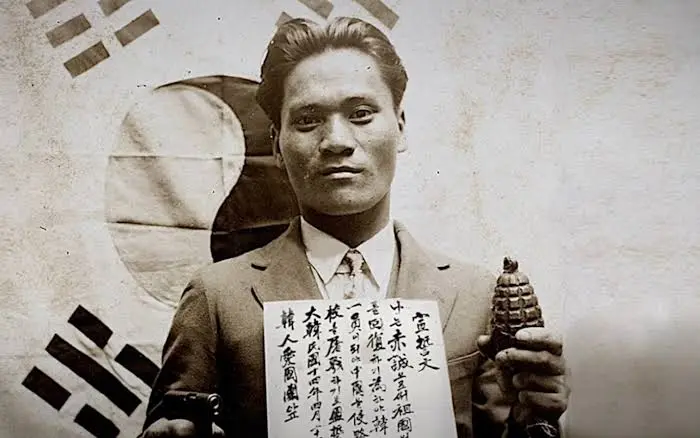
In 1930, at twenty-two years old, Yun Bong-gil left his home village, his night school, and his family — including his wife Yang Je-un and two young sons — and set out for China. The oath he wrote before his departure is among the most treasured documents of the Korean independence movement. It reads, in part: having dedicated himself to the independence movement with a resolute heart, he swore never to return home until independence was achieved. He left separate farewells to his family that acknowledged both his love and his conviction that what he was going to do mattered more than his survival.
These documents reveal the interior life of the decision: not a reckless act but a deliberate choice, made with full awareness of its costs, by someone who had concluded that the contribution he could make through martyrdom exceeded the contribution he could make through continued life. He had taught his neighbours to read. He had done the patient foundational work. Now he was going to do something else.
He made his way through the Korean exile networks in Manchuria to Shanghai, where he found Kim Ku and the Korean Provisional Government. He offered himself for whatever mission required a volunteer willing to die for it. His sincerity was unmistakable, his qualities — physical courage, careful temperament, the self-discipline of years in methodical community work — exactly what the operation Kim Ku was planning required.
The Exchange of Lunchboxes: 29 April 1932
The Korean Patriotic Corps operation targeted the Japanese military celebration at Hongkew Park on 29 April 1932 — a ceremony combining Emperor Hirohito's birthday with a victory celebration for the Shanghai Incident. The senior commanders of Japanese forces in China, the Japanese diplomatic mission, and other significant imperial figures would be gathered on an open reviewing stand: a target that a well-placed bomb could reach with devastating effect.
The device was concealed in a military-style water canteen; a backup was prepared in a lunchbox. On the morning of 29 April, before Yun entered the park, he and Kim Ku exchanged lunchboxes — Kim Ku taking the one with real food, Yun taking the one containing the backup bomb. The exchange was simultaneously practical and ceremonially significant. Both men understood it was a farewell, that Yun would not return, and the exchange of food for a weapon was the most concrete possible expression of what Yun was giving and what he was spending it on.
Inside the park, Yun positioned himself near the reviewing stand. When the Japanese national anthem began — the moment at which the assembled dignitaries would be most concentrated and most stationary — he detonated the water canteen device. General Yoshinori Shirakawa, Commander-in-Chief of the Japanese Expeditionary Army in Shanghai, was fatally wounded and died of his injuries. Kawabata Sadaji, the Japanese Minister to China, died more quickly. Lieutenant General Nomura Kichisaburō — later Japan's ambassador to the United States in the critical months before Pearl Harbour — lost an eye. Lieutenant General Ueda Kenkichi had both legs severely damaged. Several other senior officials were wounded. Yun Bong-gil was seized immediately at the scene.
Chiang Kai-shek and the Transformation of the Provisional Government
The political consequences of Hongkew Park were immediate and transformative. Chiang Kai-shek reportedly said that one Korean youth had accomplished what millions of Chinese soldiers had been unable to do — striking directly at the senior command of the Japanese forces that had just humiliated China in the Shanghai Incident. The remark established a framework: Yun's act was a contribution to the Chinese struggle against Japanese imperialism as well as to Korean independence, and it created the political basis for the Chinese Nationalist government's decision to begin providing substantial support to the Korean Provisional Government.
Before 29 April 1932, the Provisional Government had been chronically impoverished and politically marginal, receiving minimal support from any external power. After Hongkew Park, the Chinese Nationalist government became a significant patron — providing funding, facilities, and political legitimacy that sustained the Provisional Government through its most difficult years. The Korean Liberation Army that Kim Ku eventually organised in 1940 was made possible, in material terms, by the Chinese support that Yun Bong-gil's bomb had generated. One act, by one man, had changed the external situation of the entire independence movement.
The bombing also forced Kim Ku to flee Shanghai immediately — Japanese authorities placed a large reward on his head — beginning the Provisional Government's years of itinerant existence across Chinese cities. This was a cost, but a manageable one. The strategic gain was far larger.
Trial, Execution, and the Recovered Remains
Yun Bong-gil was tried by a Japanese military tribunal — a procedural choice designed for speed rather than public scrutiny. He was convicted and sentenced to death, transferred to Kanazawa Military Prison in Japan, and executed by firing squad on 19 December 1932. He was twenty-four years and two months old. His remains were buried near the execution site in Japan.
After Korea's liberation in 1945, the recovery of the independence movement's martyrs from Japanese custody became a national priority. Yun Bong-gil's remains were located, exhumed, and returned to Korea in 1946, and interred with full national honours at the Seoul National Cemetery alongside other independence movement heroes. The return of his remains — fourteen years after his execution, to an independent Korea — was the fulfilment of what his sacrifice had been for.
The Poetry: The Farmer's Inner Life
Yun Bong-gil left behind a body of poetry — written throughout his life, from his teenage years in Deoksan through his time in Shanghai — that illuminates the interior dimensions of his commitment. The poetry is written in classical Korean and Chinese forms, demonstrating the literary education he had constructed for himself, and its themes engage directly with the questions that preoccupied him: the meaning of a life dedicated to a cause larger than personal survival, the relationship between the natural world and political struggle, the obligation of those who see injustice clearly to act against it.
His pen name — Maeheon, Plum Blossom Pavilion — was itself a poetic statement. The plum blossom in East Asian literary tradition blooms in winter, in the coldest and most inhospitable conditions, demonstrating that beauty and life persist precisely where circumstances are most hostile. To take the plum blossom as a literary self-definition was to claim the quality of blooming under adversity — maintaining beauty and integrity in the most difficult conditions. His life entirely vindicated the claim.
The poetry establishes that the man who walked into Hongkew Park with a bomb was not primarily a bomb-thrower. He was a farmer's son who had spent years teaching his neighbours to read, a poet who had spent years articulating the relationship between beauty and duty, a thinker who arrived at the conclusion that martyrdom was his appropriate contribution through a process of reflection and commitment that had nothing impulsive about it. He was what his educational work had tried to produce in others — a Korean person of moral clarity, practical capacity, and willingness to serve the common good at personal cost. He simply paid a larger cost than most.
Legacy: The Completion of the Patriotic Corps Triptych
Korean national memory places Yun Bong-gil in a triptych of supreme independence movement martyrs alongside An Jung-geun and Lee Bong-chang — the three men who carried Korean independence struggle most directly into the heart of Japanese imperial power. The three form a coherent pattern: An Jung-geun the yangban Catholic who killed the architect of Korean subjugation in 1909 and wrote about it with philosophical depth; Lee Bong-chang the working-class Seoulite who took grenades to Tokyo and demonstrated that Korean resistance could reach the Emperor's procession on Japanese streets; Yun Bong-gil the farmer's son and peasant educator who destroyed Japan's senior military command in Shanghai and transformed the geopolitical situation of the independence movement overnight.
Each illuminates a different dimension of what the independence movement was and who made it. An Jung-geun demonstrates its intellectual and spiritual depth. Lee Bong-chang demonstrates its popular social breadth. Yun Bong-gil demonstrates its organic rootedness in Korean rural and community life — the farmer who taught his neighbours to read before he went to die, the poet who understood beauty and chose to spend it on freedom.
What the triptych collectively demonstrates is that Korean resistance to Japanese colonial rule was not the project of a narrow political class or professional revolutionaries. It was an expression of Korean society across its entire social range — aristocratic and working-class, educated and self-taught, urban and rural, Christian and Confucian, male and female. The movement drew from every stratum of Korean life and paid its costs from every stratum too. Yun Bong-gil, the farmer's son from Deoksan who founded a night school before he found his mission in Shanghai, belongs at the centre of that story — and Korea has never let him leave it.