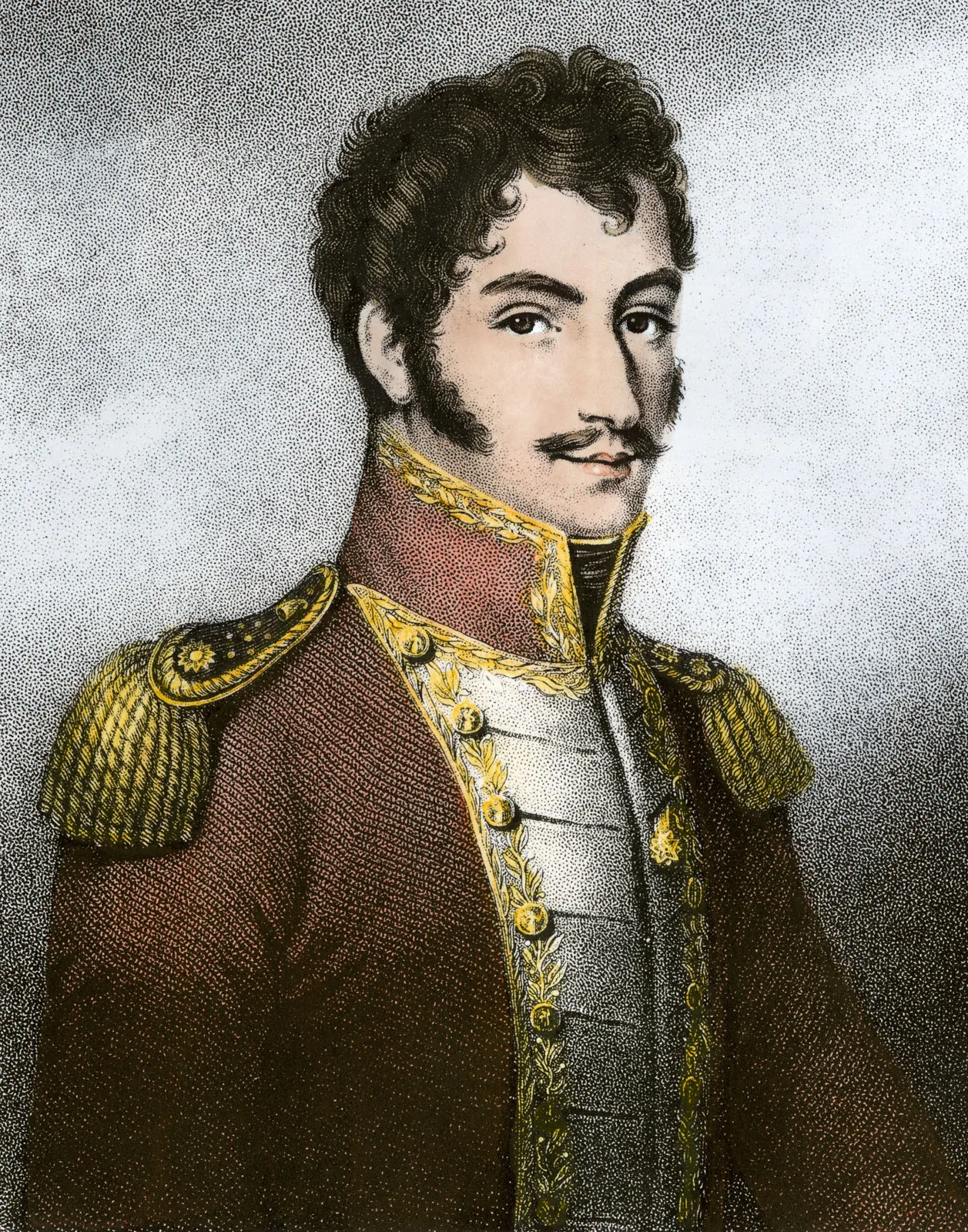
Simón Bolívar — El Libertador — who freed Venezuela, Colombia, Ecuador, Peru, and Bolivia from Spanish colonial rule and died in 1830 watching his dream of a united South America dissolve into competing republics.
Venezuela · Colombia · Latin America

Simón Bolívar

Simón José Antonio de la Santísima Trinidad Bolívar Palacios Ponte y Blanco was born in Caracas in 1783 into the wealthiest creole family in Venezuela — cacao plantations, copper mines, a palace in the city, a fortune built on two centuries of colonial exploitation that the Bolívar family had participated in and profited from at every level. He was orphaned young, educated in Europe, read Rousseau and Voltaire and Montesquieu at the knee of his teacher and lifelong intellectual companion Simón Rodríguez, made a vow on the Sacred Hill above Rome in 1805 to liberate his country from Spanish tyranny, and spent the next twenty years making that vow literal. He led armies across the Andes, through the Venezuelan llanos, down through Ecuador and Peru and into what became Bolivia, winning a series of battles — Boyacá, Carabobo, Pichincha, Junín, Ayacucho — that together constituted the most sustained military and political liberation campaign in the history of the Western Hemisphere. Five nations exist because of him: Venezuela, Colombia, Ecuador, Peru, Bolivia. He dreamed of a sixth — a unified Gran Colombia that would become a continental power — and watched it dissolve in his lifetime, the victim of regional interests, elite ambitions, and the fundamental contradiction of his own project: that a revolution led by the creole aristocracy would produce a political order in which that aristocracy's interests predominated. He died on 17 December 1830 on his way into exile, forty-seven years old, tubercular, broke, and bitter — the greatest military liberator the Americas have ever produced, dying in the ruins of the political vision that liberation was supposed to make possible.

Venezuela / Colombia El Libertador Freed Five Nations Battle of Boyacá 1819 Gran Colombia Founder Died in Exile 1830

Born: 24 July 1783, Caracas, Venezuela  |  Died: 17 December 1830, Santa Marta, Colombia — Creole aristocrat; military commander; Liberator of Venezuela, Colombia, Ecuador, Peru, Bolivia; President of Gran Colombia; died aged 47 of tuberculosis on the road to exile

At a Glance

The Formation of a LiberatorBolívar's formation was shaped by three things: the wealth and privilege of his creole family, which gave him the education, the leisure, and the connections that made a military and political career possible; the intellectual influence of Simón Rodríguez, his teacher, who introduced him to Enlightenment political philosophy and whose radical pedagogy pushed him toward ideas about human dignity and self-governance that the colonial system had no room for; and the experience of Europe, where he lived for several years and where the impact of the French and American Revolutions was still fresh in political culture. The oath he made on the Monte Sacro in Rome in 1805 — to dedicate his life to the liberation of South America — was dramatic but not theatrical: it expressed a genuine transformation in his understanding of what his life was for and what the conditions of his country required.
The Military Campaign: Scale and ScopeThe military campaign through which Bolívar liberated five nations was conducted across fifteen years, several decisive defeats, and an Andes crossing in winter conditions that military historians still regard as one of the most audacious logistical achievements of any pre-industrial army. He was driven out of Venezuela, twice. He launched the admirable campaign from the west. He crossed the Andes into New Granada in 1819 with forces that were expected to fail and won at Boyacá. He returned to defeat the Spanish at Carabobo in 1821, securing Venezuelan independence. He moved south into Ecuador, won at Pichincha. He led the Peruvian campaign, won at Junín. His generals won Ayacucho — the final battle of South American independence — in December 1824. The scope of this achievement, conducted over terrain of extraordinary difficulty against a professional European military force, is difficult to overstate.
Gran Colombia: The DreamThe political project that accompanied the military liberation — Gran Colombia, the unified republic comprising the territories of present-day Venezuela, Colombia, Ecuador, and Panama — was Bolívar's attempt to ensure that liberation produced a political unit strong enough to maintain its independence and to develop in ways that the individual territories could not achieve alone. He understood, from the beginning, that the fragmented creole elite's regional loyalties would work against unity, and he was right. Gran Colombia was formally constituted in 1821 and formally dissolved in 1830 — nine years of existence, most of which Bolívar spent fighting on distant fronts while the political tensions that would destroy the federation built up behind him. His partner and vice president Santander governed in his absence and became, in the federation's later years, the primary representative of the constitutional faction that Bolívar's increasingly authoritarian tendencies had alienated.
The Contradictions: Liberator and SlaveholderThe fundamental contradiction of Bolívar's political project was embodied in his own biography: he was born into a family whose wealth rested on enslaved labour, and the republic he built maintained slavery until long after his death. He manumitted his own enslaved people and issued various proclamations promising abolition, but the political coalition on which his project depended — the creole elite whose support was necessary for military and financial reasons — would not accept the abolition that his stated principles required. He compromised, repeatedly, on the question that the Haitian Revolution had demonstrated was the central question of any genuine liberation movement in the Americas. He acknowledged, in his final years, that the failure to address the social inequality that slavery and the caste system maintained had undermined the republic he had built.
The Dissolution and the ExileThe dissolution of Gran Colombia began before it was complete. Venezuela declared its separation in 1829, Ecuador in 1830. The Bolivarian project of continental unity could not survive the centrifugal forces of regional elite interest, and Bolívar — whose response to the federation's political crisis had been to assume increasingly dictatorial powers, alienating the constitutional republicans around Santander — could not hold it together. He resigned the presidency in January 1830, intending to go into European exile. He never made it. His tuberculosis had advanced too far. He died at the hacienda San Pedro Alejandrino near Santa Marta, Colombia, on 17 December 1830. His final written communication expressed a disillusionment that has become the most quoted summary of his legacy: he had ploughed the sea, he wrote. Nothing had taken root.
The Afterlife: BolivarianismThe invocation of Bolívar's name across Latin American political history — from the conservative nationalisms of the nineteenth century through the left-wing Bolivarianisms of the twentieth, from Hugo Chávez's Bolivarian Revolution to the M-19's theft of his sword — reflects both the genuine power of his historical achievement and the extraordinary versatility of his political symbolism. He has been claimed by almost every political tendency in Latin America, from the right that emphasises his authoritarianism and his opposition to revolutionary social change, to the left that emphasises his Pan-Americanism, his resistance to US imperialism, and his vision of continental unity. The real Bolívar — contradictory, brilliant, limited by his class origins, destroyed by the gap between his vision and the political materials available to him — is more interesting than any of the ideological appropriations, and more tragic.

The Caracas That Made Him

The Caracas that Simón Bolívar was born into in 1783 was the capital of the Captaincy-General of Venezuela — a colonial city of perhaps 30,000 people, built on the labour of enslaved Africans and the dispossessed labour of indigenous communities, governed by a Spanish colonial administration that reserved the highest offices for peninsulares and confined the creole elite to secondary positions regardless of their wealth. The Bolívar family was among the wealthiest in the colony: their cacao plantations in the valleys around Caracas produced a commodity of high export value, and their social position was as elevated as the colonial system permitted creoles to occupy. Bolívar was born into this position — the top of the colonial hierarchy below the Spanish officials — and educated to understand it as his natural station.

What his education under Simón Rodríguez did was to provide him with the intellectual framework to understand his natural station as a product of unjust arrangements rather than natural order — to see the colonial system not as the background condition of existence but as a specifically constructed system of exploitation that had a specific history and could be changed. Rodríguez introduced him to Rousseau, to the social contract, to the argument that political authority derives from the consent of the governed — an argument whose implications for Spanish colonialism were not hard to draw. Combined with the experience of revolutionary Europe, where the French Revolution had demonstrated that the existing political order was not immutable, the Enlightenment formation Rodríguez provided gave Bolívar the ideological resources for the project he would spend his life pursuing.

The Campaigns: Military Genius Under the Andes

The Andes crossing of 1819 — leading approximately 2,500 soldiers through the páramo, the high-altitude Colombian moorland, in the depths of the rainy season, over passes at more than 4,000 metres above sea level — was the military operation that decided the fate of northern South America. A third of the horses died. The troops arrived on the other side exhausted, hypothermic, and destitute of supplies. The Spanish forces waiting on the New Granada side had every military advantage. At Boyacá, on 7 August 1819, Bolívar and Santander defeated them anyway — Santander's flanking manoeuvre cutting off the Spanish retreat, the engagement over in two hours, the road to Bogotá open. The Spanish viceroy fled. Three days later, Bolívar entered the capital of New Granada.

The pattern was consistent across the years of campaigning: setbacks that would have ended a lesser commander's career — the first fall of Caracas, the retreat to New Granada, the defeats in the early phases of the Venezuelan campaign — followed by reconstitution, return, and eventual decisive engagement. He had a talent for the moral dimension of military command: for maintaining the confidence of troops in adverse conditions, for inspiring the commitment that irregular warfare against a better-equipped European army required, and for the strategic vision that could see, through immediate defeat, the arc of the campaign that would eventually produce victory. He was not always tactically brilliant — some of his battlefield decisions were questionable — but strategically, across fifteen years, he was almost never wrong about the direction the campaign needed to take.

The Dream of Unity and Its Enemies

Bolívar's vision of a unified Gran Colombia — and his broader aspiration toward a united South America capable of resisting both European re-colonisation and American hemispheric dominance — was not naive romanticism. It was a strategic analysis, derived from the observation that the individual territories of the former Spanish empire were too small, too poor, and too militarily weak to survive independently in a world where the major powers were competing for commercial and political dominance in the Americas. Unity was not a sentiment; it was a necessity. The United States was already asserting its Monroe Doctrine claim to hemispheric supremacy in 1823, the year Bolívar convened the Congress of Panama — his most direct attempt to institutionalise continental solidarity. Britain was replacing Spain as the dominant commercial power in South American markets. A fragmented continent of small republics would be vulnerable to both.

The enemies of unity were also structural: the regional elites of Venezuela, New Granada, and Ecuador each had specific interests — in land tenure, in trade arrangements, in political power — that continental unity would have constrained. Bolívar's federalist opponents, led by Santander in New Granada, were not merely acting from personal ambition, though personal ambition was also present; they were representing a genuine political constituency that preferred the sovereignty of the smaller unit to the discipline of the larger one. Bolívar's response to this opposition — increasingly authoritarian as the federation deteriorated, culminating in the assumption of dictatorial powers in 1828 — validated the opposition's worst fears rather than overcoming its causes. He could liberate nations from Spanish rule. He could not liberate the creole elites from their own regional interests.

The Last Months: Ploughing the Sea

The final months of Bolívar's life were among the most painful in the history of a life that had contained a great deal of pain. He resigned the presidency of Gran Colombia in January 1830, as Venezuela declared its separation and the federation he had built disintegrated around him. He intended to go to Europe, to die abroad rather than in the country that had expelled him — his supporters and enemies in Venezuela had made clear that he was not welcome — and to leave behind whatever remained of his reputation in the hands of history. He was forty-six years old and looked twenty years older. The tuberculosis that had been advancing for years had accelerated. He reached Santa Marta on the Colombian coast in December 1830 and could go no further.

He died at the hacienda San Pedro Alejandrino on 17 December 1830. His final testament expressed practical concerns — modest bequests to the handful of people who had remained loyal — alongside the bitter philosophical summary of a life's work. His famous statement that he had ploughed the sea — that the work of independence had produced nothing lasting, that those who served the revolution had ploughed the sea — has been quoted ever since as the expression of ultimate political disillusionment. It was not entirely accurate: the five nations that existed because of his campaigns were real, their independence was real, and the constitutional frameworks they eventually developed were built on the foundations his campaigns had cleared. But the gap between what he had fought for — a unified, genuinely republican South America whose liberation from Spain produced real political freedom for its people — and what he left behind — a collection of fragmented republics governed by the creole oligarchies whose interests his revolution had ultimately served — was a gap that no retrospective balance of achievements and failures can fully close. He was right to grieve it.

Also Profiled — Colombia, Venezuela & Bolivia

Colombia, Venezuela & Bolivia Antonio Nariño Precursor of Independence; printed the Declaration of the Rights of Man 1793 Colombia, Venezuela & Bolivia Camilo Torres Restrepo Liberation Theology priest; ELN guerrilla; killed in first combat 1966 Colombia, Venezuela & Bolivia Coco Peredo Bolivian communist; killed at Vado del Yeso with Guevara's column 1967 Colombia, Venezuela & Bolivia Francisco de Paula Santander Man of Laws; Bolívar's essential partner; administered Gran Colombia Colombia, Venezuela & Bolivia Hugo Chávez Venezuelan president who named his revolution after Bolívar; died 2013 Colombia, Venezuela & Bolivia Inti Peredo Survived Guevara's column; wrote the memoir; killed in La Paz 1969 Colombia, Venezuela & Bolivia Jacobo Arenas FARC co-founder; chief ideologist; died in the jungle 1990 Colombia, Venezuela & Bolivia Jaime Bateman Cayón M-19 founder who stole Bolívar's sword in 1974 as a political act Colombia, Venezuela & Bolivia Manuel Marulanda Vélez Tirofijo — FARC supreme commander for four decades; died 2008 Colombia, Venezuela & Bolivia Raúl Reyes FARC Secretariat; killed in Colombian airstrike inside Ecuador 2008 Colombia, Venezuela & Bolivia Simón Rodríguez Bolívar's teacher; the mind that shaped the Liberator's political formation Colombia, Venezuela & Bolivia Tania la Guerrillera Argentine-born East German operative; killed at Vado del Yeso 1967
Share X Facebook WhatsApp LinkedIn