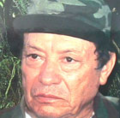
At a Glance
Génova, Coffee, and La ViolenciaMarulanda was born into the Colombian coffee-growing peasantry — the sector of Colombian rural society that the coffee export economy had enriched relative to the subsistence farmers of other regions but that remained profoundly vulnerable to the political violence of La Violencia. He was a teenager when La Violencia began and came of age in conditions of extreme partisan violence that killed hundreds of thousands of people and displaced millions. His political formation was not ideological in the first instance: it was the practical response of a young man from a Liberal family who saw his community under attack from Conservative-aligned forces and who concluded that the only available protection was armed self-defence. He joined a self-defence group, learned to fight in the Colombian mountains, and built the organisational and military skills that would define the rest of his life.
Tirofijo: The Name and the ManThe nickname Tirofijo — Sureshot — was earned in the self-defence campaigns of La Violencia period and referred to Marulanda's skill as a marksman and his effectiveness as a guerrilla fighter. It was a name from below: given by the peasant fighters he fought alongside rather than chosen by him or assigned by a party hierarchy. It stuck because it was accurate and because it captured something essential about who he was — a fighter who had earned his reputation through demonstrated practical effectiveness rather than through formal rank or political position. He was not a theorist, not an ideologist, not a political strategist in the conventional sense. He was a guerrilla commander who understood terrain, logistics, and the specific organisational requirements of keeping a force in the field under difficult conditions, and who was better at these things than almost anyone else the Colombian left produced.
Marquetalia and the FARC's FoundingThe Colombian army's assault on Marquetalia in May 1964 was intended to destroy the self-defence community that Marulanda had been building and leading since the early 1950s. The community had developed from a peasant self-defence group into a more organised agricultural and political community that the Communist Party had been helping to organise — the "independent republic" that the government claimed was a communist state within Colombia. The assault involved several thousand troops in a carefully planned operation. Marulanda and a small group of survivors — fewer than fifty people — escaped the military encirclement by a combination of tactical skill and knowledge of the terrain. He then did what he had always done when confronted with superior military force: he regrouped, reconstituted his organisation, and continued. The Marquetalia Document that Marulanda and Arenas issued in the aftermath formally founded the FARC. It was the beginning of forty-four more years in the mountains.
The Military Architecture of the FARCThe FARC's organisational structure — the division into fronts, the command hierarchy, the system of financial support through taxation of local economic activity and later through drug revenue, the training programmes, the political education of recruits — was built under Marulanda's military direction in partnership with Arenas's political guidance. He understood that the fundamental challenge of a guerrilla organisation in a country the size of Colombia — with its varied terrain, its dispersed rural population, and its well-funded military adversary — was sustainability: keeping the organisation functional across decades rather than years. This required logistical systems, financial independence, and the development of the local political base that could provide the FARC with the human resources and the community support it needed. He built these things slowly, over decades, expanding the FARC's reach from the initial handful of fronts to the dozens that covered much of Colombian territory by the 1990s.
The Ghost: Never Captured, Never FoundThe most remarkable feature of Marulanda's career — and the feature that most mystified and frustrated the Colombian state and its American backers — was his consistent ability to avoid capture or death despite being the primary target of the largest and best-funded counter-insurgency programme in the history of Latin America. Plan Colombia, initiated in 2000 with billions of dollars of US funding, deployed helicopters, aerial surveillance, special forces units, and the most sophisticated intelligence-gathering technology available specifically with the objective of finding and killing or capturing the FARC's leadership. Marulanda evaded it all. The Colombian military announced his death multiple times and was wrong every time. He moved constantly, rarely slept in the same location twice, and maintained the operational security disciplines of a man who had been hunted for fifty years and understood that survival required constant attention to the conditions of vulnerability. He died of a heart attack, in the mountains, in March 2008, from causes that no military operation produced.
The Peace Negotiations He Attended and the Chair He Left EmptyOne of the most discussed episodes of the Colombian peace process came at the January 1999 negotiations in Caguán — a peace process initiated by the Pastrana government in which the FARC was given a demilitarised zone the size of Switzerland as a condition of negotiations. President Pastrana arrived at the formal inauguration of the talks and waited for Marulanda in front of television cameras and a global audience. There was an empty chair where Marulanda was supposed to be sitting. He did not come. His absence — whether a deliberate political statement, a security precaution, or a combination of both — became one of the defining images of the Colombian peace process's repeated failures: the guerrilla commander who would not or could not fully commit to the political risk of appearing in public to negotiate the end of a war he had fought for thirty-five years. The Caguán process collapsed in 2002. The war continued for another sixteen years.
The Peasant Formation: What the Schools Did Not Teach
Marulanda never finished primary school — a fact that the Colombian right emphasised repeatedly as evidence of his barbarism and that the Colombian left sometimes presented as evidence of his authenticity, both framings being distortions of a more straightforward reality. He was not educated in the formal sense because the Colombian educational system, in the coffee country of Quindío in the 1930s and 1940s, was not designed to provide sustained education to the children of poor peasant families. The schools that existed were inadequate, the teachers irregular, and the economic pressures on rural families meant that children were expected to contribute to agricultural production rather than to pursue schooling beyond the basics. This was not Marulanda's failure; it was Colombia's.
What he learned instead — from his family, from his community, from the experience of La Violencia, from fifty years in the Colombian mountains — was a different kind of knowledge: the knowledge of terrain, of weather, of the capacities and limitations of the people around him, of the specific ways in which a guerrilla force could sustain itself in difficult conditions against a numerically and technologically superior adversary. He could read a landscape the way a geographer reads a map, understanding its military implications immediately. He understood logistics — the movement of supplies and personnel through difficult terrain — in ways that most formally trained officers do not. He understood the management of human beings under conditions of extreme stress: how to maintain morale, how to resolve conflicts, how to keep an organisation functioning when the conditions of its functioning were consistently adverse. These were not book-learned skills. They were the accumulated product of fifty years of continuous practice.
The Long War: What It Cost Both Sides
The FARC that Marulanda commanded for forty-four years was not a static organisation. It began with fewer than fifty survivors at Marquetalia and grew, through decades of sustained rural organising and military activity, to an organisation of tens of thousands of combatants controlling territory across much of Colombian rural space. Its peak was approximately the late 1990s and early 2000s, when it had sufficient military strength to threaten major Colombian cities and sufficient political organisation in some regions to function as a de facto government. Plan Colombia's military offensive, which began in 2000 with enormous US funding and technical support, reversed the trend: the FARC's territorial control shrank, its urban networks were dismantled, its military capacity was substantially reduced.
The cost of this war — on both sides and on the Colombian civilian population caught between them — was staggering. Estimates of the total death toll from the Colombian conflict across its full duration run to 200,000 to 300,000 people, with the majority of those being civilians rather than combatants. Millions were displaced. Communities were destroyed. The drug revenue that the FARC derived from taxing coca cultivation — and, later, from more direct involvement in the drug trade — produced its own social damage, strengthening the narcotrafficking organisations whose interests intersected with the FARC's in some regions and conflicted with them in others. The Colombia that emerged from the peace process of 2016 was not the Colombia that Marulanda had set out to transform in 1964: it was a country exhausted by war, its structural inequalities largely intact, its rural poor still poor, but at peace — a peace that Marulanda died eight years before seeing, in the mountains where he had spent his entire adult life.
The Empty Chair at Caguán
The image of the empty chair at Caguán on 7 January 1999 — the formal opening of the peace negotiations between the FARC and President Pastrana's government, attended by the President, diplomatic observers, and journalists from around the world, but not by Marulanda himself — encapsulates something essential about both the man and the organisation he led. He had agreed to negotiate. He had agreed to this specific event. And then, at the last moment, he did not come. The security concerns were real: appearing in public, in a fixed location, at a known time, was the kind of vulnerability that fifty years of evading capture had trained him to avoid absolutely. But the security concerns were also the expression of a deeper ambivalence about the peace process — an organisation built for war and functioning well, at that point, militarily, asked to trust that the negotiations were genuine when the history of the Unión Patriótica massacre showed what happened to FARC members who entered the political arena unprotected.
The Caguán process eventually collapsed in February 2002, when Pastrana called off the negotiations following a FARC attack on a civilian aircraft. The war resumed with increased intensity. The peace agreement that eventually ended it — the 2016 accord between the Santos government and the FARC — was negotiated in Havana over four years, without either side appearing in public, without the risks that Marulanda's empty chair at Caguán had dramatised. By then, Marulanda had been dead for eight years. The organisation he left behind completed the negotiation he had been unable to conclude, in conditions — the FARC's military weakening, the political pressure from the Colombian civil society, the changed international environment — that his death had not created but that his absence had not prevented from developing. The peace he could not make in life was made in his absence. Whether he would have endorsed it — the specific terms, the specific political framework, the specific relationship between the FARC's disarmament and the social reforms it received in exchange — cannot be known. He left the mountains only in a box, and the mountains did not give him back.
Also Profiled — Colombia, Venezuela & Bolivia
Colombia, Venezuela & Bolivia
Antonio Nariño
Precursor of Independence; printed the Declaration of the Rights of Man 1793
Colombia, Venezuela & Bolivia
Camilo Torres Restrepo
Liberation Theology priest; ELN guerrilla; killed in first combat 1966
Colombia, Venezuela & Bolivia
Coco Peredo
Bolivian communist; killed at Vado del Yeso with Guevara's column 1967
Colombia, Venezuela & Bolivia
Francisco de Paula Santander
Man of Laws; Bolívar's partner; founder of Colombian constitutional republicanism
Colombia, Venezuela & Bolivia
Hugo Chávez
Venezuelan president; Bolivarian Revolution; survived 2002 coup; ALBA founder
Colombia, Venezuela & Bolivia
Inti Peredo
Survived Guevara's column; wrote the memoir; killed in La Paz 1969
Colombia, Venezuela & Bolivia
Jacobo Arenas
Marulanda's intellectual partner; FARC co-founder; chief ideologist; died 1990
Colombia, Venezuela & Bolivia
Jaime Bateman Cayón
M-19 founder; stole Bolívar's sword; Dominican Republic Embassy; died 1983
Colombia, Venezuela & Bolivia
Raúl Reyes
FARC Secretariat member; killed in Colombian airstrike inside Ecuador 2008
Colombia, Venezuela & Bolivia
Simón Bolívar
The Liberator — freed five nations; dreamed of continental unity; died 1830
Colombia, Venezuela & Bolivia
Simón Rodríguez
Bolívar's teacher; radical educator; most original educational thinker in South America
Colombia, Venezuela & Bolivia
Tania la Guerrillera
Argentine-born East German operative; killed at Vado del Yeso 1967