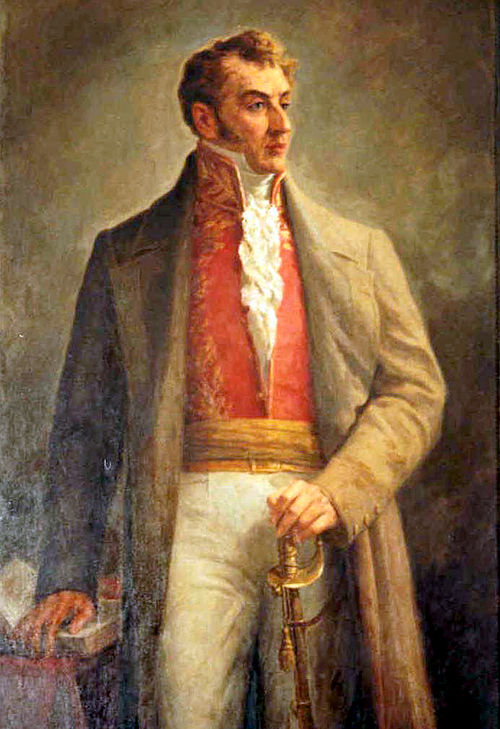
Antonio Nariño, Colombian creole intellectual and Precursor of Independence who illegally translated and printed the French Declaration of the Rights of Man in 1793, spending much of the following twenty years in Spanish colonial prisons for the act.
Colombia · Latin America

Antonio Nariño

Antonio Amador José de Nariño y Álvarez del Casal was born in Bogotá in 1765 into the creole elite of New Granada — the Spanish colonial Viceroyalty that would eventually become Colombia, Venezuela, Ecuador, and Panama — and died there in 1823, having spent much of the intervening fifty-eight years either in prison, in exile, or fighting for an independence that he had done more than almost anyone else to make conceivable. His pivotal act came in 1793, when he translated the French Declaration of the Rights of Man and of the Citizen into Spanish and printed it on his own press — an illegal act under colonial law, punishable by the confiscation of his estate, years of imprisonment, and exile to the African coast of the Spanish empire. He paid those penalties, more than once over, across two decades of imprisonment and flight that most people would have found sufficient reason to moderate their convictions. He did not moderate them. He emerged from each imprisonment and exile to resume the political work that the colonial authorities had tried to suppress, and when independence finally came he was there to participate in building the republic whose foundations his translation had helped to lay. He is called the Precursor of Colombian Independence, which is accurate but insufficient: he was the man who introduced the language of rights to a society that had no legal framework for that language, and in doing so made the argument for independence possible in terms that people trained in European political thought could recognise and act upon.

Colombia Precursor of Independence Translated the Declaration of the Rights of Man 1793 Twenty Years Imprisoned and Exiled Vice President of Gran Colombia Enlightenment in New Granada

Born: 9 April 1765, Santafé de Bogotá, New Granada (Colombia)  |  Died: 13 December 1823, Villa de Leyva, Colombia — Creole intellectual; translated Declaration of the Rights of Man 1793; imprisoned and exiled multiple times; independence fighter; Vice President of Gran Colombia 1821–23

At a Glance

The Creole Elite and Its DiscontentsNariño was born into precisely the class that the Spanish colonial system was most afraid of: the American-born creole elite, educated in European thought, prosperous enough to have genuine economic interests in the colonial territories, and systematically excluded from the highest offices of the colonial administration, which were reserved for peninsulares — Spaniards born in Spain. This exclusion was the structural condition that made the creole elite receptive to Enlightenment ideas about natural rights, popular sovereignty, and the illegitimacy of government without consent. They were not, in the main, arguing for the liberation of the indigenous and enslaved populations — they were arguing for their own right to govern themselves. Nariño was unusual among them in the radicalism of his reading of Enlightenment principles and in his willingness to accept the personal costs of acting on them.
The Library and the TranslationNariño was a bibliophile of extraordinary scope for his time and place — his private library contained thousands of volumes of philosophy, science, and political theory that the colonial authorities periodically confiscated and that he periodically rebuilt. It was through this library that he encountered the texts of the French and American Enlightenment, and it was from this formation that he undertook, in 1793, the translation and printing of the Declaration of the Rights of Man. The Declaration had been adopted by the French National Assembly in 1789 and had circulated in French and other European languages; bringing it into Spanish and printing it in Bogotá was both an act of political communication — making these ideas available to a Spanish-reading public for the first time — and an explicit act of defiance against a colonial system that understood perfectly well what the Declaration's principles implied for its own legitimacy.
The First Arrest and TrialThe colonial authorities moved against Nariño in 1794. His estate was confiscated, his library seized, and he was tried by the Audiencia of Santa Fe on charges of subversion. The sentence — ten years in a Spanish African prison, permanent exile from the Americas, forfeiture of all property — was among the harshest the colonial system could impose short of death. He was transported to Spain to begin the sentence, escaped in Cádiz before he could be shipped to Africa, made his way to France and then Britain where he sought support for American independence, and eventually returned to New Granada in 1797 — surrendering himself to the authorities in a complex political calculation that he hoped would produce a pardon and allow him to resume his political activities. It did not. He was imprisoned again.
Military Command and Further ImprisonmentWhen the independence movement erupted across New Granada beginning in 1810, Nariño was released from his most recent imprisonment and threw himself into the military and political dimensions of the struggle. He commanded independence forces, was elected president of the State of Cundinamarca (the central Colombian region around Bogotá), fought the royalist forces that were attempting to suppress the independence movement, and was captured by royalist forces in the south in 1814 during a campaign in which his army was defeated. He spent the years 1814–1820 in Spanish prisons — first in Bogotá, then in Cádiz — while the independence struggle continued without him. He was sixty years old when he was finally released for the last time, following Bolívar's decisive victories.
The Republic and Its Vice PresidentNariño was elected Vice President of Gran Colombia in 1821, under Simón Bolívar's presidency — a position that recognised his role as the intellectual forefather of the independence movement even though his physical and political capacities had been substantially diminished by decades of imprisonment. He served briefly and died in 1823, before seeing the dissolution of the Gran Colombia federation that Bolívar was fighting to hold together. The irony of his final position is considerable: the man who had introduced the language of republican rights to New Granada in 1793, at the cost of everything he owned and much of his liberty, died as the vice president of a republic that was already beginning to fracture along the lines of interest and ambition that the independence movement had temporarily suppressed.
The Long Shadow of a Single DocumentThe specific historical significance of Nariño's translation and printing of the Declaration of the Rights of Man is difficult to overstate in the context of New Granada's political development. Before 1793, the language of natural rights and popular sovereignty existed in the colony primarily in the books of Nariño's own library — accessible to those who could read French or Latin, but not available in the Spanish that was the political language of creole society. After 1793, these ideas were in circulation in their Spanish form, associated with a specific act of defiance against colonial authority, carried by the knowledge of what Nariño had paid for the act of translation. The Declaration's principles — that sovereignty resided in the people, that government derived its legitimacy from consent, that individual rights existed prior to and independent of the state's grant of them — were precisely the principles that the independence movement would invoke against Spanish colonialism. Nariño put them into the language in which that invocation could be made.

The Enlightenment Arrives in Bogotá

The Spanish colonial system's relationship to the Enlightenment was one of the central contradictions of late eighteenth-century empire. Spain's Bourbon reformers had themselves been influenced by Enlightenment ideas and had undertaken a programme of administrative modernisation in their American colonies — the same reforms that created the institutional frustrations of the creole elite by rationalising and thereby making more visible the systematic exclusion of American-born Spaniards from the highest colonial offices. The same reform programme had opened the colonial economy to more trade and thereby increased creole prosperity, and with prosperity came the ability to build the libraries and educational institutions that brought Enlightenment ideas into the colonial elite's intellectual formation. The colonial authorities were trying to modernise the empire without destabilising it, and the Enlightenment was making destabilisation increasingly difficult to prevent.

Nariño's library was the most comprehensive in New Granada — a collection built over years of systematic acquisition that reflected both his personal intellectual curiosity and his understanding that ideas were the medium in which the political questions of his era were being contested. He read widely in natural science, philosophy, and political theory, corresponding with intellectuals in Spain and France, and developing the political analysis that the translation of 1793 expressed. He was not a systematic political theorist in the sense of writing original works — his contribution was curatorial and communicative rather than originative: gathering the ideas that were transforming European political thought and making them available to a society that was beginning to understand their implications for its own situation.

The Translation and Its Consequences

The decision to translate the Declaration of the Rights of Man and to print it on his own press — rather than simply reading it in his library or sharing it in private correspondence — was a deliberate political act whose consequences Nariño understood and accepted. He knew the colonial authorities regarded the circulation of such ideas as sedition. He knew his estate, his library, and his freedom were at risk. He printed approximately one hundred copies, distributed some, and burned the rest when he realised the authorities were moving against him — though not before the Spanish inquisitorial apparatus had obtained evidence of the printing. The trial that followed stripped him of everything material he possessed and sent him into the first of the imprisonments and exiles that would occupy the next twenty years of his life.

The confiscation of his estate and library in 1794 left him materially ruined — a wealthy man made penniless by a single act of political conscience. The Spanish colonial system was designed precisely to make this kind of comprehensive punishment credible as a deterrent, and in most cases it worked: the creole elite's material interests in the colonial system were sufficient to contain their political dissatisfactions within legal bounds. That Nariño chose differently — that he accepted the confiscation, the imprisonment, the exile, and the years of uncertainty that followed rather than either conforming or moderating his convictions — is what distinguishes him from the many other creole intellectuals who shared his reading but not his willingness to act on it at personal cost.

The Fugitive Years: Europe and Return

The period between his escape in Cádiz in 1796 and his return to New Granada in 1797 is one of the most intriguing and least documented phases of Nariño's life. He was in France during a period of extraordinary political turbulence — the Directory period following the Terror — and in Britain, seeking support for American independence from governments that had their own complex relationships to Spanish colonialism. The evidence of what he actually accomplished during these months is sparse: he met people, made contacts, and returned to New Granada with a clearer understanding of the European political landscape and of the limits of what external support for independence could be expected to provide. His decision to return and surrender himself to the colonial authorities was a gamble — he believed that the political climate in New Granada had shifted sufficiently that a pardon was possible. The gamble failed: he was imprisoned again, though this time in Bogotá rather than in Spain or Africa, which at least kept him in proximity to the political developments that were building toward the independence declaration of 1810.

The years of imprisonment in Bogotá — interspersed with periods of house arrest and conditional release — were not politically idle. Nariño maintained contact with the networks of creole intellectuals and officials who were increasingly discussing independence, continued to read and write within the constraints of his confinement, and became a figure whose unjust treatment was itself a political argument: proof, for those who needed it, that the colonial system would not tolerate the expression of ideas that challenged its foundations, even by men of education and property who expressed them through the entirely peaceful medium of a printed translation.

Independence: From Ideas to Arms

The independence movement that began in New Granada in 1810 — triggered by the crisis in Spain following Napoleon's invasion and the installation of Joseph Bonaparte on the Spanish throne — found Nariño in his late forties, his best physical years behind him, his fortunes ruined by the colonial confiscations, but his political convictions entirely intact and his reputation among the independence movement's intellectual precursors unrivalled. He was elected president of the State of Cundinamarca in 1811 and threw himself into the military and political conflicts of the independence period with an energy that belied his circumstances.

The independence movement was not unified — the conflict between Nariño's centralist Cundinamarca and the federalist United Provinces of New Granada was one of the defining political disputes of the period, a foretaste of the constitutional arguments that would consume the new republics for decades after independence. Nariño's centralism — his belief that a strong central government was necessary to hold New Granada together and make independence viable — put him at odds with the federalists whose model eventually prevailed in the short term but whose fragmentation of authority helped make the royalist reconquest of 1815–1816 possible. His military campaigns in the south, aimed at extending the independence movement toward Pasto and Quito, ended in defeat and capture in 1814. He spent the following six years in Spanish prisons, released only after Bolívar's campaigns had made Spanish retention of New Granada untenable.

The Precursor's Legacy

Antonio Nariño died in December 1823, two years into the existence of Gran Colombia and two years before its contradictions became irresolvable. He did not see the republic fragment, did not see Bolívar's increasingly authoritarian attempts to hold it together, did not see the Venezuela and Ecuador that had been part of the Granadan colonial territory declare themselves separate nations in 1830. What he had lived to see was the independence that his translation had helped to make politically thinkable — the moment when the ideas he had introduced to New Granada in 1793, at the cost of his estate and his liberty, became the foundation of a new constitutional order.

The title "Precursor" that Colombian historiography attaches to Nariño is accurate but risks understating the specific nature of his contribution. He was not a precursor in the sense of someone who acted prematurely and was left behind by subsequent events — he participated in every phase of the independence movement, from the intellectual preparation of the 1790s through the military campaigns of the 1810s to the constitutional politics of the 1820s. What makes him a precursor is the specific act of 1793: the decision to translate the language of rights into Spanish at a moment when no political movement capable of acting on that language yet existed, accepting the consequences of that decision alone, without the protection of a movement or the cover of a broader political crisis. He was the person who decided that the ideas were important enough to risk everything for before it was obvious that anything could come of the risk. That is the act the title commemorates, and it deserves to be remembered as what it was: a single person's decision to make dangerous ideas available to a society that did not yet know what to do with them, in the faith that eventually it would.

Also Profiled — Colombia, Venezuela & Bolivia

Colombia, Venezuela & Bolivia Camilo Torres Restrepo Liberation Theology priest who joined the ELN guerrillas; killed in first combat 1966 Colombia, Venezuela & Bolivia Coco Peredo Bolivian communist; killed in Vado del Yeso ambush with Che Guevara's column 1967 Colombia, Venezuela & Bolivia Francisco de Paula Santander Man of Laws; Bolívar's partner; founder of Colombian constitutional republicanism Colombia, Venezuela & Bolivia Hugo Chávez Venezuelan president; Bolivarian Revolution; oil nationalisation; ALBA founder Colombia, Venezuela & Bolivia Inti Peredo Bolivian communist who survived Guevara's column; killed 1969 rebuilding resistance Colombia, Venezuela & Bolivia Jacobo Arenas FARC co-founder and chief ideologist; died in the field 1990 Colombia, Venezuela & Bolivia Jaime Bateman Cayón M-19 founder; seized the Colombian National Palace; died in plane crash 1983 Colombia, Venezuela & Bolivia Manuel Marulanda Vélez Tirofijo — FARC founder and supreme commander for four decades; died in the field 2008 Colombia, Venezuela & Bolivia Raúl Reyes FARC Secretariat; killed in Colombian airstrike inside Ecuador 2008 Colombia, Venezuela & Bolivia Simón Bolívar The Liberator — freed five nations; dreamed of a unified South America; died 1830 Colombia, Venezuela & Bolivia Simón Rodríguez Bolívar's teacher; radical educator; most original educational philosopher in South America Colombia, Venezuela & Bolivia Tania la Guerrillera Argentine-born East German operative; killed at Vado del Yeso 1967
Share X Facebook WhatsApp LinkedIn