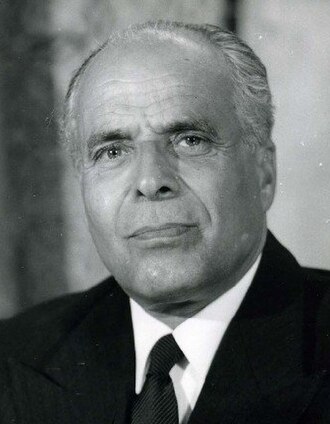
At a Glance
Monastir, Paris, and the Formation of a Nationalist
Habib Bourguiba was born on 3 August 1903 in Monastir — a coastal town on the Sahel whose ribat fortress and Islamic educational traditions gave it a specific cultural character within the world of the French Protectorate. The Monastir of Bourguiba's childhood was a community embedded in the tensions of the early Protectorate period — French administrative and educational presence was real, the transformation of the Tunisian economy by colonial commercial investment was underway, and the traditional institutions of Tunisian Muslim society were being subjected to the pressures that French cultural policy and French economic organisation generated everywhere it operated.
His educational trajectory — Sadiki College in Tunis, then the Lycée Carnot, then law school in Paris — was the standard path of the Tunisian nationalist generation, the sequence through which the colonial educational system's most ambitious Tunisian products were trained in the professional skills of European institutional life while simultaneously developing, in the specific milieu of 1920s and 1930s Paris, the political consciousness that turned professional ambition into nationalist commitment. Paris in those years was the intellectual capital of the anti-colonial movement in a very specific sense — the place where North and West African students who were simultaneously acquiring French professional credentials and encountering French racial condescension developed the political framework for understanding their home countries' colonial situation and for imagining its alternatives.
Bourguiba returned to Tunisia as a trained lawyer and as a convinced nationalist — someone who had absorbed the French liberal tradition's language of rights and citizenship and was prepared to deploy it against the colonial order that denied those rights and that citizenship to Tunisian people. His legal training gave him the specific rhetorical and analytical tools that political advocacy required, and his Paris experience gave him the political connections and the international perspective that his subsequent diplomatic work would draw on.
The Neo-Destour and the Independence Campaign
The founding of the Neo-Destour at Ksar Hellal in March 1934 was Bourguiba's most consequential political act — the establishment of a mass political party whose programme, whose organisational method, and whose political vision were qualitatively different from the Destour's constitutionalist approach. The Destour had pressed for constitutional reform through petitions and delegations to Paris — a method appropriate to a party whose social base was the educated notables' class and whose political method was the institutional negotiation of incremental reform. Bourguiba's Neo-Destour was designed for a different purpose: the building of a mass independence movement that could exert the kind of social and political pressure that colonial governments took seriously.
The French response — immediate and sustained repression — confirmed the assessment that the Neo-Destour represented a genuine threat to colonial order in a way that the Destour's constitutional approach had not. Bourguiba was arrested in 1934, again in 1938, and most significantly from 1952 to 1955, when he was held in progressively more isolated conditions by a French government that was simultaneously trying to manage him as a political problem and recognising that his imprisonment was generating the international attention and the domestic sympathy that made it counterproductive. His eventual release and return to Tunisia in 1955 — the culmination of a complex negotiation between the Neo-Destour and the French government that produced the autonomy arrangements that preceded full independence — was a moment of extraordinary political theatre, the returning hero whose twenty-year campaign had finally produced concrete results.
The independence negotiations themselves reflected Bourguiba's specific political method — preferring direct bilateral talks with the French government to the multilateral international forums where the Algerian FLN and other independence movements pursued their campaigns, and preferring negotiated solutions that preserved the possibility of a cooperative post-independence relationship with France to the confrontational approaches that might have been more satisfying symbolically but would have been more costly in practical terms. Tunisia's independence on 20 March 1956 was the product of this approach — a negotiated transfer of sovereignty that avoided the destructive armed struggle that was simultaneously devastating Algeria, and that produced an independence achieved at a cost in human life and institutional destruction that made the subsequent building of a modern Tunisian state considerably easier than it would otherwise have been.
The Personal Status Code: The Most Radical Social Reform in the Arab World
The Code du Statut Personnel, promulgated in August 1956 just months after independence, was Bourguiba's most radical legislative act and his most enduring positive legacy. In a single piece of legislation, he abolished polygamy — the practice of multiple simultaneous marriages that Islamic jurisprudence permitted but that Bourguiba declared incompatible with the modern state's commitment to equal dignity; established minimum marriage ages that prevented the child marriages that customary practice had sanctioned; granted women the right to divorce through the courts rather than being subject to unilateral male repudiation; and established women's equality before family law in a range of areas where the traditional interpretation of Islamic law had denied it.
No other Arab leader of the independence era came close to this programme. Egypt under Nasser, Algeria under Ben Bella and his successors, Morocco under Hassan II — none of them produced legislation of comparable ambition in the domain of women's personal rights, and most of them explicitly rejected the Bourguibist approach as an imposition of Western secular values on a Muslim society. Bourguiba's counter-argument — that Islam, properly understood, was compatible with the equality and dignity that the Code expressed, and that the traditional interpretations of Islamic family law represented the accretions of specific historical contexts rather than the religion's timeless requirements — was controversial within the Muslim world but expressed a genuine engagement with Islamic jurisprudence rather than a simple rejection of it.
The Code's consequences for Tunisian women were transformative across generations. Girls' education expanded dramatically as the legal framework changed the social expectations of what education was for; women entered the professions, the civil service, and public life in numbers and at rates that exceeded those of most comparable societies; and the specific legal protections of the Code gave Tunisian women a security in their family lives that translated into expanded social and economic participation. This achievement belongs to Bourguiba's legacy in a way that survives the subsequent authoritarian distortions of his presidency, and it remains the most concrete evidence that his modernising vision was genuinely held rather than merely rhetorical.
The Progressive Concentration of Power
The Bourguibist state's authoritarian character did not emerge overnight; it accumulated through a series of political decisions and institutional changes that progressively eliminated the checks on presidential power that the independence settlement had included. The suppression of Salah Ben Youssef's opposition in 1955–1956, before independence was even formally achieved, established the pattern: political challenges to Bourguiba's leadership were to be eliminated rather than accommodated. The subsequent decades refined and extended this pattern — the subordination of the UGTT to ruling party control, the elimination of independent political parties, the constitutional amendments that removed presidential term limits, the declaration of the presidency for life in 1975, and the systematic silencing of any figure who represented a potential alternative political centre of gravity.
Ahmed Mestiri's founding of the MDS and his subsequent imprisonment, the Black Thursday massacre of 1978 and the suppression of UGTT independence that followed it, the imprisonment of Islamist politicians in the 1980s, and the general atmosphere of surveillance and intimidation that characterised political life in Tunisia through the 1970s and early 1980s were all expressions of the same fundamental political choice: that the consolidation of Bourguiba's personal authority was more important than the democratic governance that the independence movement had promised. Each specific authoritarian act could be justified by specific circumstances — Ben Youssef's Egyptian backing, the UGTT's overreach, the Islamist threat to secular governance — but the cumulative pattern was a political system in which power was concentrated in a single person whose judgment about what Tunisia needed was not subject to democratic accountability.
The progressive deterioration of Bourguiba's judgement in the 1980s — the product of age, illness, and the insulation from reality that three decades of unchallenged personal authority had produced — made the situation increasingly precarious. His management of the Islamist question became erratic and vindictive; his personal interventions in specific cases — demanding the death penalty for Islamist defendants in ways that embarrassed even the judges who were expected to comply — were evidence of a man whose grasp on reality was slipping. Ben Ali's coup of November 1987, citing medical incapacity, was the response to a political crisis that Bourguiba's own political system had made impossible to resolve through any democratic mechanism.
Exile Within Tunisia: The Last Thirteen Years
Bourguiba's removal on 7 November 1987 placed him in a situation that was historically unprecedented — not exile abroad, not imprisonment, but a form of domestic quarantine in his birthplace of Monastir, supervised, maintained at the standard of a former head of state, excluded from political life, and gradually forgotten by a political community that had moved on. Ben Ali managed the Bourguiba question with the calculation that keeping him alive but politically irrelevant was safer than any alternative — that a dead Bourguiba would have become a martyr that complicated the new regime's legitimacy, while a living Bourguiba in Monastir was simply an elderly man with no political platform.
The thirteen years between the coup and his death in April 2000 were years in which the Tunisia he had built was being reshaped by his successor in ways that extended the authoritarian logic of the Bourguibist state while abandoning the specific modernising commitments — the Personal Status Code, the investment in education, the specific relationship with France — that had given that state its distinctive character. Ben Ali preserved the Code, preserved the educational system, and preserved the general framework of a secular Tunisian state while systematically destroying whatever remained of the political pluralism and civil society independence that the Bourguibist system had never fully established but had at least permitted to exist at the margins.
Bourguiba died in Monastir on 6 April 2000, at ninety-six years of age. He was buried in the mausoleum he had built for himself in his birthplace — a monument that expressed, with the grandiosity that had always been part of his political style, the self-identification between the man and the nation that had been both his greatest political achievement and his greatest political failure. Tunisia was his creation in a real sense — its independence, its legal framework, its educational system, its specific place in the Arab and African world — and it would outlive him and eventually produce, through the revolution of 2011 and the democratic transition that followed, a more genuinely democratic version of the modern state he had always claimed to be building.
The Paradox at the Centre of Tunisia's Independence Story
Habib Bourguiba's legacy is paradoxical in a way that no ideological simplification can resolve. He liberated Tunisia from French colonialism through a combination of political genius, personal courage, and diplomatic skill that produced an independence achieved more cheaply and more sustainably than the armed alternatives would have allowed. He built educational and health institutions that gave Tunisian people opportunities they had never had under colonial rule. He advanced women's rights further than any Arab leader of his generation through the Personal Status Code. And then he spent thirty years building an authoritarian system that imprisoned the men who challenged him, silenced the press, manipulated elections, and made the genuine democratic governance he claimed to be building structurally impossible.
The paradox is not simply that a good man did bad things or that a bad man did good things. It is that the same qualities that made Bourguiba effective as an independence leader — the absolute confidence in his own judgment, the impatience with institutional constraints that slowed down his vision's implementation, the identification of himself with Tunisia's national interest — were the qualities that made him incapable of building the democratic institutions that would have made his achievements durable rather than personal. Democratic governance requires leaders who accept the institutional limits on their authority even when they believe their own judgment is better than the system's. Bourguiba could not accept those limits, and his inability to accept them was the source of both his effectiveness in the short term and his failure in the long.
The Tunisia of the Fourth Republic — the democratic Tunisia that the 2011 revolution produced — carries his legacy forward in the institutions he built even as it has replaced the authoritarian system he created. The Personal Status Code remains. The educational system he developed remains. The specific secular character of the Tunisian state, which made the democratic transition possible, remains. What did not remain was the concentration of power that he had personalised — the political system that the 2011 revolution replaced with something better, something more genuinely consistent with what he had always claimed to be working toward. The revolution vindicated his stated commitments while repudiating his actual political practice. It is a complicated form of historical justice, but justice of a kind.