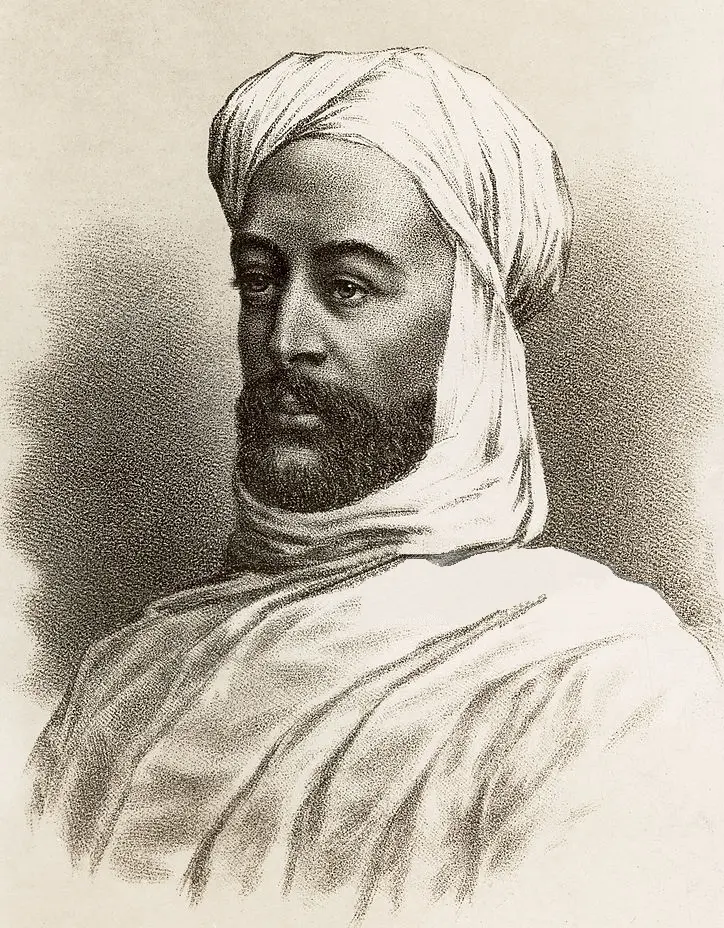
At a Glance
The Vision That Moved Mountains: Faith, Resistance, and Imperial Shock
The Mahdist revolution is, among the great episodes of nineteenth-century African history, the one that most directly and most dramatically disrupted the imperial assumptions of the European powers about the limits of African resistance to modern military force. The specific character of that disruption — its theological framework, its extraordinary military effectiveness, its capacity to mobilise across the enormous ethnic and social diversity of the Sudanese population — requires understanding in its own terms rather than simply as a precursor to the twentieth-century anti-colonial movements that would be more familiar to later readers.
Muhammad Ahmad's claim to be the Expected Mahdi was not, in the religious culture of nineteenth-century Sudanese Islam, a straightforwardly extraordinary claim. Islamic tradition had long anticipated the coming of a divinely guided figure who would appear at a time of crisis to purify the faith and establish justice — the specific expectations varied across different Islamic traditions and legal schools, but the general framework of Mahdi expectation was deeply embedded in popular Islamic religiosity throughout the Muslim world. What made Muhammad Ahmad's specific claim compelling to the populations of the Sudan was the combination of his personal religious reputation — his recognised piety, his knowledge, his asceticism, his charisma — with the specific conditions of the moment: a corrupt and extractive Egyptian administration that was experienced as both unjust and irreligious, military victories that seemed to validate divine favour, and the specific signs and portents that his followers read as confirmation of his identity.
The military genius of the Mahdist movement was inseparable from its religious character. The fighters who destroyed Hicks Pasha's army, who held Khartoum under siege for ten months against Gordon's determined defence, who charged the Maxim guns at Omdurman in 1898 with spears and obsolete firearms, were not motivated by calculations of military advantage or survival probability — they were motivated by the conviction that death in the Mahdi's service was not a cost but a reward, that the paradise guaranteed to the martyr was worth the price of the body's destruction. This conviction produced a quality of military aggression and individual courage that consistently gave Mahdist forces tactical advantages against numerically and materially superior opponents, and that no amount of training or military organisation could fully substitute for in the specific conditions of the nineteenth-century Sudan's warfare.
The social breadth of the Mahdist movement — its ability to mobilise not just the riverine Arab communities of the Nile Valley from which Muhammad Ahmad came but the nomadic Baqqara cattle-herders of Kordofan and Darfur, the agricultural communities of the Gezira, the populations of the western and southern regions — was a political as well as a military achievement. The Egyptian administration had created a shared experience of oppression and extraction that transcended the enormous ethnic and social diversity of the Sudanese population, and the Mahdi's religious ideology provided a framework within which these diverse communities could understand themselves as a single Muslim community with a common cause. The specific character of that ideology — its explicit rejection of the established order, its promise of purification and justice, its claim to divine authority that superseded all merely human authority — was calibrated, whether consciously or not, to maximise its appeal across the widest possible range of the Sudanese social world.
The destruction of the Hicks Pasha army in November 1883 deserves particular attention as a military event, because its scale and its completeness were of a different order from the earlier engagements that had suggested the Mahdi's movement was a serious but manageable regional problem. Eight thousand soldiers — an army that would have been formidable by European standards of the time — were drawn deep into Kordofan, stripped of their water supplies through the Mahdist forces' deliberate destruction of wells along their line of march, their communications cut, their supplies exhausted, and then destroyed in a series of engagements in which the specific conditions of terrain and supply had negated the Egyptian army's advantages in firearms and reduced the battle to one of close-quarters fighting in which the Mahdist fighters' courage and numbers were decisive. The capture of the army's weapons and ammunition gave the Mahdist forces a qualitative military upgrade that further strengthened their capacity for subsequent operations.
The siege of Khartoum and Gordon's death in January 1885 had a significance that extended far beyond the military and political realities of the Sudan campaign. In Britain, the fall of Khartoum was experienced as a national humiliation and a personal tragedy — Gordon had been made, through the months of the siege, into a figure of immense symbolic importance, the Christian soldier defending civilisation against barbarism, and his death shattered that narrative with a completeness that generated lasting political consequences. The Gladstone government, which had delayed the relief expedition and presided over Gordon's death, suffered the political costs; the British public demanded revenge in terms that shaped imperial policy toward Sudan for the following decade. The eventual reconquest of Sudan by Kitchener in 1898 was explicitly conceived as revenge for Gordon and for Khartoum — the Battle of Omdurman's specific character, including Kitchener's later desecration of the Mahdi's tomb, reflected the emotional and political freight that the 1885 events had accumulated.
Muhammad Ahmad al-Mahdi died before he could confront the specific governance challenges that the Mahdist state would face in the thirteen years after his death — the questions of how to administer the enormous territory his movement had conquered, how to manage the tensions between different social groups within the movement, how to sustain the revolutionary fervour that had produced military victory in the different conditions of peacetime governance. These challenges fell to his successor the Khalifa Abdallahi, whose governance of the Mahdist state involved a progressive shift from the revolutionary mobilisation of the Mahdi's period to the more conventional exercise of authoritarian power, with all the tensions and deteriorations that this shift produced. The Mahdist state that Kitchener destroyed at Omdurman in 1898 was in some respects a diminished version of the movement that Muhammad Ahmad had built — diminished by the governance challenges, the internal conflicts, and the economic deterioration of the post-Mahdi years — but it was also the longest-lasting product of nineteenth-century African anti-colonial resistance, sustained for thirteen years by the social and institutional structures that the Mahdi had built.
The legacy of Muhammad Ahmad al-Mahdi in Sudanese political culture has been continuous and profound. The Ansar — the term used for the Mahdi's followers — became the name of the religious and political movement built around his memory and the authority of his descendants, who established the Umma Party as the political vehicle of the Mahdist tradition in Sudan's twentieth-century parliamentary politics. Sadiq al-Mahdi, his great-grandson, served multiple times as Sudan's prime minister and remained a significant political figure into the twenty-first century. The Mahdist tradition's intersection with Sudanese nationalist politics, its complex relationship with the Islamist movement that eventually dominated Sudanese politics under Omar al-Bashir, and its continuing role as a source of political identity and cultural memory in the communities of the Nile Valley and western Sudan all reflect the depth and durability of the foundation that Muhammad Ahmad laid in the extraordinary four years between his proclamation of the Mahdiship and his death.