At a Glance
A Life Defined by the Courage to Demand Equality
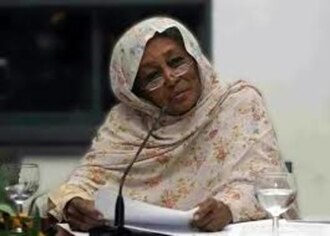
The significance of Fatima Ahmed Ibrahim's contribution to Sudanese political life cannot be understood apart from the specific context in which she made it — a context defined by the intersection of three forms of structural subordination that she challenged simultaneously throughout her career: the colonial and then neo-colonial subordination of Sudan within global power structures, the political subordination of democratic civil society to military dictatorship within Sudan, and the social subordination of women within a patriarchal culture reinforced by both customary practice and Islamic legal interpretation. She was not a single-issue activist who focused on one of these three dimensions to the exclusion of the others; she was a figure who understood them as connected, and whose political project required confronting all three.
The Sudanese Women's Union represented the institutional vehicle for this project at its most fundamental level. Founded in the late colonial period and built through decades of painstaking organisational work, the SWU was the organisational expression of the conviction that Sudanese women's political, legal, and social equality was not a secondary question to be deferred until after independence or socialist transformation but a dimension of liberation as urgent and as fundamental as any other. Ibrahim's contribution to the SWU was both organisational and intellectual: she helped to build the organisation's membership and its national reach, and she articulated the framework of analysis that grounded the SWU's demands in a coherent account of women's oppression and women's rights. The organisation's demands — for voting rights, for equal education, for equal pay, for legal reforms in family and personal status law — were each a challenge to specific structures of gender inequality, and the combination of them amounted to a comprehensive program for women's liberation within Sudanese society.
The electoral victory of 1965 was the most visible single achievement of Ibrahim's political career, but its significance lies not only in the historic first it represented but in what it demonstrated about the political possibilities that the SCP's commitment to women's political leadership had created. Sudan's parliamentary system in 1965 was operating in a specific political context — the post-Abboud restoration of civilian government, with its briefly expanded political freedoms and its genuine competitive electoral arena — and the SCP's decision to run Fatima Ahmed Ibrahim as a serious candidate for a graduate constituency was a deliberate political choice that reflected the party's understanding of both electoral strategy and the symbolic importance of putting a woman's rights leader in parliament. Her campaign drew on the SWU's networks, on the trade union movement's organisational capacity, and on the broader constituency of women voters who had been formally enfranchised precisely because of the advocacy of the women's movement that Ibrahim represented. Her victory was, in this sense, the fruit of years of organisational work by the women's movement as much as it was the achievement of an individual candidate.
The parliamentary period gave her a platform from which to advocate for specific legal reforms — pushing for changes to personal status law that would give women greater rights in marriage and divorce, arguing for women's economic rights in the workplace, and using the visibility of her parliamentary position to maintain public attention on the women's rights agenda at the national level. The SCP's eventual suppression and the end of the parliamentary period cut this work short, but the precedent had been established and the symbolic importance of a woman in parliament had been demonstrated in ways that the subsequent periods of military government could repress but not erase.
The catastrophe of July 1971 — the execution of the SCP's leadership in the aftermath of the failed coup attempt — was the defining trauma of Ibrahim's personal and political life. The murder of Al-Shafie Ahmed al-Sheikh, her husband, by a government that had moved from professed left-nationalism to murderous repression in a matter of months, was the kind of loss that could have broken a person's political will. Instead, Ibrahim transformed it — into a fiercer determination to pursue the democratic politics that the Nimeiry regime had tried to destroy, into an insistence on the historical memory of those murdered in 1971, and into a continuing engagement with the international human rights and women's rights communities that gave her work a platform even when Sudan's own political space was closed to her. The murdered men — Mahjoub, al-Sheikh, Garang, and others — were not replaced by their deaths but made into foundations for the continuing work of those who survived.
The decades of exile in London were not a withdrawal from political life but a continuation of it by different means. Ibrahim wrote, spoke, organised, and advocated from abroad with the intensity of someone who understood that exile was temporary and that the political work of the diaspora was continuous with the political work that would eventually be possible inside Sudan. Her participation in international women's conferences, her engagement with human rights organisations documenting the abuses of successive Sudanese military governments, and her continued connection to the networks of the Sudanese Women's Union inside Sudan — maintained even when the organisation was formally suppressed — kept alive a thread of organised women's rights politics that would re-emerge whenever political conditions permitted.
The relationship between Fatima Ahmed Ibrahim's politics and the question of Islam deserves particular attention, because it cuts to the heart of one of the most contested dimensions of women's rights politics in the Arab and Muslim world. Her advocacy for women's rights was developed in a Sudanese Muslim context, and she was not arguing for a secular politics that rejected Islamic tradition but for an interpretation of Islamic values and legal principles that was compatible with women's equal dignity and equal rights. The Islamist movement that eventually dominated Sudanese politics under Omar al-Bashir took the opposite position, arguing that Islamic law required the subordination of women in specific ways that the SWU's demands challenged directly. The contest between these two approaches to the relationship between Islam and women's rights was not peripheral to Sudanese political life but central to it, and Ibrahim's consistent articulation of the women's rights position within rather than against a Muslim political context was a significant intellectual and political contribution to that contest.
Fatima Ahmed Ibrahim died in London in January 2017, before the December 2018 uprising that brought down the al-Bashir government and opened the possibility of a democratic transition. The uprising itself, in which women played a prominent and visible role — the image of Alaa Salah standing on a car and leading protest chants becoming one of the iconic images of the Sudanese revolution — was a direct continuation of the political tradition that Ibrahim had built. The Sudanese Women's Union was among the organisations that participated in the Forces of Freedom and Change, the civilian coalition that negotiated with the military after al-Bashir's fall. The questions that Ibrahim had asked in the 1940s — about women's political participation, about legal equality, about the relationship between democratic governance and women's rights — were the same questions that the 2019 Constitutional Declaration was attempting to answer, incompletely and under enormous pressure from a military establishment that had no interest in genuine democratic transformation. Her life's work had not resolved those questions, but it had ensured that they could not be ignored.