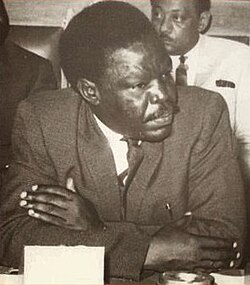
Aggrey Jaden, South Sudanese liberation leader, SANU co-founder, and early advocate of southern autonomy and self-determination.
Sudan · Africa

Aggrey Jaden

Aggrey Jaden stands among the founding generation of South Sudanese political leaders — the men and women who, in the decade after Sudan's independence in 1956, first articulated in organised political form the conviction that the people of Sudan's southern regions could not achieve justice, dignity, or security within a Sudanese state whose northern political establishment treated the south as a colonial hinterland rather than as a community of equal citizens. As a co-founder of the Sudan African National Union and later as its president during one of its most assertive phases, Jaden gave institutional form to southern political aspirations at the moment when those aspirations were most urgently in need of organised expression — when the Anyanya insurgency was in the field, when the Khartoum government was alternating between military repression and political manipulation, and when the question of whether the south's future lay within a reformed Sudan or in separation was being forced onto the agenda by the accumulating weight of violence, displacement, and broken promises. Born around 1924 in the Equatoria region — the southernmost of Sudan's three southern provinces, the part of the country farthest in every sense from the northern political centre — Jaden came to political consciousness through the mission school education that was, for the educated southern Sudanese of his generation, simultaneously the principal pathway to the literacy and administrative skills that political participation required and the institutional formation that connected southern education to Christian missionary networks rather than to the Arab-Islamic world of the north. His political career unfolded across the tumultuous 1960s, when he represented southern Sudan's case at the 1965 Round Table Conference in Khartoum — a moment at which the possibilities of negotiated accommodation within a united Sudan were briefly and ultimately futilely explored — and when, dissatisfied with the terms being offered, he moved toward the more uncompromising position on southern self-determination that defined his political legacy. He died in 1993, more than a decade before the Comprehensive Peace Agreement that would finally create the framework for South Sudan's independence, but the political work of his generation made that outcome possible.

Sudan SANU Co-Founder and President Southern Sudan Liberation Movement Self-Determination Advocate 1965 Round Table Conference Delegate Equatoria Political Leader

Born: c. 1924, Equatoria, Sudan  |  Died: 1993 — SANU co-founder; southern Sudan liberation movement leader; represented south at 1965 Round Table Conference; advocate of southern self-determination; died aged c. 69

At a Glance

The Southern Sudan Problem at IndependenceWhen Sudan achieved independence from Anglo-Egyptian condominium rule in 1956, the fundamental political problem of the south was already visible to anyone who chose to see it: the three southern provinces — Upper Nile, Bahr el-Ghazal, and Equatoria — were populated predominantly by African communities of diverse ethnicities and predominantly Christian or animist religious traditions, communities whose encounter with the north had been shaped by the slave trade, by the violence of nineteenth-century imperial conquest, and by the separate administrative development of the British southern policy that had governed the south on different principles from the north. The transfer of power to a Sudanese government dominated by northern Arab Muslim politicians brought these communities under an authority whose cultural and political assumptions were alien to them and whose practical policies — the Sudanisation of the civil service, the northernisation of the southern army, the imposition of Arabic and Islamic education — demonstrated that independence would bring the south not liberation but a new form of domination.
The Equatoria Corps Mutiny and the AnyanyaThe political crisis of southern Sudan erupted militarily with the mutiny of the Equatoria Corps in August 1955 — before independence had even formally arrived — when southern soldiers, alarmed by reports of northernisation and unwilling to be disarmed and transferred to northern commands, rose against their northern officers. The mutiny was suppressed, its leaders executed, but it signalled the depth of southern distrust of the political transition that independence represented for the south. The armed resistance that eventually became known as the Anyanya — drawing on the word for a kind of snake poison in a southern Sudanese language — developed slowly through the early 1960s as southern soldiers who had escaped into the bush, combined with civilian men driven from their homes by government repression, formed the nucleus of an irregular armed force. It was in this context of armed struggle and political exile that SANU emerged as the attempt to give the southern cause organised political voice.
SANU and the Politics of ExileThe Sudan African National Union was founded in 1963 by southern Sudanese exiles in Uganda, with figures including Joseph Oduho and William Deng Nhial among its early leadership alongside Jaden. The choice of name — consciously echoing the liberation movement nomenclature of the African nationalist moment, with its evocation of TANU in Tanzania and ANC in South Africa — signalled the intention to situate the southern Sudan struggle within the broader African liberation movement context. SANU operated primarily from exile in Uganda and the Congo, attempting to coordinate with the Anyanya forces in the field, to gain international recognition for the southern cause, and to articulate political positions that could represent the southern Sudan movement to the world. The organisation was from the outset divided by personal rivalries, strategic disagreements, and the difficulty of maintaining a coherent political line while operating from the diaspora with limited resources and no secure territorial base.
The 1965 Round Table ConferenceThe Round Table Conference convened in Khartoum in March 1965 represented the most serious attempt in the first decade of Sudanese independence to find a negotiated political solution to the southern Sudan problem. Jaden attended as a SANU representative and presented the southern case with a clarity and firmness that reflected both his political convictions and his assessment of the accumulated evidence that Khartoum's offers of accommodation would not be sufficient. He articulated positions on regional autonomy and self-determination that the northern participants found unacceptable, and the conference ended without agreement — a failure that pushed the conflict back toward military means and that confirmed, for Jaden, that the southern position needed to become more rather than less demanding. His performance at the conference established him as a significant figure in southern politics but also deepened the divisions within SANU over strategy and leadership.
The Split in SANU and the Question of StrategyThe internal tensions in SANU came to a head around the question of whether to engage with the northern political parties' offers of accommodation within a unified Sudan or to insist on the southern right to self-determination up to and including independence. William Deng Nhial represented a faction willing to work with northern politicians and to return to Sudan to organise politically within the system; Jaden represented the more uncompromising position that southern self-determination could not be negotiated away. This strategic and personal division effectively split SANU, with Jaden's faction maintaining the harder line in exile while Deng's faction returned to Sudan. The split weakened the organised political representation of the southern cause at a crucial period and contributed to the difficulty of coordinating political and military activity in the years before the Addis Ababa Agreement of 1972.
The Long View: Vindication and LegacyJaden died in 1993, before the Comprehensive Peace Agreement of 2005 that established the framework for the referendum that produced South Sudan's independence in 2011. The independence of South Sudan — the outcome that Jaden had argued for, that the northern political establishment had consistently refused to countenance, and that the Addis Ababa Agreement of 1972 had deferred without finally resolving — represented the ultimate vindication of the political position that he and his generation had staked their lives and careers on. The road from his advocacy at the 1965 Round Table Conference to the flag raising in Juba in July 2011 was long, brutal, and soaked in suffering, but it led to the place that Jaden had pointed toward when almost no one in the corridors of African and international diplomacy was willing to acknowledge the legitimacy of where he was pointing.

Speaking the Unspeakable: The Southern Sudan Case

Aggrey Jaden's historical significance lies in his willingness to speak clearly about a political reality that the conventions of postcolonial African diplomacy, committed to the principle of inherited colonial borders and deeply resistant to any precedent of territorial revision, made it extraordinarily difficult to name. What Jaden said, at the Round Table Conference in 1965 and in the political documents and statements of his SANU leadership period, was this: that the people of southern Sudan had not been liberated by Sudanese independence but had exchanged one form of colonial administration for another; that the political, cultural, and physical violence that the northern-dominated Sudanese state was directing against the south was not a transitional problem of national integration but a structural feature of the relationship between a northern political establishment and a southern population it regarded as inferior and available for subjugation; and that the appropriate response to this situation was not the patient negotiation of better terms within a framework of Sudanese unity but the assertion of the southern Sudanese people's right to determine their own political future.

This position was radical in the context of 1960s African politics. The Organisation of African Unity had made the inviolability of colonial borders a foundational principle of its collective diplomacy, and for good reason — the alternative, a continent-wide opening of every colonial boundary to revision by force, offered only chaos. But the OAU's border principle also had the effect of foreclosing political solutions that the actual diversity and actual history of African states sometimes urgently required, and Sudan was a case in which the principle was being used to deny the most elementary political legitimacy to communities that had been incorporated into a state against their will and were being governed with a combination of neglect and violence that, by any reasonable standard, constituted colonial rather than national rule. Jaden was not ignorant of the complications; he was insisting that the southern Sudan case was one in which the complications had to be confronted rather than wished away in the name of continental solidarity with a northern political establishment that was doing things in the south that the same African governments would have condemned as colonialism had a European power been doing them.

The formation of SANU in 1963 gave this political position an institutional form — a liberation movement organised on the model that the era's African liberation movements had developed, with exile political structures, relationships with sympathetic African governments, international advocacy efforts, and coordination with armed forces in the field. Jaden's contribution to this organisation was both strategic and representative: he gave articulate expression to positions that the more diplomatically minded members of the southern political community were reluctant to state so plainly, and he represented the Equatoria region's perspective — the perspective of the south's southernmost province, the part of the country most remote from Khartoum and most thoroughly shaped by the separate development of the southern administered under British rule.

The 1965 Round Table Conference was the moment at which Jaden's political positions received their fullest public expression and their most consequential test. The conference had been convened by Sudan's post-Abboud parliamentary government as a genuine attempt to find a negotiated solution to the southern problem, and it brought together northern political parties, southern political leaders, and observers from African governments in a forum that offered, at least in principle, a real possibility of agreement. Jaden presented the southern case with clarity: he argued for a degree of southern autonomy that the northern parties were not prepared to grant, and he framed that argument in terms of the south's specific historical experience and its accumulated evidence that northern assurances of equal treatment could not be trusted. The conference's failure was not his failure — the northern parties' unwillingness to offer the genuine power-sharing that the south required was the decisive obstacle — but it confirmed his assessment that the southern position needed to become more explicit about the right to self-determination rather than seeking the least unacceptable version of continued union.

The divisions within SANU that split the organisation after the conference reflected real strategic disagreements about how to respond to this failure. William Deng Nhial's decision to return to Sudan and work within the political system represented a different theory of how southern political objectives could be advanced — a theory that Jaden judged to be based on an insufficient assessment of the northern political establishment's willingness to share power genuinely. The subsequent assassination of Deng in 1968, murdered in circumstances that most observers attributed to government responsibility, seemed to vindicate the more pessimistic view of what engagement with northern politics offered. But the split had weakened SANU and fragmented the organised political representation of the southern cause at a crucial moment.

Jaden continued to represent the harder line on southern self-determination through the years of the Anyanya insurgency, operating from exile as the military situation inside the south developed its own logic and its own leadership structures. The relationship between the external political organisations and the internal armed movement was always complicated — the men in the bush had their own priorities and their own political visions, and the exile political leaders were sometimes more of a complicating factor than a unifying force in the southern movement's development. The Addis Ababa Agreement of 1972, negotiated by Joseph Lagu on behalf of the Anyanya forces and by Joseph Garang and others on behalf of the south's political leadership, established a regional autonomy arrangement for the south within a united Sudan — the kind of outcome that Jaden had argued was insufficient, and the subsequent history of the agreement's erosion and the renewal of war in 1983 would suggest that his pessimism about the durability of autonomy arrangements without genuine power-sharing had been well-founded.

The independence of South Sudan in July 2011 was the culmination of a process that Jaden's generation of leaders had initiated — the insistence, against the overwhelming weight of regional and international opinion in the 1960s, that southern Sudanese people had the right to determine their own political future. The specific path that led to that outcome — the Comprehensive Peace Agreement of 2005, the referendum of January 2011, the formal declaration of independence on 9 July 2011 — involved actors and processes far removed from the SANU politics of the 1960s, but the political foundation on which the CPA was built — the acceptance of the principle that southern Sudan's status within or without a Sudanese state was a question for the southern people themselves to answer — was the principle that Jaden had asserted at the Round Table Conference nearly half a century earlier. His life's work was the insistence that this principle be taken seriously; the history of the decades after his death in 1993 was the slow, agonising, enormously costly process of the world's political institutions arriving at the same conclusion.

Also Profiled — Sudan

Sudan Abdel Khaliq Mahjoub SCP Secretary-General; Marxist intellectual; executed by Nimeiry 1971 Sudan Aggrey Jaden South Sudan liberation leader; SANU founder; early southern autonomy advocate Sudan Fatima Ahmed Ibrahim Sudan's foremost women's rights activist; SCP parliamentarian; exile and return Sudan Gaafar Nimeiry Military ruler 1969–1985; Addis Ababa Agreement; later Islamist turn Sudan Izbone Mendiri Southern Sudanese political figure; regional autonomy advocate Sudan John Garang SPLA founder; Comprehensive Peace Agreement architect; died 2005 Sudan Joseph Lagu Anyanya commander; unified southern resistance; Addis Ababa Agreement signatory Sudan Marko Rume Southern Sudanese leader; early independence movement figure Sudan Muhammad Ahmad al-Mahdi The Mahdi; 1880s theocratic revolution; defeated Gordon at Khartoum Sudan Riek Machar SPLM/A splinter leader; South Sudan VP; civil war figure Sudan Salva Kiir Mayardit First President of South Sudan; Garang's successor; SPLA commander Sudan William Deng Nhial SANU leader; southern Sudan negotiator; assassinated 1968
Share X Facebook WhatsApp LinkedIn