At a Glance
Note on Duplication
Editorial note: Rusty Bernstein is also profiled on this site as Lionel Bernstein — his birth name — which is the name under which the Rivonia Trial record and most historical scholarship identifies him. The profile under Lionel Bernstein covers the same life and is the primary profile. This entry exists because he was listed in the site's South Africa index under his commonly used nickname. Both profiles cover the Freedom Charter drafting, the Rivonia Trial, the acquittal and re-arrest, and the exile years in detail.
Johannesburg, Architecture, and the Communist Tradition
Rusty Bernstein was born in Johannesburg in 1920, into the Jewish immigrant community that had settled in the city in the generations since the gold rush and that had produced, along with its business and professional class, a disproportionate share of the South African communist and liberal left. He trained as an architect — a profession that combined technical rigour with aesthetic judgment and that, in the Johannesburg of the 1940s and 1950s, offered the possibility of engaging with the built expression of the racial and class structures that apartheid was formalising and intensifying. The townships, the compounds, the racially segregated spaces of the apartheid city were an architect's subject as much as a political one.
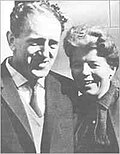
He joined the Communist Party in the early 1940s, along with many of his generation in the Jewish immigrant milieu who found in the communist tradition the most rigorous and most morally serious response to the racial capitalism of South African society. His marriage to Hilda Watts in 1941 joined two of the most committed figures in the South African communist movement in a partnership that would sustain both their individual contributions for more than sixty years — through the Treason Trial and the Rivonia Trial and exile in London and the return to a democratic South Africa they had spent their lives working toward.
The Congress of the People and the Writing of a Nation's Aspirations
The Congress of the People, held at a vacant lot in Kliptown, Johannesburg, on 26–27 June 1955, was the most representative political gathering the Congress Alliance had ever organised. Approximately three thousand delegates assembled from across South Africa to adopt a document that would articulate the rights and aspirations of all South Africans in terms that could serve as the foundation for a post-apartheid dispensation.
The document they adopted — the Freedom Charter — had been produced through a process of genuine mass consultation. The Congress Alliance's organisers had spent months collecting "freedom demands" from ordinary South Africans across the country, asking what kind of South Africa they wanted to live in. The responses — tens of thousands of them, written on scraps of paper, in notebooks, on whatever was available — were sent to a central location where they needed to be synthesised into a coherent document. This synthesis was Rusty Bernstein's primary contribution.
The task required both political judgment — about which demands to include, how to frame contested questions, how to reconcile the different emphases of the Alliance's constituent organisations — and literary skill, the ability to write sentences that were both precise and inspiring, that communicated complex political positions in language that ordinary people could understand and be moved by. The Freedom Charter's opening declaration — "We, the people of South Africa, declare for all our country and the world to know: That South Africa belongs to all who live in it, black and white, and that no government can justly claim authority unless it is based on the will of all the people" — is among the most important sentences in South African political history. Bernstein wrote those words.
The document he produced from the mass consultation became the foundational statement of the ANC's political programme for the following four decades, the basis for the ANC's negotiations with the apartheid government, and the intellectual foundation of the 1996 democratic Constitution whose Bill of Rights enshrined the Charter's principles in the highest law of the land. The Freedom Charter is, in this sense, the most consequential document that any single figure in the South African liberation movement produced, and Rusty Bernstein produced it.
The Rivonia Trial: Acquitted and Immediately Re-Arrested
The Rivonia Trial of 1963–64 produced, on 12 June 1964, a verdict that contained within it one of the most damning illustrations of the apartheid state's relationship to the rule of law. Eight of the accused were convicted and sentenced to life imprisonment. Rusty Bernstein was acquitted — the court found that the prosecution had not established his guilt beyond reasonable doubt. He rose from the dock. He walked toward the door. And at the door, Security Branch officers were waiting for him. They arrested him again, immediately, under the ninety-day detention law, before he had left the building in which he had just been found not guilty.
The legal system had found him innocent. The security apparatus had re-imprisoned him before the legal system's verdict could take effect. The gap between these two facts — the gap between the court's verdict and the security police's immediate override of that verdict — is one of the most compact and most devastating demonstrations in the historical record of what the apartheid state actually was beneath its claims to legal legitimacy. It was a state that used law when law served its purposes and overrode law by executive means when it did not. The acquittal of Rusty Bernstein and his simultaneous re-arrest was the apartheid system's relationship to law expressed in a single moment, documented in the presence of the Rivonia Trial's domestic and international observers.
Hilda Bernstein's account of this moment in The World That Was Ours is one of the most powerful passages in the literature of the anti-apartheid struggle — rendered with a precision that makes it more devastating than any rhetorical denunciation could be, the specific detail of the specific moment carrying more political weight than any abstraction about the nature of the apartheid state.
London, Memory Against Forgetting, and the Exile's Legacy
After his eventual release from the second detention, Rusty Bernstein and Hilda fled South Africa via Botswana — the standard clandestine exit route for people the security apparatus had identified and who could no longer safely remain. They settled in London, where Rusty resumed his architectural career and Hilda began the writing career that would produce the books through which she documented the liberation struggle and their experience of it.
London in the 1960s, 1970s, and 1980s was the centre of the international anti-apartheid movement, and the Bernsteins were part of that community — contributing to the campaigns, maintaining connections to the ANC's external mission, and preserving in their own lives and their relationships the memory of the South Africa they had left and the movement they had been part of. Rusty's architectural practice gave him a professional identity and an economic foundation in exile, and the combination of professional practice and political engagement that had characterised his life in South Africa continued in London, if in a different register.
He published his memoir, Memory Against Forgetting, in 1999 — three years before his death, forty-five years after the Rivonia Trial. The title was the book's argument as well as its description: against the forgetting that time and distance produce, against the erosion of the specific detail of specific events in the general wash of historical narrative, he was setting down what he remembered of the Party and the Congress Alliance and the Rivonia period, in the specific detail that only an eyewitness could provide. The book, alongside Hilda's The World That Was Ours, constitutes the most complete personal documentation of the Rivonia period available from the perspective of the people who lived it.
Legacy: The Author of the Beginning
Rusty Bernstein died in London on 23 June 2002. He was eighty-two years old. He had lived long enough to see the apartheid system he had fought against dismantled, to see the ANC elected to government, to see the 1996 Constitution whose principles were the direct intellectual descendants of the Freedom Charter he had drafted in 1955, to see South Africa become — imperfectly, incompletely, but unmistakably — the country the Freedom Charter had described.
He was the architect who designed documents as well as buildings. The Freedom Charter is the most enduring thing he designed, and it is still standing — not as a relic but as the foundational document of the democratic South Africa's constitutional order, the statement of principle from which the post-apartheid legal system draws its deepest commitments. The opening words he wrote — "South Africa belongs to all who live in it" — are among the most important words in the political history of the country, and they remain true, and they remain contested, and they remain the standard against which the democratic South Africa measures itself and finds itself still falling short.
That a document written in 1955 by a communist architect in Johannesburg who was subsequently acquitted of high treason for writing it and re-arrested before he could leave the courtroom should become the intellectual foundation of the post-apartheid constitutional order forty years later: this is the unlikely arc that Rusty Bernstein's most important contribution traces. He wrote the beginning. The country is still living out what the beginning meant.