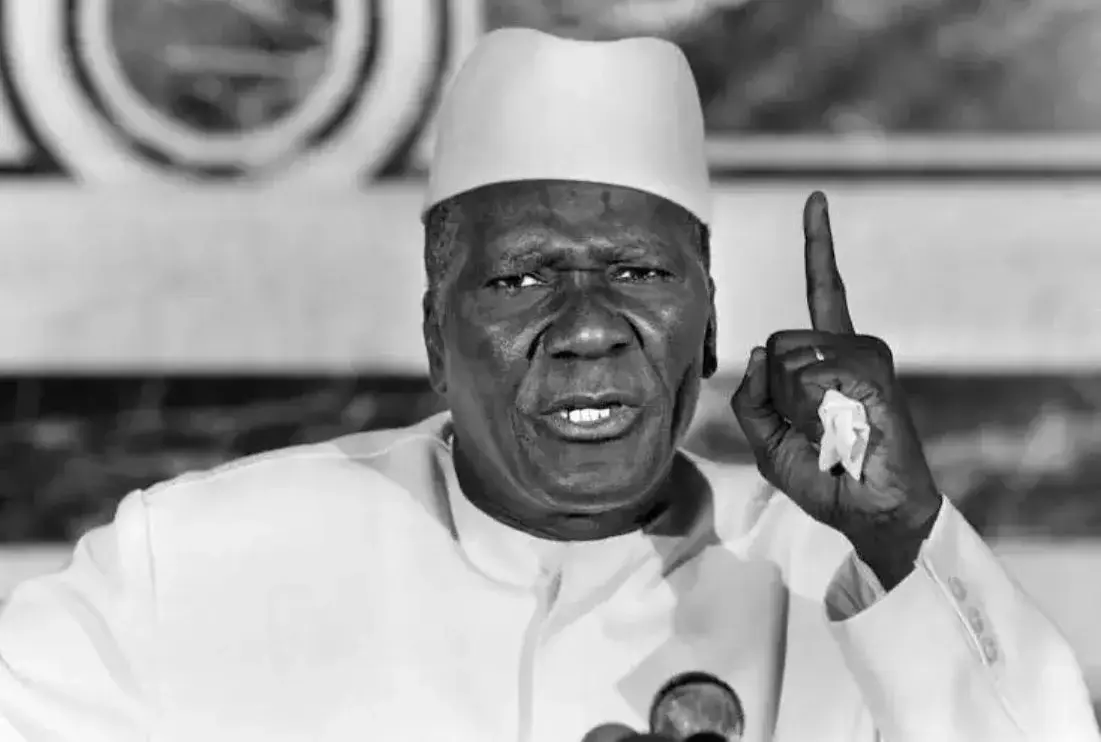
At a Glance
Faranah, Samori, and the Formation of a Working-Class Nationalist
Sékou Touré was born in 1922 in Faranah, a town on the upper Niger River in the interior of French Guinea — far from Conakry, far from the colonial administrative centres, in a region whose primary historical significance in the nineteenth century had been as the heart of the resistance empire that Samori Touré had built against French conquest. The claim to descent from Samori was both a family tradition and a political resource of considerable power. Samori Touré had been one of the most determined and militarily effective opponents of French expansion in the western Sahel — a Malinké leader who had built a substantial empire, modernised his army by acquiring and manufacturing firearms, and fought the French to a standstill for nearly two decades before his capture in 1898. His name resonated across the region as a symbol of African military resistance and political organisation in the face of overwhelming colonial force.
Whether Sékou Touré's descent from Samori was precisely as claimed is less important historically than the political use he made of it. The invocation of Samori's memory — the explicit positioning of his own struggle as the continuation of the resistance that Samori had conducted — was a way of grounding Guinean nationalism in an authentically African, authentically resistant tradition that predated both French colonialism and the Western-educated nationalist movements that colonialism had produced. It was an argument about historical continuity: the struggle for Guinean liberation was not a new idea imported from France or the Soviet Union but the resumption of a resistance that had never been fully abandoned.
His expulsion from school at around fifteen — for leading a food strike against the colonial school administration — was formative in ways that distinguished his political development from that of most of his contemporaries. Without access to the Ponty school or to French metropolitan education, Touré built his political education through a different path: the trade union movement, the CGT's educational programmes, the practical experience of organising workers and negotiating with colonial employers, and the networks of the French Communist Party and the international labour movement that the CGT provided access to. This working-class political formation gave him a different relationship to the ideas of labour, exploitation, and collective organisation than the school-formed politicians had, and it gave him organisational skills that were more immediately practical than the parliamentary and intellectual skills that formal education produced.
Building the PDG: Mass Organisation as Political Achievement
The decade between the founding of the PDG in 1947 and the 1958 referendum was a period of sustained, systematic organisational work that produced the most effectively organised mass political party in French West Africa. Touré's approach to party building drew on his trade union experience: the emphasis on membership, on branch organisation, on political education at the local level, on the cultivation of women's and youth wings that gave the party genuine reach into communities that purely male-led organisations could not penetrate. The result was a party that had meaningful presence in virtually every community in Guinea — not just in the urban centres and the educated class, but in the villages, the farms, and the communities of the interior where most Guineans lived their daily lives.
The ethnic dimension of this organisational achievement deserves emphasis. Guinea was, like most West African territories, a complex mosaic of ethnic communities with different histories, different social structures, and different political traditions. The Malinké commercial and urban communities of the towns and trading routes. The Fula pastoralists and scholars of the Fouta Djallon highlands. The Susu coastal communities. The diverse peoples of the Forest Region. Building an organisation that had genuine roots across this diversity — that could bring Fula, Malinké, Susu, and Forest Region members into the same movement without one group's dominance destroying the others' commitment — was a genuine political achievement, and one that required constant attention to the ways in which the movement's leadership and its programme were perceived across ethnic lines.
The women's mobilisation was equally significant. The PDG's Comité Féminin was not an afterthought but a genuine mass organisation that mobilised women as political actors in their own right — organising around the specific conditions of women's lives, building the networks of the market women and the domestic sphere into political networks, and producing the extraordinary capacity for collective action that expressed itself most dramatically in the confrontation with de Gaulle during his 1958 visit to Conakry. The women who surrounded the General's motorcade and sang anti-colonial songs at him were not acting spontaneously — they were members of a political organisation that had been educating and organising them for years.
The Non: What It Cost and What It Meant
The decision to campaign for a Non vote in the September 1958 referendum was the defining act of Touré's political career and the moment that established Guinea's place in the history of African independence. De Gaulle's proposed French Community offered a framework of autonomy — significant self-governance in internal affairs, a French-associated status rather than continued colonial subjugation — that most French African leaders found acceptable, or at least preferable to the risks of immediate independence without French support. Touré disagreed, and he led his party and his country to disagree with him.
His speech to de Gaulle at the Conakry rally in August 1958 — delivered with the General present and listening — was one of the most significant political statements of the independence era. The formulation that African freedom was not negotiable, that Guinea preferred poverty in freedom to prosperity in servitude, that no French Community was worth Guinea's sovereignty — these were not rhetorical flourishes but statements of genuine political conviction, delivered to the most powerful representative of French authority in conditions that made their meaning unmistakeable. De Gaulle heard them and understood them. His response, when the Non vote produced its overwhelming majority, was to treat Guinea as an example that needed to be made — punishing it with the swiftest and most complete withdrawal of French support that the Fourth Republic's successor could organise.
France's vindictiveness in the aftermath of the Non was itself a kind of validation. The overnight removal of French administrators, the deliberate destruction of records and equipment, the cutting of development funding, the attempts to destabilise the new government through economic pressure and political interference — all of this confirmed that France had understood the Non vote as a genuine challenge to its authority and was responding to it as such. For the rest of Africa watching, Guinea's willingness to absorb this punishment without capitulating was a demonstration of what African sovereignty could look like when it was actually asserted rather than merely claimed.
The material costs were real and lasting. Guinea's development trajectory in the first years of independence was severely hampered by the withdrawal of French support, by the need to build state institutions almost from scratch without the infrastructure and expertise that the colonial administration had provided, and by the economic pressure that France and French commercial interests maintained against a government that had rejected their terms. The socialist bloc aid that partially replaced French support — Soviet, Chinese, and Eastern European technical assistance and development finance — helped, but it was neither sufficient nor without its own complications. Guinea's economic difficulties in the 1960s were partly the consequence of the choice Touré had made in 1958, and the government's management of those difficulties was imperfect.
Pan-Africanism in Practice: The PAIGC and African Liberation
Whatever judgements are made about Touré's domestic governance, his commitment to African liberation movements was genuine and consequential. Conakry under Touré was one of the most important bases of operations for liberation movements across the continent. The PAIGC — the African Party for the Independence of Guinea-Bissau and Cape Verde, led by Amílcar Cabral — operated from Guinean territory throughout its war against Portuguese colonialism, using Guinea as the rear base from which it supplied, organised, and directed the liberation struggle in Guinea-Bissau. This was not costless solidarity: Portugal maintained significant hostile pressure on Guinea as a consequence, including the 1970 invasion of Conakry in which Portuguese-organised forces attacked the capital in an attempt to free Portuguese prisoners and destabilise the Touré government. Touré's mobilisation of international condemnation of this invasion through the United Nations was effective, but the fact that the invasion happened at all demonstrated the real price of the solidarity he offered.
The ANC of South Africa, Zimbabwean liberation movements, and others maintained presences in Conakry that were supported by the Touré government. The practical support — territory, logistics, diplomatic advocacy — that Guinea provided to these movements during the period when they had few allies in independent Africa was a genuine contribution to the liberation struggles that eventually produced the end of apartheid and white minority rule across southern Africa. This dimension of Touré's legacy is real and should not be erased by the account of his domestic failures.
His relationships with Nkrumah and Modibo Keïta were the closest of the pan-African connections — the Ghana-Guinea Union of 1958 and the subsequent attempt to create a Ghana-Guinea-Mali union were genuine political projects rather than merely symbolic gestures, attempts to create the continental political integration that the independence era's most committed pan-Africanists believed was necessary. That these projects ultimately failed — that the small states of post-colonial Africa proved unable to overcome the centrifugal forces of nationalism, ethnic politics, and French interference to build the genuine unions they attempted — was a tragedy for the pan-African vision rather than a reflection of bad faith on Touré's part.
The Descent: How the Revolution Became a Terror
The transformation of Touré's Guinea from a genuine liberation movement into a system of political terror was not sudden but gradual — a process that accelerated through the 1960s and reached its most extreme expression in the mid-1970s, though it never fully reversed. Understanding how this transformation happened is not merely a biographical question but a political one, with implications for the broader understanding of how revolutionary movements become authoritarian states.
Several factors contributed. The external pressure on Guinea — the French economic war, the CIA destabilisation efforts, the Portuguese military threat — was real and created a genuine security environment in which the government's concerns about foreign-backed subversion were not entirely paranoid. But genuine security concerns do not explain or justify the scale and character of what Camp Boiro became. The gap between the real security threats Guinea faced and the thousands of Guineans who died in its detention system cannot be bridged by reference to French or CIA interference.
Touré's political psychology appears to have been a significant factor — the specific combination of genuine intelligence and political skill with a growing tendency toward paranoid interpretation of opposition, a belief that any challenge to his authority must be evidence of foreign inspiration rather than legitimate political disagreement. This tendency, combined with the absence of any institutional check on executive power in a single-party state, created conditions in which political terror was not the aberration of a system gone wrong but a structural feature of a system that had no mechanism for constraining the leader's worst impulses.
The ethnic dimension worsened over time. The PDG had been built on pan-ethnic nationalism, but Touré increasingly interpreted the communal solidarity of the Fula people — the largest ethnic group in Guinea, with their strong Islamic identity and their traditions of political autonomy — as a threat. The purges of Fula politicians, intellectuals, teachers, and community leaders from the late 1960s onward represented a systematic attack on one of Guinea's major communities that contradicted everything the independence movement had claimed about pan-ethnic Guinean citizenship. The Fula people were not the only targets — Camp Boiro consumed people from every ethnic community — but their targeting had a particular character of collective ethnic suspicion that went beyond the individual political persecution that was the camp's baseline mode of operation.
Camp Boiro: The Numbers and the Names
The full scale of Camp Boiro's death toll is not precisely established, because the Touré government suppressed information about it systematically and because the subsequent Conté military government had limited incentive to investigate fully. Estimates of the number who died at Camp Boiro range from several thousand to tens of thousands; the number who passed through the detention system without dying was much larger. What is established with certainty is the character of the camp's practices: the diète noire — the deliberate withholding of all food as a method of slow execution; systematic torture during interrogation; forced confessions extracted under torture and then used to justify further arrests; the killing of prisoners whose continued survival was considered inconvenient.
The names of those who died are, slowly and incompletely, being recovered. Keïta Fodeba, the founder of the Ballets Africains, died at Camp Boiro. Diallo Telli, Guinea's first Secretary-General of the OAU and a figure of genuine distinction in African diplomacy, died there of the diète noire in 1977. Countless others — teachers, doctors, soldiers, farmers, religious leaders, former PDG activists, people who had given years of their lives to the independence movement and who were killed by it — have names and histories that deserve to be remembered even as the full record remains incomplete.
The contrast between these victims and the man responsible for their deaths — who was simultaneously the man who had stood up to de Gaulle, who had supported Cabral's liberation struggle, who had articulated some of the most powerful anti-colonial arguments of the independence era — is not a paradox that any simple framework can resolve. It is a fact that demands to be held in its full complexity.
Death in Cleveland and the End of the First Republic
Touré died on 26 March 1984 in Cleveland, Ohio, where he had gone for heart surgery at the Cleveland Clinic. His death in the United States — in the medical infrastructure of the country whose economic model he had spent his career opposing — was the kind of biographical detail that would be too obvious if it were fiction. The practical explanation was simple: the best cardiac surgery available in the early 1980s was in the United States, and Touré needed it. The symbolic dimensions could be read multiple ways, depending on one's assessment of his career.
Lansana Béavogui became Acting President for eight days before the military, under Colonel Lansana Conté, seized power on 3 April 1984, ending the First Republic and dismantling — with relative speed and considerable popular relief — the political structures of the Touré era. Camp Boiro was opened; the political prisoners who remained alive were released; the scale of what had happened there began to become more widely known. The popular response to the coup, which in many African countries would have generated significant resistance, was largely one of exhausted relief — the testament, if any were needed, to how thoroughly the Touré government had consumed the political energy and the human capital that the independence movement had produced.
The Verdict That Cannot Be Rendered
Every assessment of Sékou Touré must reckon with the impossibility of a simple verdict. The man who delivered the Non speech is the man who ran Camp Boiro. The leader who supported Cabral's PAIGC is the leader who killed Keïta Fodeba. The pan-Africanist who stood with Nkrumah and Keïta for African unity is the ethnic chauvinist who targeted the Fula people. These are not different men at different stages of a career — they are the same man, and the historical record must account for all of them simultaneously.
The political traditions that claim his legacy — those who honour him as one of Africa's great independence leaders — are not wrong about the independence achievement. The critics who condemn him as a murderous tyrant are not wrong about Camp Boiro. Both are right, and both need to be right simultaneously, because that is what the historical record shows.
What the record also shows is the structural problem that Touré's career illustrates with particular clarity: that genuine anti-colonial courage and organisational brilliance at the moment of liberation are no guarantee of — and may even be in tension with — the patience, the tolerance of dissent, and the institutional restraint that genuine democracy requires. Touré's absolute conviction in the correctness of his analysis — the same absolute conviction that made him willing to confront de Gaulle and accept the consequences — became, in the governance of an independent state, the intolerance of any challenge to his authority that Camp Boiro expressed. The revolutionary's virtues became the autocrat's vices, and tens of thousands of Guineans paid for that transformation with their freedom and their lives.
That is the full account of Sékou Touré. It is not a comfortable one. It should not be.