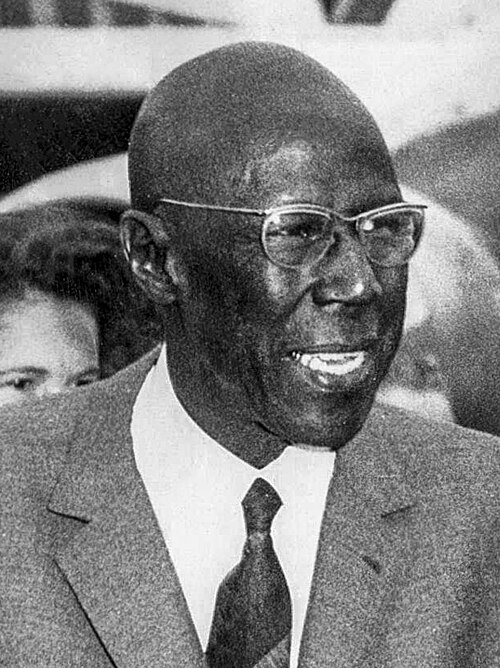
At a Glance
Saint-Louis, the Four Communes, and the Tradition of African Citizenship
To understand Lamine Guèye and the political project he pursued across four decades, it is necessary to understand the specific and peculiar political tradition of the Four Communes of Senegal. Saint-Louis, Dakar, Gorée, and Rufisque were the four urban centres of colonial Senegal whose African inhabitants held a legal status that was unique in French colonialism: they were originaires, entitled to French citizenship by virtue of their residence in these towns, a status that went back to the revolutionary and Napoleonic periods when the French Republic had, in one of its more generous moments, extended citizenship to the inhabitants of its oldest colonial possessions.
This status was not merely formal. Originaires voted in French elections. They had a representative in the French National Assembly — a position that, between 1914 and 1934, was held by Blaise Diagne, the first African elected to the French parliament. They were subject to French civil law rather than the indigénat — the special legal code for colonial subjects that allowed administrative punishment without judicial process and that created a framework of legal vulnerability quite different from the formal protections of the Code civil. The originaires were not equal to metropolitan French citizens in every respect — there were areas where the formal equality of their status did not translate into practical equality — but they were in a fundamentally different legal and political position from the millions of Africans elsewhere in French West Africa who were subjects rather than citizens.
Lamine Guèye was born into this tradition and formed by it. Growing up in Saint-Louis — the city that had been the administrative capital of French West Africa, where the colonial bureaucracy, the Catholic missions, the French trading houses, and the African educated elite had all existed in complex proximity for two centuries — he absorbed both the French legal and political culture that citizenship entailed and the African cultural and intellectual tradition that was its foundation. His decision to study law in France, and his achievement of the first African doctorate of law in 1921, was the fullest expression of this formation: the use of the best tools of the colonial educational system to become the most qualified advocate for African rights that the system had produced.
Building the First Mass Party in French West Africa
When Guèye founded the Senegalese section of the French Socialist Party — the SFIO — in the 1930s, he was doing something without precedent in French West Africa: building a mass political organisation with branches, members, committees, a programme, and a connection to the broader international socialist movement. The Four Communes had had political organisations before, but these had been essentially electoral machines serving the narrow constituency of the originaires. What Guèye was building was something more ambitious — a party that aspired to represent not just the enfranchised elite of the communes but the broader population of Senegal, and that connected the Senegalese political struggle to the French and international left.
The SFIO affiliation brought both advantages and constraints. The advantages were real: connection to the French left's networks, resources, and international solidarity; a political framework that had developed sophisticated thinking about labour rights, social equality, and anti-imperialism; access to French political institutions and debates in ways that purely African organisations would not have had. The constraints were equally real: the metropolitan party's priorities were not always those of African members, and the framework of socialist solidarity within the French state was not the same as the framework of African liberation from that state. Guèye's politics were always shaped by the tension between these two orientations — the desire for full equality within French institutions and the recognition that those institutions were themselves the instruments of African subordination.
The 1945 elections to the French Constituent Assembly — the body that would write the constitution of the Fourth Republic — sent Guèye and the young Léopold Sédar Senghor to Paris as Senegal's representatives, the two men sitting alongside each other in the assembly that would determine the institutional framework of the post-war French empire. This moment was the high point of Guèye's political influence, and it produced his most enduring legislative achievement.
The Law of 7 May 1946: The Architecture of African Citizenship
The legislation that bears Guèye's name — the Lamine Guèye Law, passed by the French Constituent Assembly on 7 May 1946 — was the most sweeping extension of legal rights to Africans in the history of French colonialism. In a single stroke, it declared all inhabitants of French overseas territories to be citizens of the French Union, with full civil status equivalent to that of metropolitan French citizens. The implications were extraordinary in scale: approximately sixty million people — in Africa, in Madagascar, in Indochina, in the Caribbean, in the Pacific — had their legal status transformed from colonial subjects to citizens.
The law was not perfect, and its practical effects were considerably more limited than its formal scope. The distinction between citizenship and the right to vote — the latter still restricted in the overseas territories in ways that it was not in metropolitan France — meant that the extension of citizenship did not immediately translate into full political equality. The indigénat was abolished, but the legal and administrative structures that had encoded African subordination did not disappear overnight. The extension of labour rights and social benefits to African workers — the practical economic content of equality — was contested and only partially achieved through subsequent legislation. And the French colonial government's actual behaviour toward African subjects changed much less rapidly than the formal legal framework might have suggested.
But the law mattered enormously nonetheless. It established a new legal baseline — a formal declaration that Africans were citizens, not subjects — that created new possibilities for rights claims and political organisation. The labour movement, for example, could now argue for equal wages and benefits not merely on grounds of economic justice but on grounds of equal citizenship: if African and French workers were citizens of the same republic, what justification could there be for paying them differently? The law created the legal terrain on which the decade of political advancement that followed — including the 1952 Overseas Labour Code and the 1956 Loi Cadre that gave African territories significant self-governance — could be argued and won.
The Split with Senghor and the Political Landscape of the 1950s
The 1948 split between Guèye and Senghor was one of the defining events in the political history of Senegal's path to independence. Senghor had come into politics under Guèye's patronage — he was elected to the French National Assembly in 1945 as one of Senegal's two representatives, alongside Guèye, and was initially part of Guèye's political family. But the differences between them were real. Senghor was building a political base in the interior of Senegal — among the Wolof, Serer, and Fulani peasant communities of the groundnut basin — that differed from Guèye's urban, commune-based constituency. He was also developing a more distinctively African political and cultural vision — the Négritude movement, the argument for African cultural specificity, the critique of pure assimilation — that sat less easily with Guèye's more straightforwardly integrationist approach.
The founding of Senghor's Bloc Démocratique Sénégalais in 1948 split the Senegalese political landscape and began a decade of competition between the two men and their organisations that Senghor eventually won. Guèye remained a significant figure throughout the 1950s — a deputy in the French National Assembly, the leader of a substantial party, the elder statesman of Senegalese political life — but the centre of gravity in Senegalese politics moved toward Senghor's more expansive political base and his more culturally specific vision of African identity and political aspiration.
The reconciliation that eventually brought Guèye's organisation into coalition with Senghor's was a recognition of this political reality. The merged party — ultimately the Union Progressiste Sénégalaise and then the Union Progressiste Sénégalaise — gave Guèye a honoured place as founding father while leaving Senghor as the dominant figure in the relationship. It was a resolution that reflected accurately the respective weights of the two men's political followings and the respective orientations of their political visions, and Guèye accepted it with the pragmatism of a politician who understood when the balance of forces had shifted against him.
The Contradictions of Assimilation and the Limits of the Legal Approach
The deepest tension in Guèye's political career was between his commitment to full African equality within French institutions and the recognition — forced on him by experience — that those institutions were not, in fact, prepared to grant that equality on terms that would make a real difference to the lives of the majority of West Africans. The Lamine Guèye Law extended formal citizenship, but formal citizenship and practical equality were not the same thing. The French government's actual behaviour toward African workers, African farmers, and African political aspirations consistently fell short of the equality that citizenship implied.
This gap between formal and substantive equality is the central problem of the assimilationist approach to colonial liberation. If the colonial power is genuinely committed to equality, assimilation can be a path to freedom; if it is not, assimilation becomes a mechanism for incorporating African elites into the colonial structure while leaving the fundamental relationship of exploitation and subordination in place. Guèye's faith in the possibility of genuine assimilation — his belief that France could be brought to honour the universalist commitments of its own republican tradition — was both his most admirable quality and the source of the limitations of his politics. It was admirable because it took seriously the best in French political thought and held France to standards it had set for itself. It was limiting because it underestimated the structural commitment of French capitalism and French nationalism to African exploitation and the degree to which that commitment would resist the pull of French universalist ideals.
The generation that came after Guèye — Senghor's generation, and then the even more radical generation of Cheikh Anta Diop and Abdoulaye Ly — drew different conclusions from this tension. Senghor sought cultural synthesis rather than pure assimilation; Diop and Ly sought genuine independence rather than equality within French structures. Each of these approaches represented a further step away from Guèye's assimilationism, a recognition that the path he had pioneered was necessary but insufficient. That recognition does not diminish the significance of what he achieved on that path.
Elder Statesman and the Long Afternoon of a Political Career
In the years after Senegalese independence in 1960, Lamine Guèye occupied the role of elder statesman with dignity and without bitterness. His appointment as President of the Senegalese National Assembly gave him a formal position appropriate to his historical standing — the man who had built the first mass party, who had won the citizenship law, who had been one of Senegal's first representatives in the French National Assembly — while leaving executive power in Senghor's hands. He continued to be consulted, to be respected, to be acknowledged as one of the founding fathers of Senegalese political life, even as the political world had moved significantly beyond the positions he had staked out in the 1940s.
He died in Dakar in June 1968 — the month when student and worker protests were shaking Senghor's government and when the political world he had helped build was being challenged by a younger generation with different analyses and different demands. The continuity between the world he had worked to create and the world that was now challenging it was real: the political consciousness, the organisational capacities, and some of the legal and institutional frameworks that the protesters were using had been built, partly, on foundations that Guèye had laid. The distance between his integrationism and their radicalism was also real — a distance that measured the decades of post-colonial disappointment and neo-colonial continuity that had accumulated since the independence he had pursued by a different route.
Lamine Guèye's place in the history of West African liberation is secure. He built the first mass political party in French West Africa. He won the most significant single legal advance for African rights in the colonial period. He brought Senegalese voices into the French National Assembly at the moment when the post-war institutional framework was being determined. And he did all of this before the independence generation had fully found its voice — preparing the ground, building the organisations, establishing the legal precedents that made everything that followed more possible. That is a genuine contribution to a struggle that was larger than any single strategy, and it deserves its recognition in the full history of how West Africa achieved its freedom.