At a Glance
The Forest Region, Independence Politics, and the Making of a Diplomat
Lansana Béavogui's origins in the Forest Region of Guinea placed him at some distance from the dominant currents of Guinean nationalism as they developed in the late colonial period. The independence movement that Sékou Touré led was rooted primarily in the trade union movement of Conakry and the coastal towns, in the Malinké cultural and commercial networks of the Guinea interior, and in the political organisation of the Parti Démocratique de Guinée across the territory's diverse communities. The Forest Region — the area of highland forest in southeastern Guinea bordering Sierra Leone, Liberia, and Côte d'Ivoire — was the home of the Kpelle, Loma, Kissi, and other peoples whose cultural traditions and political structures differed significantly from those of the Fula highlands or the coastal plains.
The Forest Region's integration into the PDG's national movement was, like all such integrations in the multi-ethnic complexity of French West Africa, a political achievement that required sustained organisational effort and that produced relationships that were real but not always easy. Touré's ability to build a genuinely pan-Guinean movement — one that crossed ethnic and regional lines in ways that most West African parties did not — was one of his most significant political achievements, and figures like Béavogui who came from minority regions and ethnic groups were essential to making that achievement credible. Their presence in the movement and subsequently in the government was both a genuine expression of its national character and a political necessity for maintaining that character over time.
Béavogui's path into the colonial administrative structure, and from there into the politics of the independence movement, followed the general pattern of his generation. The French colonial school system selected and trained a small number of Africans from each territory for the lower and middle levels of the administrative apparatus — as teachers, clerks, medical assistants, agricultural agents — and these individuals formed the educated class from which the independence movements recruited their organisers and cadres. Béavogui's education and administrative experience gave him the skills that the new state would need: literacy in French, familiarity with administrative procedures, the ability to navigate the institutional culture of the colonial system while organising against it.
The 1958 Non and What It Cost Guinea
The September 1958 referendum on de Gaulle's proposed French Community was the defining moment of Guinea's independence history and the event that shaped everything that followed, including the specific challenges that Béavogui would face throughout his career as a Guinean diplomat and minister. De Gaulle's proposed Community would have given the French African territories significant autonomy in internal affairs while maintaining French control over foreign policy, defence, and economic arrangements. It was, in effect, a sophisticated neo-colonial framework — more elegant and more stable than outright continued colonialism, but fundamentally preserving the essential relationships of the colonial economy.
Touré's PDG rejected this arrangement and campaigned for a Non vote that would mean immediate and complete independence from France — independence without the transitional arrangements, the financial continuity, and the institutional linkages that the Community framework would have provided. When the Guinean electorate voted overwhelmingly Non on 28 September 1958, France's response was swift and vindictive. French administrators were withdrawn, technical assistants recalled, equipment removed — in some cases physically destroyed rather than left for the new Guinean state. Financial assistance was cut off. Guinea was, in the space of weeks, deprived of the institutional and financial infrastructure that French colonialism had created and that the new state had been planning to use as the foundation for its governance.
The consequences of this enforced isolation shaped the entire first decade of Guinean independence and created the diplomatic challenges that Béavogui inherited when he took on responsibility for Guinea's foreign relations. Guinea needed international support — financial, technical, political — to replace what France had withdrawn. The Soviet Union, China, and other socialist states filled some of this gap, providing aid, technical assistance, and political solidarity. The United States was more ambivalent — interested in Guinea as a potential anti-communist partner but suspicious of Touré's socialist commitments and his non-aligned positioning. African neighbours were variably supportive, their relationships with Guinea shaped by their own interests, their own relationships with France, and the degree to which Touré's example made their own governments uncomfortable.
The Art of Non-Alignment: Guinea's Diplomatic Position
Managing Guinea's international position through the 1960s required the kind of sustained diplomatic skill that Béavogui developed and demonstrated across his years as Foreign Minister. Non-alignment was a real political position in the Cold War context, not merely a rhetorical posture, but maintaining it required constant calibration — keeping the Soviet relationship productive without becoming so dependent that Guinea lost its freedom of manoeuvre, keeping communication open with the United States without conceding the political positions that Touré's government defined as non-negotiable, maintaining pan-African solidarity while navigating the often sharp differences between African states about the proper approach to decolonisation and to relations with the former colonial powers.
Guinea's specific contributions to pan-African politics in this period were significant. Conakry became a refuge and a base for liberation movements from across the continent — the PAIGC of Guinea-Bissau and Cape Verde under Amílcar Cabral operated from Guinean territory; the ANC and other South African liberation organisations maintained presences in Conakry; movements from Mozambique, Angola, and Zimbabwe passed through and received support. This solidarity with African liberation movements was one of the most genuinely admirable dimensions of the Touré government's foreign policy, and it created significant diplomatic costs — particularly in Guinea's relationships with Portugal, which was conducting a colonial war in Guinea-Bissau partly from its own territory bordering Guinea, and with the apartheid South African government and its allies.
Béavogui's management of these relationships — keeping the liberation movement solidarity while managing the diplomatic consequences, maintaining the non-aligned position while navigating the Cold War pressures that sought to pull Guinea into one camp or the other — was a demonstration of real diplomatic competence. The 1970 Portuguese invasion of Conakry, which aimed in part to destroy the PAIGC's Guinean base of operations, was a direct consequence of Guinea's solidarity with African liberation movements, and the diplomatic aftermath of the invasion — Guinea's successful mobilisation of international condemnation of the Portuguese action at the United Nations — showed Béavogui's organisation at its most effective.
Serving Touré: The Impossible Position of a Senior Official
The central problem of Béavogui's political career — and of any serious attempt to assess it — is the relationship between his own record and the government he served. Sékou Touré's Guinea began as a genuine independence movement, the most democratic expression of Guinean nationalism in the 1950s, the party that had mobilised workers, women, farmers, and students behind the vision of a free and equal Guinea. By the late 1960s and through the 1970s, it had become something very different: a paranoid one-party state in which any expression of independent political thought was treated as evidence of conspiracy, in which ethnic communities were purged on suspicion of collective disloyalty, and in which Camp Boiro — the detention centre where Keïta Fodeba and thousands of others died — was the instrument of systematic political terror.
How does a senior official in such a government bear responsibility for what that government does? The question is not unique to Guinea — it arises wherever authoritarian states produce figures who served them with apparent competence and who may or may not have been complicit in their worst aspects. The range of possible positions is wide: from those who actively participated in the repression, to those who were aware of it and said nothing, to those who tried within the constraints available to moderate its worst excesses, to those who were genuinely kept ignorant of the full extent of what was happening. Where on this spectrum Béavogui sat is not established with certainty in the historical record. What is certain is that he was a senior figure in a government responsible for extensive atrocities, that he was close enough to Touré to be trusted with the most sensitive diplomatic and administrative responsibilities, and that the government continued its repressive practices throughout his tenure without apparently producing from him any documented protest or resistance.
This does not necessarily make Béavogui personally culpable for Camp Boiro — the moral philosophy of complicity in state violence is more complex than simple proximity to power allows — but it does make his career an example of the problem that post-colonial African historiography has to grapple with: that many of the figures who served genuinely in the cause of African independence also served, or at least did not resist, governments that reproduced the authoritarian practices of the colonial states they had replaced. Béavogui is not a villain in this story; he is a complicated figure in a story that has too many complications to allow simple villains and heroes.
Prime Minister: Administration in the Shadow of Total Power
The appointment of Béavogui as Prime Minister in 1972 formalised what had been in practice for some years: his position as the most senior administrative figure in the Guinean state after Touré himself. But the role of Prime Minister in Touré's Guinea was not what the title might suggest. It was not the position of a head of government in a parliamentary system who commanded a cabinet, set a legislative agenda, and was accountable to an elected assembly. It was the position of a senior administrator who coordinated the implementation of decisions made by Touré, managed the day-to-day functions of the state apparatus, and served as the principal interface between the President's office and the various ministries.
Within these constraints, Béavogui brought real organisational competence to the role. The administrative challenges of governing Guinea in the 1970s were genuine and significant. The country's economy had suffered considerably from the combination of the post-independence French withdrawal, the inefficiencies of Touré's socialist economic programme, and the political interference in economic management that the PDG's single-party structure produced. Managing state enterprises, coordinating the activities of ministries with different and often competing priorities, maintaining basic services across a geographically diverse country with limited infrastructure — these were demanding administrative tasks that required skill and experience to perform adequately.
Béavogui performed them adequately, which in the context of Touré's Guinea was itself a significant achievement. The state did not collapse; basic functions continued; the diplomatic relationships he had built as Foreign Minister were maintained; Guinea remained a functioning entity in the international community despite its internal difficulties. This is not a glowing assessment, but it is an honest one. The counterfactual — what Guinea might have been with a genuinely competent and non-repressive government — is impossible to test. What can be assessed is that Béavogui's administrative performance was significantly better than the political system in which he operated deserved.
March 1984: Touré Dies, Béavogui Inherits the Ruins
When Sékou Touré died in Cleveland, Ohio on 26 March 1984 — he had gone to the United States for heart surgery — the succession he had never prepared for came due with brutal suddenness. Touré had dominated Guinean politics so completely for twenty-six years that the institutions of the state existed primarily as instruments of his will rather than as independent mechanisms of governance; they were not designed to function without him, and in the absence of a designated successor or a clear constitutional process, the question of who would lead Guinea was genuinely open.
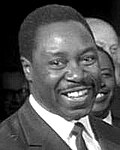
Béavogui became Acting President by virtue of his position as Prime Minister — the constitutional logic, such as it was, pointed to him as the most senior government official. His tenure lasted eight days. On 3 April 1984, while Béavogui was still attempting to organise a governmental response to Touré's death and to manage the transition to some form of successor government, Colonel Lansana Conté led a military coup that ended the First Republic and established the Comité Militaire de Redressement National as the governing authority.
The coup was not particularly surprising to those who had been watching Guinea closely. The military had chafed under Touré's political control for years; many officers had personal grievances related to the purges and political imprisonments that had affected the armed forces as much as the civilian population; and the combination of economic failure and political repression had created a level of popular exhaustion with the First Republic that made a change of regime broadly welcome even if the specific form it took was not chosen by the population. Béavogui's eight days as Acting President gave him no time to alter the trajectory or to establish any alternative to the military solution that Conté provided.
The Legacy Problem: What Did Twenty-Six Years of Guinean Independence Produce?
Lansana Béavogui's career is inseparable from the larger question of what the Touré government achieved and what it destroyed over its twenty-six-year existence. The achievements were real: Guinea achieved and defended genuine independence, maintained a non-aligned position in the Cold War, supported African liberation movements with material solidarity rather than merely rhetorical support, built some basic infrastructure, and demonstrated that an African government could say Non to a major European power and survive. The historic vote of 1958 retained its significance through all the subsequent disappointments.
The costs were also real and severe. Camp Boiro and the broader system of political repression killed thousands and imprisoned tens of thousands. The economy was mismanaged through ideological rigidity and political interference to the point where one of West Africa's most resource-rich countries — with substantial bauxite and iron ore reserves, significant agricultural potential, and a deep-water harbour at Conakry — was among the region's poorest states by the time of Touré's death. The educated class that Guinea had produced — the teachers, doctors, engineers, and administrators who were the human capital of any development project — was decimated by emigration, imprisonment, and death. And the institutional capacity of the Guinean state was severely compromised by twenty-six years of governance through personal loyalty to Touré rather than through functioning institutional processes.
Béavogui spent his career inside this system, contributing to both its achievements and its failures. His diplomatic work was among the achievements; his tenure as Prime Minister was associated more with the period of deepest institutional decay. He was not, by the accounts available, a figure of exceptional cruelty or personal corruption — he appears to have been a competent and relatively honest official by the standards of the system in which he operated. But competent and relatively honest service in a deeply flawed system is not a heroic legacy, and the honest assessment of his career must place his considerable skills in the service of an enterprise that, for all its liberation credentials, failed the Guinean people in fundamental ways.
He died in 1984, the year the republic he had served ended — a coincidence that gives his story a kind of biographical completeness. The Guinean independence project that he had participated in from its early days, that he had served as diplomat and administrator for a quarter century, ended with his life. What came after — the Conté military government, the Second Republic, the ongoing difficulties of building functioning democratic institutions from the damaged inheritance of the First Republic — is a different story, one in which Béavogui plays no part. His part was the earlier story, and it was a story that ended without the resolution that Guinea's people deserved.