At a Glance
Bafia and the World of the Cameroonian Worker
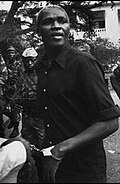
Ernest Ouandié was born in 1924 in Bafia, a town in the Centre region of French Cameroun sitting on the Mbam River, in territory that lay between the dense forest of the south and the savannah of the north. His background was not that of the mission-educated teacher or clerk who composed much of the nationalist leadership generation — he was a worker, formed in the labour conditions of colonial Cameroon rather than in the European intellectual traditions that mission education conveyed. His political consciousness came from the direct experience of colonial labour exploitation: the wage structures that kept African workers permanently below their European counterparts, the absence of any legal protection for organised labour action, the casual violence of European supervisors and colonial administrators toward African workers who showed signs of asserting their rights.
This working-class formation gave Ouandié a different relationship to the UPC's political programme than his more intellectually inclined colleagues. Where Um Nyobé's genius was for the legal and diplomatic language of petitions and UN submissions, and Moumié's was for the charismatic public political appeal, Ouandié's was for the patient, practical work of organising — building the networks of committed people at the grassroots level whose trust and commitment would sustain the movement when the external conditions became hostile. He was not a man who wrote manifestos or addressed great crowds. He was a man who knew how to build organisations that survived, and that knowledge proved, in the long run, to be the most necessary of the UPC's qualities.
The UPC's Founding Decade: Petition, Ban, and the Turn to Arms
The Union des Populations du Cameroun that Ouandié helped to found in 1948 operated, in its first years, within the framework of the United Nations Trusteeship system. French Cameroun was a UN Trust Territory, not a colony in the strict legal sense, and this status gave the UPC a legal avenue for its demands that ordinary colonial subjects did not possess: the ability to send petitions and delegations to the UN Trusteeship Council in New York, to address that body directly, and to place the question of Cameroonian self-determination on the international agenda in ways that the French colonial administration could not simply suppress without international embarrassment. Um Nyobé made the most of this opening, presenting Cameroon's case before the UN with remarkable skill and consistency through the early 1950s and building an international profile for the UPC that far exceeded what its mass following in a small territory would normally have generated.
Ouandié's role in this period was in the internal organisation — maintaining the party's networks in Cameroon, recruiting and training the activists who would carry the nationalist message into workplaces and communities, building the mass base that gave the UPC's UN submissions their credibility as expressions of popular will rather than elite opinion. He was the organisational spine of a movement whose diplomatic face was Um Nyobé and whose public charisma was, later, Moumié. Without Ouandié's patient work in the party's internal structures, the UPC could not have achieved the mass following that made it genuinely threatening to the French colonial administration.
The French ban of 1955 — justified by the colonial administration on the grounds of the UPC's alleged communist connections and its incitement of violence — was the moment that converted a legal political movement into an armed one. The UPC's response to the ban was shaped by the character of the leadership: Um Nyobé chose to remain inside Cameroon and maintain the struggle from the forest of the Sanaga Maritime region; Moumié went into exile and built the external organisation from Guinea and Ghana; Ouandié moved between both worlds, maintaining connections to the internal resistance while also working to sustain the international dimension of the struggle. The three men complemented one another, and the complementarity of their roles — internal organiser, external diplomat, strategic coordinator — gave the UPC a coherence under repression that few banned political movements achieve.
The Deaths of Um Nyobé and Moumié: The Last Man Standing
The killing of Ruben Um Nyobé in September 1958 — ambushed by French forces in the forest near Boumnyébel — was the first of the blows that would reduce the UPC's founding leadership to a single surviving member. Um Nyobé had been irreplaceable in one sense: his voice, his legal skill, his moral authority among the Bassa people of the Sanaga Maritime, his ability to make the Cameroonian independence case intelligible and compelling to international audiences — these were not qualities that could simply be transferred to another person. But the movement continued because the organisations that Um Nyobé had built continued, and the men and women who had committed themselves to the struggle in the Sanaga Maritime and the Bamiléké continued to fight.
The poisoning of Félix-Roland Moumié in Geneva in November 1960 — administered by a French intelligence operative who had gained access to him under the cover of journalistic interest — was the second blow. Moumié had been the most public face of the exile UPC, the man who maintained the party's connections to sympathetic African governments and who presented its case to international audiences from the platforms that Nkrumah's Ghana and Sékou Touré's Guinea provided. His death severed the most important of the exile movement's international links at precisely the moment when international support was most needed — when formal independence had transferred juridical sovereignty to the Ahidjo government without transferring real power, and when the maquis was under sustained military pressure.
After Moumié's death, Ouandié was the last. He was the last member of the founding leadership generation, the last person who had been present at the creation of the UPC and had participated in every major decision of its first decade, the last connection to the founding vision of what the movement had been and what it had set out to achieve. The weight of that survival — the obligation it created to continue, to justify the deaths of those who had gone before — shaped the choices he made in the decade that followed.
The Clandestine Return: A Commander Who Chose to Be Present
The decision to return to Cameroon from exile was not made in ignorance of its consequences. Ouandié knew, as clearly as anyone could know, what the Ahidjo government did to UPC fighters and leaders who were captured. He knew that French military intelligence was tracking the UPC's exile leadership with lethal intent — Moumié's poisoning in Geneva had demonstrated that French intelligence operations against the UPC were global in scope and had no compunction about assassination. He knew that the maquis networks inside Cameroon were under sustained pressure and that the fighters in the field were in desperate need of experienced leadership and political direction that could only be provided from inside the country.
He returned because the alternative — continuing to direct an armed struggle from the safety of exile while the people fighting it faced death in the Bamiléké forests — was incompatible with his understanding of what political leadership meant. This was not romanticism or a death wish. It was a specific moral calculation: that a political leadership which asks others to risk their lives while preserving its own safety has forfeited the right to lead. The tradition of revolutionary politics that Ouandié drew on — both the UPC's own practice and the broader tradition of anti-colonial armed struggle — held that the leader was present in the same danger as the fighters, and that presence in shared danger was the basis of the trust that made command possible.
The Long Hunt: French Counterinsurgency in the Bamiléké
The French military operations against the UPC maquis in the Bamiléké region were systematic, technically sophisticated, and extraordinarily violent. They drew on lessons learned in Indochina and Algeria — the use of helicopters for mobility, the construction of strategic hamlets to separate the civilian population from the guerrillas, collective punishment of communities suspected of sheltering fighters, the use of psychological operations to divide and demoralise the movement, and the deliberate targeting of the movement's political cadres as distinct from its military fighters.
General Max Briand's operations in the Bamiléké beginning in the late 1950s and continuing through the 1960s destroyed hundreds of villages, killed tens of thousands of people — estimates range from 100,000 to 400,000 for the total death toll of the Cameroonian independence war — and produced a landscape of physical and social devastation that the highlands took decades to recover from. The resettlement programmes that accompanied the military operations deliberately disrupted the community structures through which the maquis drew its support, moving populations away from areas where fighters operated and into controlled settlements where their contacts and communications could be monitored.
In this environment, Ouandié moved and organised. His survival for several years inside the country against an adversary with this level of military capacity and intelligence resources was an extraordinary operational achievement. It depended on the continued willingness of Bamiléké communities to shelter him — a willingness that reflected the depth of UPC political commitment in the region — and on his own skills in security, movement, and the management of the clandestine networks through which information and supplies could be passed without interception. It could not last indefinitely against an adversary with superior resources and no political constraint on the violence it was willing to use.
The Public Execution at Bafoussam: A Message Written in Blood
The decision to execute Ouandié publicly at Bafoussam was not a judicial necessity — it was a political theatre. The Ahidjo government could have executed him privately, as states do when the purpose is simply to eliminate a dangerous person. The choice of Bafoussam — the principal city of the Bamiléké region, the heartland of UPC support, the community that had produced most of the maquis fighters — as the site of the public execution was a deliberate communication to the Bamiléké people: that their resistance had been defeated, that its last leader had been destroyed, and that the power of the post-colonial state and its French military allies was absolute and final.
The execution took place on 15 January 1971, before an assembled crowd. Ouandié was shot alongside two others convicted in the same military tribunal. The staging of the event — the public square, the crowd, the firing squad — replicated the colonial practice of public execution as a demonstration of state power, and it was recognised as such by observers at the time. The Organisation of African Unity condemned the executions. International human rights organisations protested. The French government, whose intelligence and military services had done so much to bring about this moment, said nothing that it did not have to say.
Memory, Erasure, and the Debt of History
For decades after the execution, the name of Ernest Ouandié was as suppressed in Cameroon as the names of Um Nyobé and Moumié. Official Cameroonian history presented the independence era in terms that excluded the armed struggle entirely — presenting the transfer of power from France to Ahidjo as a natural and uncontested transition, the product of French generosity and Cameroonian readiness for self-government, rather than as the outcome of sustained armed conflict that had killed tens of thousands of people and been decided by French military intervention on behalf of a client government.
The rehabilitation of Ouandié as a national figure came only slowly, against the resistance of a political establishment that had built its legitimacy on the denial of his legitimacy, and it remains incomplete. His name appears on streets and institutions. He is taught in schools as a hero — but taught in ways that often obscure the specific political content of what he fought for, the specific programme of the UPC, and the specific role of France in suppressing it. A hero can be commemorated without the political implications of his struggle being acknowledged, and this is the risk that faces the memory of Ernest Ouandié as it has faced the memories of Um Nyobé and Moumié before him.
What Ouandié deserves is not merely commemoration but comprehension: an understanding of the full arc of his life, from the worker in Bafia who became a trade union organiser, to the founding member of the UPC who built its grassroots networks while Um Nyobé made its international case, to the exile who maintained the movement's connections while Moumié mobilised its international support, to the clandestine commander who returned to share the danger of the fighters in the forest rather than direct them from the safety of a foreign capital, to the prisoner who faced a military tribunal that had no interest in his defence and a firing squad that ended his life in a public square in Bafoussam. That life was spent in service of a programme — Cameroonian sovereignty, genuine independence, self-determination without French tutelage — that was never achieved, and that remains, in important respects, unfinished business.