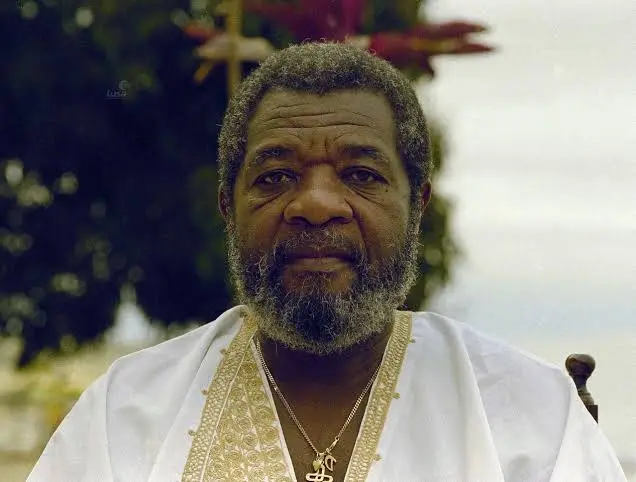
At a Glance
Bié, the Ovimbundu, and the Football Path to Political Consciousness
Daniel Chipenda was born in the Bié district of the central Angolan highlands in 1931, into the Ovimbundu world that the Portuguese colonial economy had shaped with particular intensity. The Benguela Railway — the colonial infrastructure project that connected the central highlands to the port of Lobito on the Atlantic coast — ran through Ovimbundu territory and had transformed the region's economic and social life, creating new patterns of labour migration, new forms of colonial economic integration, and new concentrations of African workers in the towns along the railway line. The Ovimbundu had been among the most severely affected by the late nineteenth century rubber trade's collapse, which had left communities that had organised their economies around rubber collection and porterage suddenly impoverished and vulnerable to the Portuguese colonial labour demands that filled the economic vacuum. By the time of Chipenda's birth, the Ovimbundu highlands were deeply integrated into the colonial economy as a source of cheap agricultural and industrial labour, and the Methodist and other Protestant missions that had established themselves among them had produced a layer of educated Ovimbundu Angolans who were acutely conscious of the gap between the colonial system's promises and its realities.
Chipenda's father was among this educated mission layer — a Methodist pastor whose position gave his son access to mission schooling and the literacy that opened further possibilities. What made Chipenda's trajectory unusual was the specific door that opened for him: not the scholarship to a metropolitan university that took Agostinho Neto to Lisbon or Viriato da Cruz to Coimbra, but the talent identification system of Portuguese football that brought promising players from the colonies to the clubs of the metropolitan first division. Portuguese football in the early 1950s was beginning to integrate African players from the colonies — Eusébio would arrive at Benfica from Mozambique in 1961 and become the most famous example of this pattern — and Chipenda was among the earlier wave of African talent that Portuguese clubs were beginning to recruit.
His years in Portugal as a footballer gave him an unusual immersion in metropolitan Portuguese society — not the academic-intellectual world that educated scholarship students encountered, but the more visceral world of professional sport, with its specific racial dynamics, its patterns of acceptance and exclusion, its gap between the valorisation of African athletic ability and the social subordination of African personhood. He observed the Portuguese social world from the inside, encountered the full range of Portuguese attitudes toward Africans from genuine personal warmth to casual racist condescension, and returned to Angola with a political consciousness that had been sharpened by direct exposure to the metropolitan world of the colonial power.
The MPLA, Military Training, and the Eastern Front
Chipenda's path into the MPLA reflected the movement's attraction for educated Angolans of diverse backgrounds who were committed to independence but who found the FNLA's Bakongo ethnicity and the nascent UNITA's Ovimbundu focus less compelling than the MPLA's stated non-racial, class-based nationalism. For an Ovimbundu with a mission education and a metropolitan experience, the MPLA's ideological universalism was genuinely appealing — it claimed to represent all Angolans rather than any particular ethnic community, and its Marxist analysis of colonialism provided a framework that transcended ethnic divisions by locating the fundamental conflict in the class and colonial relationships between the Portuguese coloniser and the Angolan colonised.
He received military training through the MPLA's connections with the Soviet Union and its Eastern Bloc allies — training that gave him the tactical and command skills needed to direct a guerrilla front — and was assigned command of the MPLA's Eastern Front when that front was established in the Moxico region of southeastern Angola in the late 1960s. The Eastern Front was geographically the most remote of the MPLA's operational zones, requiring infiltration through Zambia and across hundreds of kilometres of the sparsely populated eastern Angolan savanna before reaching areas where the movement could organise and fight. It was also, from the Portuguese military's perspective, one of the most strategically important fronts to contain, because eastern Angola bordered Zambia and the routes through which the MPLA received Soviet weaponry and supplies.
Chipenda commanded the Eastern Front through its most active period, building a fighting force that conducted sustained guerrilla operations against Portuguese military installations and economic infrastructure across eastern Angola. His fighters endured conditions of extreme physical hardship — operating in one of the most remote and logistically challenging environments in Angola, far from the supply chains and the political support networks that sustained the exile leadership in Brazzaville and Lusaka. The contrast between the conditions of the Eastern Front fighters and the relative comfort of the exile leadership became one of the central grievances of what would eventually become the Eastern Revolt.
The Eastern Revolt — Political Critique and Factional War
The Eastern Revolt that Chipenda launched against Agostinho Neto's MPLA leadership in the early 1970s was one of the most serious internal crises in the movement's history — serious enough that it came close to destroying the MPLA as a unified organisation before the liberation struggle reached its decisive phase. Understanding it requires distinguishing between its different dimensions: the genuine political critique it embodied, the factional and personal interests it served, and the external pressures that shaped its trajectory.
The genuine political critique was real and not without force. Chipenda argued that the MPLA under Neto had become dominated by its mestiço and assimilado intellectual leadership — the educated Luanda-based urban community of mixed-race and "civilised" African Angolans who had historically provided the movement with its intellectual and organisational backbone — at the expense of the African ethnic majority of the Angolan interior. He argued that this leadership culture made the MPLA unrepresentative of the people it claimed to liberate, that it prioritised the political positions and career interests of a small educated elite over the needs of the peasant and worker base, and that the movement's internal democracy was insufficient to hold its leadership accountable. These arguments resonated with fighters on the Eastern Front who had genuine grievances about the exile leadership's perceived remoteness and about the distribution of resources and recognition within the movement.
At the same time, the Eastern Revolt was also a bid for personal power. Chipenda had built a personal following on the Eastern Front through years of shared hardship and was in a position of military command that gave him significant leverage within the movement. His challenge to Neto was not purely principled — it combined genuine political disagreement with personal ambition of a kind that liberation movement politics always generates and that is not in itself disqualifying, but that complicated the assessment of his motives and gave Neto's supporters a basis for characterising the Revolt as opportunistic rather than ideological.
The Revolt also attracted support from external sources that were, at best, ambiguously aligned with the MPLA's liberation goals. The FNLA and certain Zambian government figures had interests in seeing the MPLA weakened, and there is evidence that some support for the Chipenda faction came from these quarters. The Soviet Union, which was the MPLA's primary external patron, remained committed to Neto's leadership and withheld support from the Eastern Revolt — a position that proved decisive, because Soviet material support was the MPLA's most important military resource and Neto could use Soviet alignment as an argument for his own indispensability.
Lusaka 1974, Defeat, and Defection
The MPLA's Lusaka conference of 1974 — held in the Zambian capital where the movement's exile leadership was based — was convened specifically to address the internal crisis created by the Eastern Revolt and the simultaneous challenge from the Active Revolt of the Angolan intellectuals based in Brazzaville. Neto arrived at the conference with Soviet backing, with the support of the OAU's Liberation Committee, and with the political skills of someone who had navigated MPLA internal crises before. The conference consolidated his authority and effectively expelled the Chipenda faction from the movement.
Chipenda's response was the decision that permanently defined his historical legacy: he defected to the FNLA — Holden Roberto's organisation, the MPLA's principal rival and the movement whose March 1961 uprising had launched the armed struggle but which was, from the MPLA's perspective, an ethnic sectarian organisation backed by the United States and Zaire. The defection was astonishing in its political logic: Chipenda had spent years within the MPLA criticising it for being insufficiently representative of African Angolans, and he resolved this critique by joining an organisation that was primarily Bakongo in its social base and American in its external alignment. The move suggested that his quarrel had been primarily with Neto personally rather than with the MPLA's ideological direction, or that the desperation of political defeat had overcome any principled calculation about where his interests and commitments lay.
Within the FNLA, Chipenda added an Ovimbundu dimension to what had been a Bakongo-centred organisation, and he played a role in the military operations that the FNLA conducted in 1975 as it competed with the MPLA for control of Angola before and after independence. But the FNLA's military defeat at the Battle of Quifangondo on 10 November 1975 destroyed the organisation's capacity for further military challenge, and with it whatever political future Chipenda had imagined for himself within the FNLA. By 1976 he was effectively without a political home — rejected by the MPLA as a traitor, marginalised within the FNLA by the collapse of its military position, and without the independent organisational base that would have been necessary to remain a relevant political actor.
Exile, Obscurity, and the Question of Legacy
The years after 1976 brought Chipenda no political rehabilitation and no meaningful role in the Angolan story that continued without him. He spent much of his remaining life in Europe, primarily in Portugal — the country of the colonial power against which he had fought — with occasional attempts to re-engage with Angolan politics that came to nothing. The MPLA government that ruled independent Angola had no interest in acknowledging his contributions to the liberation struggle, which were real if complicated, and every interest in perpetuating the narrative that he was simply a traitor who had gone over to the enemy. UNITA under Jonas Savimbi also had no particular use for him — Savimbi was building his own Ovimbundu political base and did not need a figure whose trajectory had taken him through the MPLA and the FNLA before ending in European exile.
He died in Lisbon in March 1996, at the age of sixty-four. The Angolan civil war was still ongoing — it would not end until Savimbi's death six years later — and the political landscape he had tried to navigate in the 1970s had been transformed in ways that made his earlier manoeuvres seem simultaneously distant and tragically consequential. The MPLA he had fought against was still in power. The FNLA he had joined in desperation had effectively ceased to exist as a political force. The Ovimbundu constituency whose interests he had claimed to champion was living through the devastating consequences of Savimbi's twenty-seven-year insurgency.
The honest assessment of Daniel Chipenda must acknowledge both the validity of the critique he articulated and the inadequacy of the political choices he made in pursuing it. The MPLA's domination by its mestiço and Luanda-based intellectual elite was a genuine structural problem — one that the movement's post-independence governance would amplify rather than correct, as the oil-state patronage system concentrated wealth and power in networks connected to the MPLA's coastal urban base while the interior populations whose interests Chipenda had championed remained marginalised. His critique was right about the problem. His solution — defection to the FNLA, collaboration with the movement's enemies at the most critical moment of the liberation struggle — was politically disastrous and personally ruinous. The gap between the diagnosis and the prescription is the central tragedy of his career, and it reflects the conditions of exile politics under Cold War pressures rather than simple personal failure: conditions in which the available choices were all bad, and in which the worst choice was the one that offered the most immediate relief from political defeat.