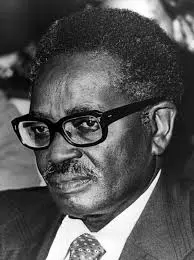
At a Glance
Origins, Mission Education, and the Colonial Contradiction
Agostinho Neto was born in 1922 into a world organised entirely around the premise of African inferiority. Portuguese Angola in the early twentieth century was a colonial society of exceptional brutality — one that combined the formal apparatus of European imperial administration with the specific Portuguese institution of the contrato, a system of forced labour that kept the African rural population in a condition of near-serfdom. The Salazar regime that came to power in Portugal in 1933 had deepened the ideological scaffolding of this system, replacing the earlier language of civilising mission with a more explicitly racial hierarchy dressed in the pseudo-philosophical clothes of Lusotropicalism — the claim that Portuguese colonialism was uniquely benign because the Portuguese were culturally adapted to the tropics and disposed toward racial mixing. This claim was, for Africans living under it, transparently false, but it had the effect of making the Portuguese colonial system more ideologically rigid and more resistant to the currents of decolonisation that were beginning to move through the British and French empires in the 1940s and 1950s.
Neto's father was a Methodist pastor — a position that placed the family within the small minority of Angolan Africans who had access to Protestant mission education, which differed from Catholic mission education in being somewhat less directly integrated into the colonial administrative apparatus. The Methodist missions of the Luanda hinterland had a tradition of educating Africans to a level that the colonial system did not intend to sustain, and they had produced a generation of Angolan intellectuals and professionals — men and women who were literate, politically aware, and acutely conscious of the gap between the colonial rhetoric of civilisation and the reality of racial subordination. Neto belonged to this generation and drew on this formation throughout his life.
He demonstrated exceptional academic ability from childhood, completed his secondary schooling in Luanda, and worked as a clerk in the Portuguese colonial health services — a position that gave him an intimate view of the medical consequences of colonial poverty and malnutrition in the African neighbourhoods of Luanda. He wrote his earliest poems during this period, verses that circulated among the small community of educated Angolan Africans who were beginning to articulate the cultural nationalism that would become one of the MPLA's distinctive features. His decision to go to Portugal to study medicine in 1947 was a natural extension of this trajectory — an attempt to acquire the credentials that the colonial system respected while simultaneously engaging with the anti-colonial politics that the Portuguese left, despite its own limitations, kept alive.
Student Years in Portugal, the PIDE, and the Formation of a Revolutionary
Neto arrived in Portugal in 1947 and enrolled at the University of Coimbra before transferring to the University of Lisbon. Portugal under Salazar was a fascist state — not identical to Nazi Germany or Mussolini's Italy, but sharing their essential features: the suppression of political opposition, the use of a secret police force (the PIDE, Polícia Internacional e de Defesa do Estado) to monitor, arrest, and torture dissidents, the control of the press and universities, and the maintenance of an imperial ideology that justified the exploitation of Portugal's African territories as a civilising mission. The Portuguese Communist Party (PCP) operated clandestinely in this environment and provided one of the few organised spaces within which anti-fascist and anti-colonial politics could develop. Neto joined the PCP and became involved in the broader anti-fascist cultural movement — the Movimento de Unidade Democrática — that brought together Portuguese liberals, socialists, and communists in a fragile coalition against the Salazar regime.
His political activities brought him to the attention of the PIDE. He was arrested for the first time in 1951, after signing a petition to the Portuguese National Assembly calling for democratic rights — an act that in a democratic country would be entirely unremarkable but in Salazar's Portugal was treated as a subversive act. He was held for several months before being released. He was arrested again in 1955 and once more in 1960, by which point he was back in Angola and had become the president of the MPLA. The 1960 arrest, which occurred at his medical practice in Luanda while his patients watched, provoked a demonstration in his home district of Icolo e Bengo that the Portuguese colonial police suppressed by firing into the crowd, killing an estimated thirty people and wounding two hundred more in what became known as the Icolo e Bengo massacre — one of the first significant acts of mass repression in the sequence that led to the armed uprising of 1961.
Throughout his years in Portugal, Neto continued to write poetry. His poems circulated in clandestine samizdat form among the anti-colonial and anti-fascist circles of Lisbon and Coimbra, and also reached the communities of African students from Angola, Mozambique, Guinea-Bissau, Cape Verde, and São Tomé who were gathering in Portugal during this period and who would provide many of the leaders of the subsequent liberation movements. These students — the generation that included Amílcar Cabral, Marcelino dos Santos, and others — formed a network of shared political commitment and cultural identity across the Portuguese African empire that was foundational to the liberation movements' subsequent capacity to mobilise international solidarity and to articulate a coherent anti-colonial vision.
The MPLA, the Armed Struggle, and the Long War Against Portugal
The MPLA — the Movimento Popular de Libertação de Angola — was founded in Luanda in December 1956, emerging from the convergence of several earlier Angolan political organisations and drawing its membership primarily from the educated urban African and mestiço communities of Luanda and the Mbundu-speaking hinterland. Its founding ideology combined Marxist anti-imperialism with a non-racial, civic Angolan nationalism that distinguished it from the more ethnically specific political formations that would develop around the FNLA (primarily Bakongo) and UNITA (primarily Ovimbundu). Neto became the MPLA's president in 1962, following a period of internal reorganisation after the movement's founding leadership had been suppressed or forced into exile by the Portuguese security services.
The armed struggle began on 4 February 1961, when MPLA militants attacked the São Paulo prison in Luanda in an attempt to free political prisoners. The attack failed, and the Portuguese response — which included the massacre of African civilians in Luanda's musseques and in the Baixa do Cassanje cotton-growing region in the following weeks — killed thousands of Angolans and demonstrated that Portugal intended to defend its colonial empire with maximum violence. A second uprising in March 1961, led by the UPA (later FNLA) in northern Angola in the Bakongo region, was also suppressed with extraordinary brutality, with Portuguese settlers and the colonial army killing an estimated twenty thousand Africans in reprisal operations. These events marked the effective beginning of a thirteen-year armed conflict that the MPLA fought from bases in the Republic of the Congo (Brazzaville) and later Zambia, with Cuban, Soviet, and Eastern Bloc support, against a Portuguese colonial army that at its peak deployed sixty thousand troops in Angola.
Neto's leadership of the MPLA through this period was not unchallenged. The movement suffered repeated internal crises that reflected the pressures of guerrilla warfare, the ideological tensions between its Marxist, nationalist, and Mbundu-ethnic tendencies, and the inevitable strains of exile politics. In 1963 Viriato da Cruz, one of the MPLA's founding intellectuals and its first secretary-general, broke with the movement and eventually aligned with the FNLA. In the early 1970s Daniel Chipenda, who commanded the MPLA's Eastern Front, launched what became known as the Eastern Revolt against Neto's leadership, accusing him of privileging the mestiço and assimilado intellectual elite over the African peasant and worker base. A simultaneous challenge from a group of Angolan intellectuals in the MPLA's Brazzaville structures — the Active Revolt — further threatened the movement's cohesion. Neto navigated all of these challenges through a combination of political skill, personal authority, Soviet and Cuban support, and a willingness to use organisational force against internal opponents that reflected both the exigencies of underground politics and the authoritarian tendencies that would mark his subsequent governance.
Independence, Civil War, and the Cuban Alliance
Portugal's Carnation Revolution of 25 April 1974 — the military coup that ended the Salazar-Caetano dictatorship and brought a left-wing military government to power in Lisbon — transformed the situation in Angola overnight. The new Portuguese government committed to decolonisation, and negotiations between Portugal, the MPLA, the FNLA, and UNITA produced the Alvor Agreement of January 1975, which established a transitional government and set a date for independence. The transitional government collapsed almost immediately under the pressure of military clashes between the three movements, and by mid-1975 Angola was in a state of full civil war, with each of the three movements backed by competing external powers — the MPLA by the Soviet Union and Cuba, the FNLA by the United States and Zaire, and UNITA by the United States and South Africa.
The South African Defence Force intervened directly in October 1975, advancing northward from Namibia with a column that came within two hundred kilometres of Luanda by the time Angola's independence date of 11 November 1975 arrived. Neto proclaimed independence in Luanda on that date, knowing that the MPLA controlled the capital but that the country beyond it was contested. Cuba's response — Operation Carlota, which airlifted Cuban troops and military advisers into Angola beginning in November 1975 — proved decisive. The Cuban forces, equipped with Soviet weaponry and deployed with a tactical sophistication that the South African column had not anticipated, halted the South African advance and then pushed it back. South Africa withdrew from Angola in early 1976, a defeat that had significant consequences for the internal politics of the apartheid state and for the broader trajectory of Southern African liberation.
Neto governed the People's Republic of Angola from November 1975 until his death in September 1979. His government nationalised the oil sector, which — given Angola's substantial offshore petroleum reserves — provided the fiscal base for the state, even as the civil war consumed a large proportion of government revenues. He maintained the alliance with Cuba and the Soviet Union, accepted the presence of Cuban troops as the primary defence against UNITA and the continuing South African threat, and attempted to build the institutions of an independent state in conditions of near-constant warfare. His government was authoritarian by the standards of liberal democracy — the MPLA was the sole legal party, political opposition was suppressed, and the security apparatus engaged in human rights abuses — but it was operating in circumstances in which a CIA-backed insurgency and repeated South African military incursions made the claim of external threat to the state far from hypothetical.
The Poetry of Agostinho Neto
Neto's literary achievement is inseparable from his political biography, but it is also independent of it in the sense that his poetry endures as literature rather than merely as historical document. His collected poems, published under the title Sagrada Esperança in 1974 — on the eve of independence — draw on three decades of writing that spans his years in colonial Angola, his student period in Portugal, his imprisonment, his years of exile and guerrilla leadership, and his engagement with the Angolan landscape and people. The poems range in mode from lyric meditation to direct political address, from intimate personal grief to visionary proclamation, and they achieve in the best instances a compression and emotional precision that raises them above the merely occasional.
His most celebrated poem, "Western Civilisation," is a bitterly ironic meditation on the physical collapse of an African man exhausted by colonial labour — the "western civilisation" of the title being the system that has produced this wreckage. Other poems address the landscape of the Angolan hinterland with a tenderness that suggests Neto's deep attachment to the country whose independence he fought for as something more than a political project — as a personal and emotional home. His prison poems, written during his periods of PIDE detention, have the concentrated intensity of writing produced under conditions of genuine existential pressure, and they circulated internationally in translation, helping to bring the Angolan liberation cause to the attention of European and Latin American literary communities that might otherwise have remained unaware of it.
Neto was part of a literary generation — the generation of Lusophone African writers that included José Craveirinha in Mozambique, Amílcar Cabral's occasional verse, and the poets associated with the Casa dos Estudantes do Império in Lisbon — who understood the reclamation of African literary and cultural expression as itself a form of anti-colonial resistance. The Portuguese colonial system had attempted to define African culture as primitive and therefore beyond the reach of serious literary production. The deliberate cultivation of a sophisticated, politically engaged, formally accomplished Angolan literature in Portuguese was a direct rebuttal of this claim — an assertion that Angolans could inhabit the European literary tradition on their own terms while simultaneously transcending it by insisting on the specific experience and consciousness of people who had lived under colonial domination.
Death, Legacy, and Angola After Neto
Agostinho Neto died in Moscow on 10 September 1979, where he had been receiving treatment for cancer. He was fifty-six years old. His death came just four years after Angolan independence — not enough time to know what kind of leader he would have become in conditions of genuine peace, or whether the authoritarian tendencies of his wartime governance would have moderated as the existential threat to the state receded. He was succeeded as president by José Eduardo dos Santos, who would rule Angola for the next thirty-eight years in a manner that fulfilled the worst fears of those who had worried about the MPLA's authoritarian trajectory.
Neto's legacy in Angola is officially celebrated and politically instrumentalised to an extent that makes honest assessment difficult. He is "the Father of the Nation," his image is on the currency, his mausoleum is one of Luanda's most prominent architectural landmarks, and his collected works are required reading in Angolan schools. But the MPLA government that invokes his name governed Angola through a civil war that killed an estimated five hundred thousand people, displaced millions more, and left the country with some of the worst landmine contamination and infant mortality rates in the world. How much of this catastrophe was attributable to external aggression — the South African destabilisation campaign, the American backing for UNITA — and how much was attributable to the MPLA's own failures of governance and political culture is a question that Angolan history is still working through.
What is not in question is Neto's personal commitment to the cause of Angolan liberation and his extraordinary range as an individual — physician, poet, guerrilla leader, diplomat, head of state — who brought to each of these roles a seriousness of purpose and a quality of intelligence that would have been remarkable in any circumstances and was exceptional in the circumstances of a colonised African people fighting for their freedom against a European empire that had no intention of letting them go.