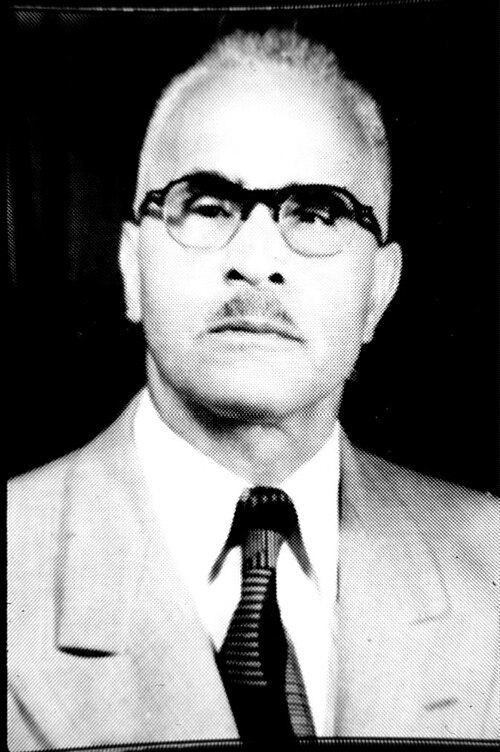
Vernon Johns, prophetic Baptist minister who preceded King at Dexter Avenue Baptist Church in Montgomery, whose confrontational preaching about racial injustice and direct action organising prepared the institutional ground for the movement that King would lead.
United States · Civil Rights Movement

Vernon Johns

Vernon Napoleon Johns was born on April 22, 1892, in Darlington Heights, Prince Edward County, Virginia, into a family that included both formerly enslaved people and free Black people, and he grew up in the specific world of Virginia's rural Black community with a theological intelligence and a personal eccentricity that distinguished him from virtually every other Black Baptist minister of his generation. He was educated at Virginia Theological Seminary and College, at Oberlin College in Ohio, and at the University of Chicago's Divinity School — an educational formation that gave him one of the most sophisticated theological intellects in twentieth-century Black Protestantism. He preached at the Dexter Avenue Baptist Church in Montgomery, Alabama, beginning in 1947 — seven years before Martin Luther King Jr. arrived to pastor the same congregation — and used the pulpit to preach the most confrontational prophetic theology that Montgomery's Black establishment had ever heard. He preached sermons whose titles were themselves challenges: "Segregation After Death," "When the Rapist Is White," "It's Safe to Murder Negroes in Montgomery." He organised the congregation to boycott white merchants who were disrespectful to Black customers, predating the 1955 boycott by years. He attempted to organise Black farmers to sell their produce directly to Black consumers, bypassing the white merchants who controlled the agricultural marketing system. He sold produce from the back of a truck to make the point practical as well as theoretical. His relationship with the Dexter Avenue congregation was one of sustained, mutual frustration: they wanted a pastor whose prophetic ministry would inspire without disrupting their lives; he wanted a congregation whose prophetic faith would lead them to disrupt the racial order they were living in. The tension produced confrontations, attempts to remove him, temporary departures, and returns, until he finally left Dexter Avenue for the last time in 1952 — two years before King arrived. He continued to preach and write and farm and sell produce and make arguments until his death on June 11, 1965, in Washington D.C., at the age of seventy-three, having spent his entire career as the person who was too far ahead of his congregation to be successfully heard by it and who nonetheless prepared the ground for the person who would be heard.

United States Dexter Avenue Baptist Montgomery Prophetic Ministry Pre-Movement Virginia

Born: 22 April 1892, Darlington Heights, Virginia, USA  |  Died: 11 June 1965, Washington, D.C., USA — aged seventy-three

At a Glance

Full NameVernon Napoleon Johns; born 22 April 1892, Darlington Heights, Prince Edward County, Virginia; educated at Virginia Theological Seminary and College, Oberlin College, and the University of Chicago Divinity School; married Altona Trent 1927; pastor of Dexter Avenue Baptist Church, Montgomery, Alabama, 1947-1952; preceded Martin Luther King Jr. at Dexter Avenue by seven years; continued preaching at various churches after leaving Montgomery; was involved in farming and produce selling as practical economic resistance; died 11 June 1965, Washington D.C., aged seventy-three
Born22 April 1892, Darlington Heights, Prince Edward County, Virginia; a rural Virginia county with a large Black community and a long tradition of Black educational and civic engagement; his family background included both formerly enslaved people and free Black people; his theological intelligence was evident from an early age and was developed through one of the most sophisticated educational formations available to a Black Baptist minister of his generation; graduated from Oberlin College and studied at the University of Chicago Divinity School
Died11 June 1965, Washington D.C.; died at the age of seventy-three; his death came in the year that the Voting Rights Act was passed — after the civil rights movement he had been ahead of had produced its legislative victories; he had lived to see the movement that built on the foundations he had laid achieve what he had been arguing for decades was both necessary and possible; his death received less attention than his contribution warranted, consistent with the pattern of prophetic figures whose recognition comes late if at all
Dexter Avenue SermonsPreached sermons at Dexter Avenue Baptist Church whose titles were themselves confrontational challenges to the racial order and to the congregation's comfort: "Segregation After Death," "When the Rapist Is White," "It's Safe to Murder Negroes in Montgomery"; the sermon titles communicated what the sermons developed: that racial injustice was not merely a social problem to be addressed through patient improvement but a moral emergency requiring immediate prophetic response; his congregation found the sermons inspiring and disturbing and too demanding in equal measure
Economic Resistance and Produce SellingOrganised the Dexter Avenue congregation to boycott white merchants who were disrespectful to Black customers — predating the 1955 Montgomery Bus Boycott by years and demonstrating that the economic pressure methodology the movement would later use was available and effective before the movement's formal campaign structure had been built; sold produce from the back of a truck to make the point that Black farmers could sell directly to Black consumers rather than through white-controlled marketing systems; the combination of theological argument and practical demonstration was characteristic of his ministry
The Congregation He Couldn't KeepHis relationship with the Dexter Avenue congregation was one of sustained mutual frustration; they wanted a pastor who could inspire without disrupting; he wanted a congregation whose faith would lead them to act; the tension produced multiple confrontations and attempts to remove him; he departed and returned multiple times before leaving finally in 1952; his successor at Dexter Avenue was a young minister from Atlanta whose doctoral dissertation was nearly complete, whose eloquence was already evident, and whose willingness to lead the congregation in the direction Johns had been pointing was confirmed within two years of his arrival
Theological Formation and Prophetic TraditionWas one of the most theologically sophisticated Black Baptist ministers of the twentieth century; his education at Oberlin and Chicago gave him the intellectual formation that distinguished his preaching from the evangelical emotionalism that characterised much of the Black church's public ministry; his theology was prophetic in the technical sense: it understood the prophetic tradition of the Hebrew Bible as a direct address to the conditions of the present, requiring response rather than merely acknowledgment; his sermons were long, intellectually demanding, and morally uncomfortable in the specific way that prophetic preaching is supposed to be

Prince Edward County, Oberlin, and the Education of a Prophet

Vernon Johns grew up in Prince Edward County, Virginia — a county that would later become famous, in the darkest possible way, for closing its entire public school system in 1959 rather than comply with the Supreme Court's desegregation orders, depriving Black children in the county of any public education for five years. Johns grew up there before this particular expression of white supremacy had occurred, but in the conditions that would eventually produce it: a county with a large Black population, a tradition of Black civic and educational engagement, and a white political establishment whose resistance to any challenge to the racial order was as comprehensive as anywhere in Virginia.

His educational formation at Oberlin College — the same institution that had educated Mary Church Terrell and many other Black intellectual figures — and at the University of Chicago's Divinity School gave him one of the most sophisticated theological intellects in twentieth-century Black Protestantism. He could read Hebrew and Greek, was familiar with the entire range of Christian theological tradition from the patristic period through the twentieth century, and had developed through his studies at Chicago an understanding of the prophetic tradition that went beyond the evangelical emotionalism that characterised much of Black Baptist preaching and into the specific moral and political demands that the Hebrew prophets made on their communities.

This formation was both his gift and his limitation. He was too sophisticated for most of his congregations, too demanding in his expectations of what faith required in practice, too unwilling to accept the comfortable distance between theological conviction and social action that most Black church communities maintained for self-protective reasons. He was the kind of minister who made the people who heard him feel that they were not doing enough and should be doing more, which is exactly what a prophet is supposed to do and exactly what congregations find most difficult to sustain over years.

Montgomery's Most Unwelcome Preacher

Johns arrived at Dexter Avenue Baptist Church in Montgomery in 1947 to pastor the congregation that had been one of the most prestigious Black Baptist churches in the city for decades — a church whose middle-class and professional congregation expected a ministry of intellectual quality and social respectability. Johns provided the intellectual quality and replaced the social respectability with something far more uncomfortable: a prophetic ministry that named the racial order by name, that demanded the congregation respond to it actively rather than navigate it patiently, and that refused to maintain the separation between theological conviction and civil confrontation that the congregation's position in Montgomery's racial order made prudent.

The sermon titles he preached at Dexter Avenue were themselves acts of confrontation: "It's Safe to Murder Negroes in Montgomery" said directly what the Black community's daily experience confirmed and what the social code required to be left unsaid; "When the Rapist Is White" addressed the specific pattern of sexual violence by white men against Black women that the legal system reliably refused to prosecute; "Segregation After Death" imagined the absurdity of a heaven organised on Jim Crow principles. Each title was a challenge not merely to the racial order but to the congregation's willingness to acknowledge what the racial order was.

His economic resistance programme — organising the congregation to boycott white merchants who were disrespectful to Black customers, selling produce from a truck to demonstrate the possibility of economic independence from the white-controlled marketing system — was practical as well as symbolic. He was not merely preaching about economic justice; he was demonstrating it, in the specific way that a farmer from Prince Edward County who understood the practical dimensions of agricultural economics could demonstrate it. The boycott he organised was the same methodology the Montgomery Bus Boycott would use seven years later; the economic logic was the same; what was missing was the organisational infrastructure to sustain it and the political moment to make it nationally significant.

The Ground He Prepared and the Man Who Walked On It

Johns left Dexter Avenue finally in 1952, after years of the mutual frustration that his ministry produced in any congregation he served. His successor, after an interregnum, was Martin Luther King Jr. — a twenty-five-year-old minister with a doctoral dissertation nearly finished at Boston University, with eloquence that had already impressed everyone who heard him, and with a willingness to engage with the racial order that Johns's years of prophetic preaching had established as the expectation for a Dexter Avenue minister, even if Johns had made the specific form that engagement should take too demanding for the congregation to sustain.

King arrived at Dexter Avenue in October 1954 knowing, from those in the congregation who told him, what Johns had been like and what he had been trying to do. The fourteen months between King's arrival and the Montgomery Bus Boycott were months in which King was learning the congregation, learning Montgomery, and carrying in his mind the understanding that his predecessor had been pushing the community toward something that the community had not yet been ready to do. The boycott that began in December 1955, when E.D. Nixon called the meeting that produced the Montgomery Improvement Association and selected King to lead it, was the moment when the community was ready — and the preparation that Johns had done, however frustrating and however incomplete, was part of what had made it possible.

Johns is one of the civil rights movement's most important nearly-forgotten figures — nearly forgotten because he was ahead of his time, because the institution he served was not ready for what he had to offer, because he died in 1965 before the recognition of his contributions had been organised, and because the person who succeeded him became so much more celebrated that the ground-preparation work was lost in the celebrity of what was built on it. He prepared the ground. King built on it. Both were necessary, and history has remembered only one of them.

Other Civil Rights Movement Profiles

USA · Civil Rights Martin Luther King Jr. Succeeded Johns at Dexter Avenue Baptist Church in 1954 and built the Montgomery Bus Boycott on the institutional ground Johns had prepared USA · Civil Rights E.D. Nixon Montgomery NAACP leader who had been doing the same work as Johns — building the community organisation that would eventually produce the boycott USA · Civil Rights Rosa Parks Whose December 1955 arrest activated the Montgomery community that Johns had been attempting to move for years USA · Civil Rights Ralph Abernathy King's closest colleague who was also shaped by the specific culture of Montgomery's Black Baptist ministerial community that Johns had helped to define USA · Civil Rights Fred Shuttlesworth Birmingham ACMHR founder whose confrontational prophetic ministry was the closest equivalent to Johns's in the civil rights era USA · Civil Rights Kelly Miller Smith Nashville Baptist minister whose SCLC co-founding paralleled the institutional support Johns's ministry had attempted to build in Montgomery USA · Civil Rights James Lawson The Gandhian nonviolence trainer whose theological depth and prophetic commitment made him the closest intellectual equivalent to Johns in the Nashville movement USA · Civil Rights Prathia Hall The prophetic preacher whose gifts in a SNCC context paralleled Johns's gifts in a Baptist ministerial context — ahead of the congregation, always USA · Civil Rights Bayard Rustin Who was also consistently ahead of the movement's dominant tendency and who paid personal costs for it, as Johns paid institutional ones USA · Civil Rights Joseph Lowery SCLC co-founder whose Methodist ministerial tradition in the same Alabama and Georgia context paralleled Johns's Baptist one
Share X Facebook WhatsApp LinkedIn