At a Glance
Auburn Avenue, Morehouse, and the Education of a Minister
Martin Luther King Jr. grew up on Auburn Avenue in Atlanta — "Sweet Auburn," the most prosperous Black business street in the South — in the home of Ebenezer Baptist Church's pastoral family. The specific formation this provided was unusual even within the Black professional class: it was not merely educational or economic privilege but institutional privilege, the privilege of being raised in an institution that was simultaneously a religious community, a civic organisation, and a network of social relationships that extended throughout Atlanta's Black life. His grandfather A.D. Williams had built Ebenezer into this kind of institution; his father had inherited and extended it; and Martin grew up understanding that the church was not merely a house of worship but a platform from which Black civic life was organised and maintained.
His entry into Morehouse College at fifteen was the beginning of his formal intellectual formation under Benjamin Mays, whose presidency had made Morehouse the intellectual centre of Black civic engagement in the South and whose influence on King was profound and direct. Mays's insistence that Black men of intelligence and education had civic obligations that their education required them to fulfil was the institutional expression of what King's family had transmitted as a personal and religious obligation. The combination produced a young man who was both genuinely intellectually serious and genuinely committed to acting on what he understood.
His doctoral work at Boston University and his earlier divinity training at Crozer gave him the two intellectual traditions that defined his theological and political framework: the social gospel tradition of Walter Rauschenbusch, which argued that Christian faith required engagement with the structural conditions of social injustice rather than merely the individual conditions of personal sin; and the Gandhian tradition of nonviolent direct action, which he first encountered seriously at Crozer and which provided the strategic and tactical framework for everything the movement subsequently did. These were not abstract influences; they were the intellectual foundations from which he built the specific form of political action that the movement used.
Montgomery: The Formation of the Method
King's arrival in Montgomery in October 1954, fourteen months before Rosa Parks's arrest, placed him in the right place at the right time in ways that were not accidental but were also not fully intentional — he had not chosen Montgomery because he foresaw the boycott, but the specific qualities that Montgomery required in a boycott leader (eloquence, moral authority, freedom from local political entanglements, theological seriousness) were precisely the qualities that his formation had produced. His selection as MIA president was in this sense both fortunate for him and rational for the people who chose him.
The 381 days of the boycott were King's formation as a movement leader — the period in which the capacities he had developed in formal education were tested against the actual demands of leading a sustained community campaign in conditions of constant threat and constant pressure. His home was bombed on January 30, 1956, while Coretta and their daughter Yolanda were inside; he arrived at the scene after the bomb had gone off and found an angry crowd gathering who were prepared for violence against the white community. He persuaded them to go home. The ability to hold a crowd in a moment of genuine anger and grief and direct that energy toward continued nonviolent engagement rather than retaliation was the quality that made him, in exactly that moment, irreplaceable.
The boycott's legal resolution came not through the negotiations the MIA was conducting with the Montgomery city government but through Fred Gray's Browder v. Gayle case in federal court. The Supreme Court's November 1956 ruling desegregated the buses; the boycott ended on December 20, 1956. King had spent 381 days demonstrating a form of leadership that the movement needed and that no existing institution had been providing, and the SCLC he co-founded in 1957 was the attempt to build an institutional framework around that form of leadership and deploy it systematically across the South.
The Letter from Birmingham Jail: The Movement's Most Important Document
"Letter from Birmingham Jail," written in April 1963 in the margins of a newspaper and on scraps of paper while King was in solitary confinement after his arrest during the Birmingham campaign, is the most important document the civil rights movement produced and one of the most important documents in American political thought. It was written in response to "A Call for Unity" published by eight white Alabama clergymen who argued that King's demonstrations were "unwise and untimely" and urged patience and negotiation through the courts rather than direct action in the streets.
King's response addressed the specific arguments of the clergymen while deploying the full resources of his theological and political formation — his knowledge of Christian scripture and tradition, his familiarity with the philosophy of natural law from Augustine to Aquinas, his understanding of American democratic theory, and his specific experience of what injustice actually looked and felt like from inside a jail cell in Birmingham, Alabama in 1963. The Letter's argument was that the injustice of segregation was not merely a political problem to be resolved through proper procedures but a moral emergency that Christian faith and democratic principle both required addressing immediately, and that the clergymen's call for patience was a form of complicity with the system they were urging patience about.
The Letter's most famous passage — the description of the "white moderate" who preferred "a negative peace which is the absence of tension to a positive peace which is the presence of justice" — was the movement's most precise diagnosis of the political obstacle that the nonviolent mainstream actually faced: not the explicit white supremacist but the white liberal who agreed with the goal in the abstract and objected to the method and the timing in the specific. The diagnosis was both analytically accurate and politically productive; it named an obstacle that the movement could address rather than merely deploring.
The Dream, the Nobel, and the Turn to Economic Justice
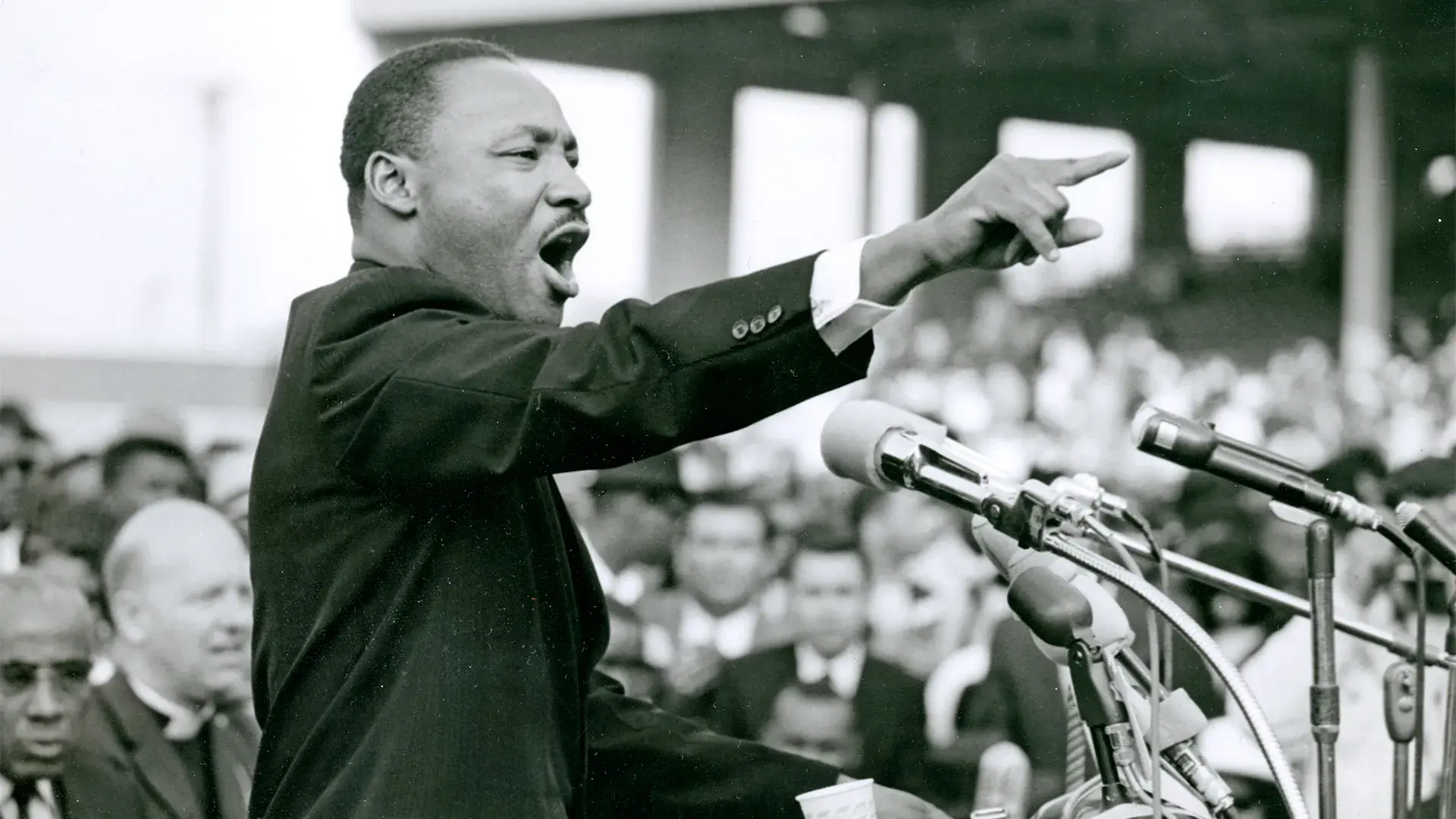
The March on Washington of August 28, 1963, was the largest civil rights demonstration in American history to that point and one of the largest public gatherings of any kind in Washington's history. King's address was the culminating event of the day, and its two-part structure — the prepared argument followed by the improvised peroration — reflects two different understandings of what the speech was trying to accomplish. The prepared portions argued the political case for civil rights legislation with the precision and the urgency of someone who understood how legislative advocacy worked. The improvised "dream" peroration was a different kind of political act — an invocation of American democratic idealism in terms that challenged America to live up to the promises it was already making, that made the demand for civil rights not a demand for something new but a demand for the fulfilment of what already existed in law and in principle.
The Nobel Peace Prize he received in December 1964, at thirty-five years old, was the formal international acknowledgment of his significance — and it came at a moment of genuine triumph. The Civil Rights Act of 1964 had been signed in July; the Voting Rights Act would be signed in August 1965. The formal legal architecture of segregation was being dismantled. But King was already aware, as he received the Nobel Prize, that the next phase of the movement would be harder than the phase that had just produced its legislative victories. Economic injustice was more resistant to moral argument and legal challenge than formal segregation had been, and the political coalition that had produced the civil rights legislation was not prepared for the economic justice agenda.
His "Beyond Vietnam" speech of April 1967 was the clearest expression of his understanding that the movement could not be morally consistent and strategically serious simultaneously if it remained silent about a war that was killing disproportionate numbers of Black soldiers, consuming the federal resources that anti-poverty programmes required, and contradicting in its violence the movement's core commitment to human dignity. The political costs were real and immediate — Johnson's fury, the withdrawal of white liberal support, the FBI's expanded surveillance — and King paid them knowing what they would be. He was developing the Poor People's Campaign, a multiracial economic coalition that would march on Washington with demands for a guaranteed income and an economic bill of rights, when he came to Memphis in April 1968 to support the sanitation workers who were making similar demands in a single city.
Memphis and the Assassination: Thirty-Nine Years Old
King had been in Memphis once before the fatal April visit — the first march, on March 28, had been disrupted by violence from a faction of the crowd, and he had returned to lead a second march that would demonstrate that the movement's nonviolent discipline could be maintained. He arrived in Memphis on April 3, the day before his death, and delivered what has come to be known as his "Mountaintop" speech at Mason Temple — a speech whose famous conclusion, in which he described having been to the mountaintop and having seen the promised land that he might not reach with them, was not a prediction of his own death but an expression of the acceptance of mortality that he had been working toward as the death threats accumulated.
He was shot on the balcony of the Lorraine Motel at 6:01 p.m. on April 4, 1968. He was thirty-nine years old. James Earl Ray, who pleaded guilty to the murder and later recanted his plea, was convicted and sentenced to ninety-nine years; he died in prison in 1998. The FBI's COINTELPRO programme had been conducting a sustained campaign against King for years — surveilling him, attempting to blackmail him with recordings of his private life, sending him an anonymous letter suggesting suicide — and the question of whether Hoover's FBI had any involvement in the assassination has never been definitively answered.
The riots that followed King's assassination in more than a hundred American cities were the movement's grief and rage expressed in the form the movement had spent thirteen years arguing against. The Fair Housing Act, which had been stalled in Congress, passed within days of his death — another demonstration of the mechanism that the movement's strategic theory had always depended on: that the political system was more responsive to death than to argument, more capable of legislating in the aftermath of catastrophe than in the presence of organised democratic demand. King had spent his life trying to demonstrate that the democratic system could respond otherwise. His assassination was the system's final answer to the argument.